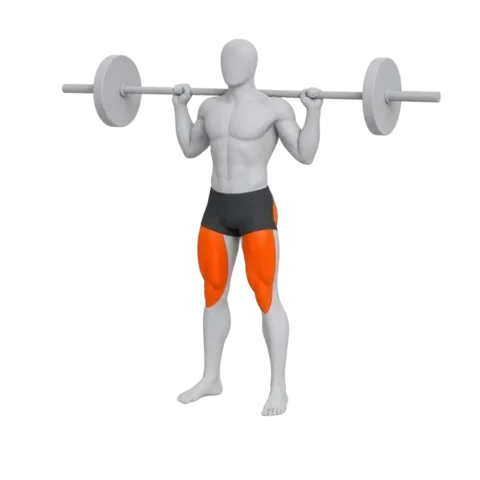
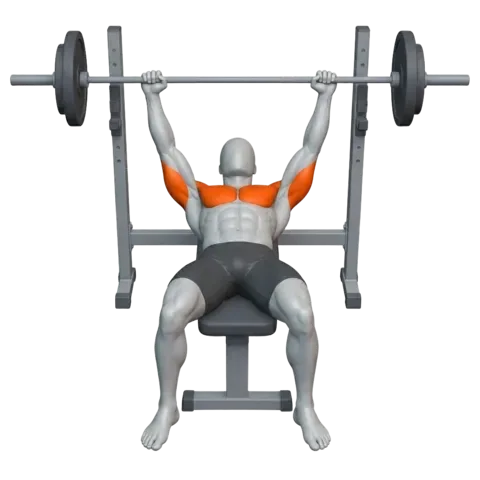
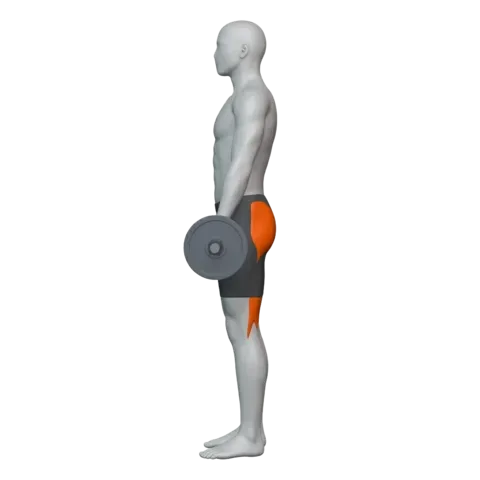
Double progression means two things go up in turn, reps first and then weight. Keep the weight the same and add reps until every set reaches the top of your rep range, such as 4 to 6. Then add the smallest weight your gym can make and build the reps back up.
What is double progression?
Double progression is a rule for what to do the next time you train a lift: keep the weight and add reps until every set reaches the top of a rep range, then add weight. Two things go up, one after the other, which gives the double progression method its name.
Picture two dials. One is reps: how many times you lift the weight in a set. The other is the weight. Each exercise gets a rep range, such as 4 to 6. You start with a weight you can lift for about the bottom of the range and leave that dial alone. Each session you try to add a rep to each set. When every set reaches 6, you turn the weight dial one step, the reps come back down, and you climb again.
It is one way to apply progressive overload, the general idea of asking for a little more over time. Progressive overload does not say what to add or when. Double progression does.
Why add reps before weight?
Because one rep is a smaller step than one plate. The smallest step on most barbells is 2.5 kg or 5 lb. On a 90 kg squat that is about 3% more; on a 40 kg press, about 6%. One more rep asks for less, so you keep moving between jumps.
Adding reps is not marking time. In an eight-week study of 43 trained lifters, one group added weight at fixed reps and the other added reps at a fixed weight. The authors judged both workable ways to progress. To track gym progress over many sessions, compare the estimated one-rep max; right after a weight jump it can sit a little lower. The American College of Sports Medicine's guidance has the same shape: raise the load by 2 to 10% once you can do one or two reps more than the target.
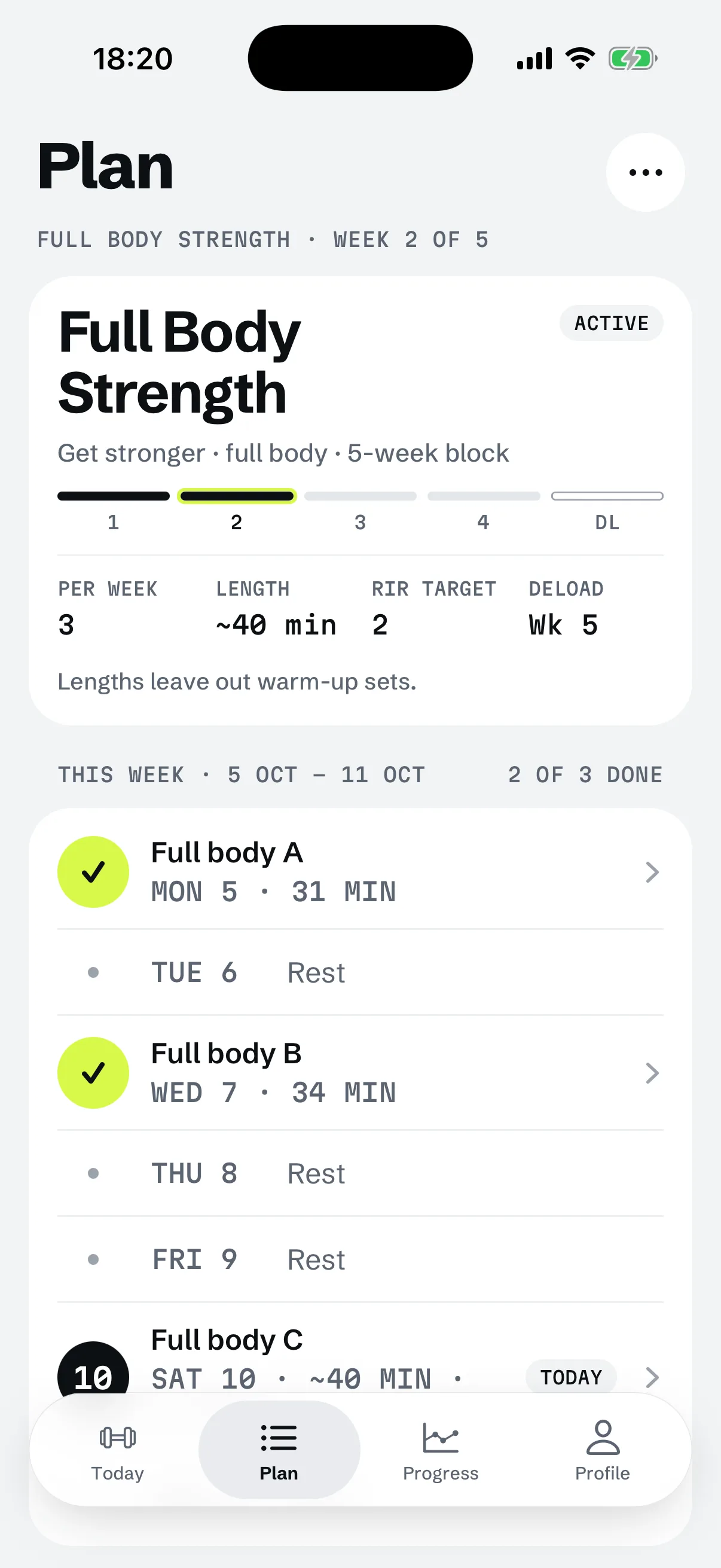
RIGOR is a strength training app for iPhone that builds your plan and sets every weight by rules you can read.
YOUR IPHONE

A worked example: 90 kg to 92.5 kg
Barbell Back Squat, 4 sets, rep range 4 to 6, at 90 kg on a 20 kg bar. Here are five sessions and what the rule asks for after each. In pounds the step is 5 lb: 200 lb becomes 205 lb.
TOP OF THE RANGE4 REPS · BOTTOM
| Session | Weight | Reps | Next time |
|---|---|---|---|
| 1 | 90 kg | 5, 5, 4, 4 | Same weight, +1 rep per set |
| 2 | 90 kg | 6, 5, 5, 5 | Same weight, 6 on every set |
| 3 | 90 kg | 6, 6, 6, 5 | Same weight, 6 on every set |
| 4 | 90 kg | 6, 6, 6, 6 | Up to 92.5 kg × 5 |
| 5 | 92.5 kg | 5, 5, 5, 5 | Same weight, 6 on every set |
Each set aims for one more rep than last time, and a set already at 6 stays at 6. The weight does not move until all four sets reach 6. A 3 day full body workout built on this rule shows it across a week.
When should you add weight?
Add weight when every working set reached the top of the range, not only the first one. In the example that is session 4. Had the last set stopped at 5, the weight would stay. The rule needs each set's reps in your log, as how to track workouts sets out.
Effort counts too. Double progression assumes each set was about as hard as planned. RIGOR plans effort as reps in reserve: how many more reps you could have done before failure. If you reached the top of the range but logged a set two or more reps in reserve below the plan (0 left when 2 were planned), the weight stays for another session.
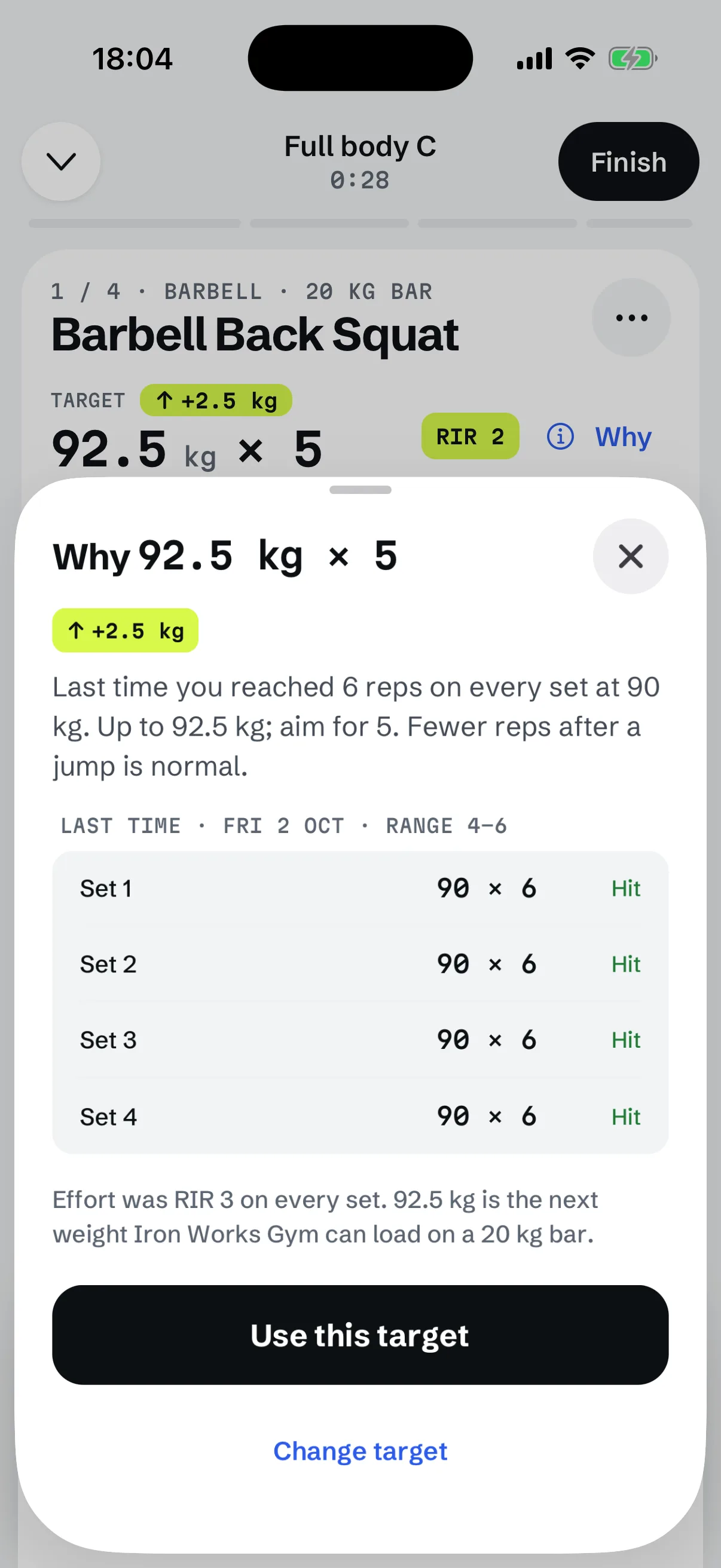
Why two and not one? A guess at reps in reserve is rough: in a 2022 review, lifters underestimated the reps they had left by about one on average. See logging a set and reps in reserve.
How many reps after the jump?
Fewer than before, but not always the bottom of the range. RIGOR estimates what your last sets say you can do at the new weight and keeps the number inside the range. In the example, 6 reps at 90 kg with 3 in reserve predicts 5 reps at 92.5 kg with 2 in reserve, the effort planned for the next session. With 3 in reserve planned again it would be 4. The app's line: "Fewer reps after a jump is normal." The estimate is the Epley formula, the one behind the 1RM calculator.
RELATED TOOL1RM calculatorEstimate the most you could lift once, from a set you have already done.How much weight should you add?
The smallest step your equipment can make. On a barbell that is usually 2.5 kg, a 1.25 kg plate on each side, or 5 lb with 2.5 lb plates. RIGOR takes the next of the weights your gym can make.
Dumbbells and machines go up in bigger steps, and that changes the rule. From 22.5 kg dumbbells the next pair is 25 kg, 11% more. If the estimate says the heavier weight would drop you below the bottom of the range, stay and go past the top of the range first: one more rep per set each session.
Take a Dumbbell Shoulder Press, 8 to 12 reps with 2 in reserve planned. After 12, 12, 12 at 22.5 kg the next target is 13 on every set at the same weight. Reach that and the 25 kg pair comes next, for 8. The 3 day dumbbell workout runs on this version of the rule.
The extra reps have a limit: 5 over the top of the range, or 2 over when the range tops out at 8 reps or fewer. Reach it on every set and the weight goes up anyway. After a forced jump like that, sets that fall short in the first three sessions hold the weight; they do not lower it.
What rep range is best?
No single range is best. A range a few reps wide works, lower for heavy compound lifts and higher for small ones. These are the ranges RIGOR's plans use:
- Main compound lifts (the first compound of a workout): 4–6 for a strength goal, 6–10 for muscle, 5–8 for both.
- Other compound lifts: 6–8 for strength, 8–12 otherwise.
- Isolation lifts: 8–12 for strength, 10–15 otherwise.
- Small muscles (calves, side and rear delts, forearms, abs): 10–15 for strength, 12–20 otherwise.
Keep the range fixed while you run it. Change it and last time no longer compares; RIGOR recalculates the weight when that happens.
What if the reps stop going up?
Repeat the weight after one bad session. Take 10% off after two misses in a row, or after three sessions without progress:
- One session with a set under the bottom of the range. Same weight next time. The sets that fell short aim for the bottom of the range, the others for one more rep.
- Short two sessions running at the same weight. The weight comes down 10%, rounded down to a weight you can load: 92.5 kg becomes 82.5 kg.
- A stall. Three full sessions at the same weight and effort target, and the newest has no more total reps than the oldest. Down 10% as well.
Only that lift changes, and after a drop you climb again by the same rule. How weights go up shows each case as the app words it.
A planned lighter week is a different thing. Deload weeks are scheduled in advance and are never used to judge progress.
Double progression vs linear progression
Linear progression adds weight every session at fixed reps. Double progression adds weight only after the reps are earned. A linear plan might be 3 sets of 5 with 2.5 kg more each time. It is the faster of the two while it lasts, which is why many beginner barbell programs use it. When the next jump does not go, it has no smaller step to offer. Double progression has one: the rep.
Looking for an app that runs the rule for you? RIGOR vs Hevy puts two side by side.
When does double progression not apply?
It fits almost any lift with a weight and a rep range, for a beginner or an experienced lifter. These cases need something else:
- Your first session of a lift. There is no last time yet. Pick a weight you can lift for the range with the planned reps in reserve; your first session sets the starting point. A guess that was far off is recalculated from your best set.
- Bodyweight lifts and timed holds. There is no weight dial. Reps or seconds go up, and at the top the next step is added weight or a harder variation.
- Deload weeks and easier sessions. They are lighter on purpose, so they do not set the next target.
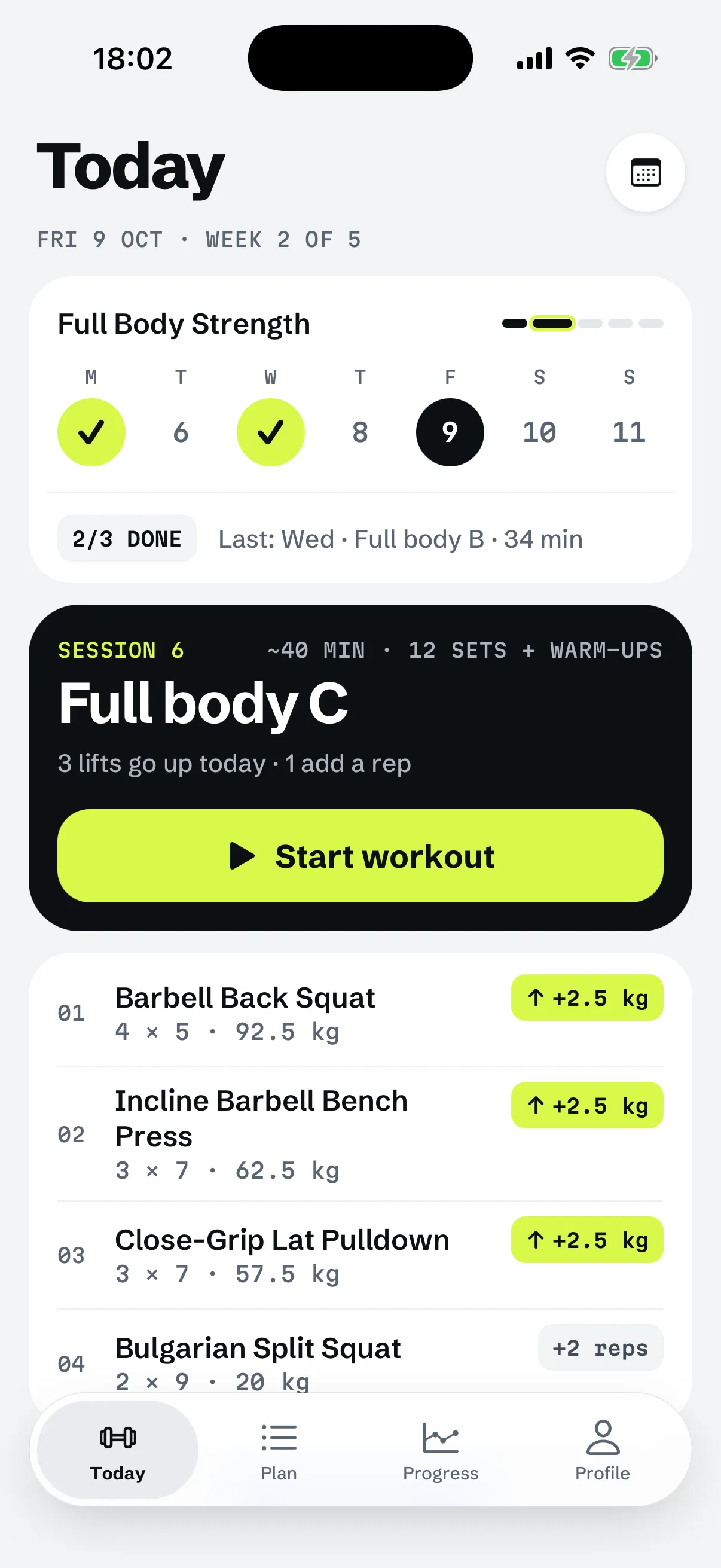
RIGOR runs this rule for you
Questions
What is double progression?
A rule for what to lift next time: keep the weight and add reps until every set reaches the top of a rep range, then add weight and climb again.
When should you add weight?
When every working set reached the top of the rep range at about the planned effort. If a set fell short, or the sets were much harder than planned, repeat the weight.
How much weight should you add?
The smallest step your equipment can make, usually 2.5 kg or 5 lb on a barbell. When the next dumbbell is a big jump, add reps past the top of the range first.
What rep range is best for double progression?
No single range is best. Use one a few reps wide: lower for heavy compound lifts, such as 4 to 6, and higher for small isolation lifts, such as 12 to 20.
How is double progression different from linear progression?
Linear progression adds weight every session at fixed reps. Double progression adds weight only after the reps are earned.
What is dynamic double progression?
A version in which each set moves on its own: a set that reaches the top of the range goes up in weight next time, even if the others have not. The standard version, and RIGOR, wait for every set.