Reps in reserve (RIR) is the number of reps you could still have done when you ended a set. Stop at 8 reps with a weight you could have lifted 10 times and you left 2 in reserve, which is RPE 8. RIGOR, the app behind this guide, plans 0 to 3 in reserve in training weeks, set by the lift and the week, and 4 or more in a deload week.
What does reps in reserve (RIR) mean?
Reps in reserve is the number of reps you could still have done when you ended a set. RIR is the short form. Squat 100 kg (220 lb) for 8 reps when 10 was your limit, and you left 2 reps in reserve.
The number describes effort, not weight. Zero means nothing was left. Past three it is easier to give a range than a count, so the scale below groups 4 to 6.
A plan uses it twice. Before a set it is a target: "5 reps with 2 in reserve" tells you how heavy to go. After a set it is a record of how hard that was.
RIR vs RPE: the chart
RIR and RPE are the same scale read from opposite ends: RPE 10 is 0 reps in reserve, RPE 9 is 1, and so on down. RPE stands for rating of perceived exertion, a score from 1 to 10. A version built for lifting was published in 2016 by Michael Zourdos and colleagues, who gave each score from 5 upwards a count of reps left.
| RIR | RPE | What it feels like |
|---|---|---|
| 0 | 10 | Maximum effort, no more reps |
| 1 | 9 | One more rep was there |
| 2 | 8 | Two more reps were there |
| 3 | 7 | Three more reps were there |
| 4–6 | 5–6 | Four to six more, given as a band |
What does RPE mean in the gym?
RPE means rating of perceived exertion: a score from 1 to 10 for how hard a set was. On the lifting version above, RPE 10 is a set with nothing left, and each point below it is the reps you still had. "Squat 5 × 5 at RPE 8" means a weight that leaves two reps in you.
RPE 6, 7, 8 and 9: what each means
RPE 9 means one more rep was there, RPE 8 two, RPE 7 three, and RPE 6 four to six. In plain words:
- RPE 9. Very hard. One more rep, and no more.
- RPE 8. Hard but controlled. Two more reps.
- RPE 7. Solid work with room left. Three more reps.
- RPE 6. Moderate. Four to six more reps; the scale gives RPE 5 and 6 that one band.
How many reps in reserve is RPE 8?
Two. RPE 8 means you could have done two more reps.
The scale's authors argue that a count of reps left may be more precise near your limit than a general score of how hard a set felt. RIGOR uses reps in reserve.
RIGOR is a strength training app for iPhone that builds your plan and sets every weight by rules you can read.
YOUR IPHONE

How many reps in reserve for hypertrophy?
There is no single agreed number. The best evidence so far points to ending sets close to failure, without having to reach it. A 2024 analysis of earlier training studies estimated the reps in reserve in each. Muscle growth rose as sets ended closer to failure, while strength gains were about the same across a wide range. Its authors call the work exploratory: the reps in reserve were estimated, and the exact relationship is unclear.
For a number to train with, the 2016 guide to using the scale suggests 6 to 12 reps with 0 to 2 in reserve for muscle growth, and mostly 2 to 4 in reserve on main lifts such as the squat and the bench press.
Reps in reserve vs training to failure
Training to failure has not been shown to build more muscle than stopping just short. A 2023 meta-analysis of 15 studies found no advantage for sets taken to momentary muscular failure over sets that stopped before it. When each study's own definition of failure was counted, the advantage was trivial.
Failure also has a cost inside the workout. The 2016 guide warns that it can cut the work you manage on the sets that follow, and keeps it to the last set for a muscle, on simple exercises.
How RIGOR sets reps in reserve across a block
RIGOR plans the reps in reserve for each exercise, the same on every set, from three things: the week, the kind of lift and your level. A block is four training weeks, and the effort rises through it.
| Week | Compound | Isolation | Beginner |
|---|---|---|---|
| 1 | 3 | 2 | 3 and 2 |
| 2 | 2 | 1 | 3 and 2 |
| 3 | 2 | 1 | 2 and 1 |
| 4 | 1 | 0 | 2 and 1 |
| Deload | 4+ | 4+ | 4 or more |
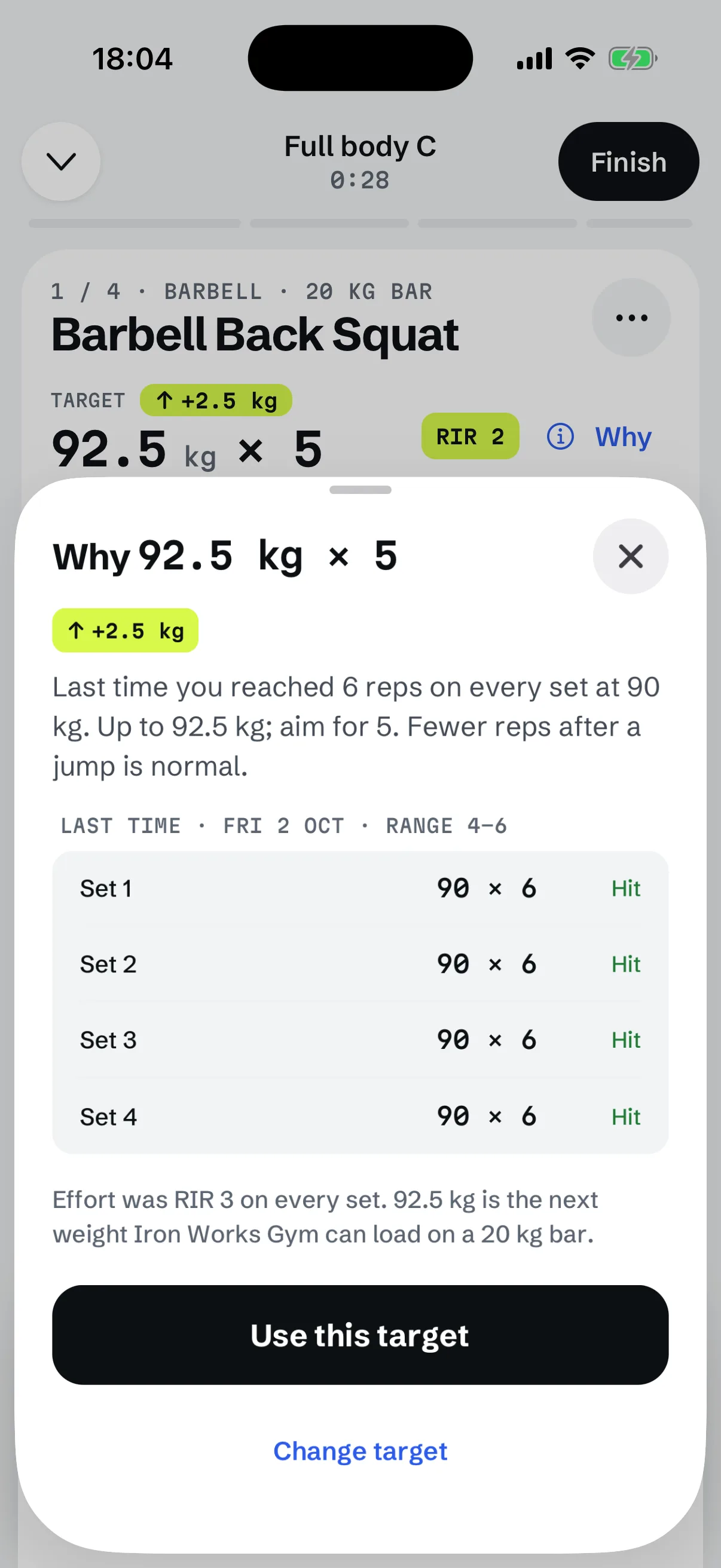
The target stands beside the weight and reps: here RIR 2, the number for a compound lift in weeks 2 and 3.
Only isolation lifts reach 0, in week 4, and never for a beginner. A beginner keeps one more rep in reserve in weeks 2 and 4.
With deload on, a fifth week follows: fewer sets, lighter weights, and two more reps in reserve than week 1, never fewer than 4. Deload weeks are on by default for intermediate and advanced lifters and off for beginners.
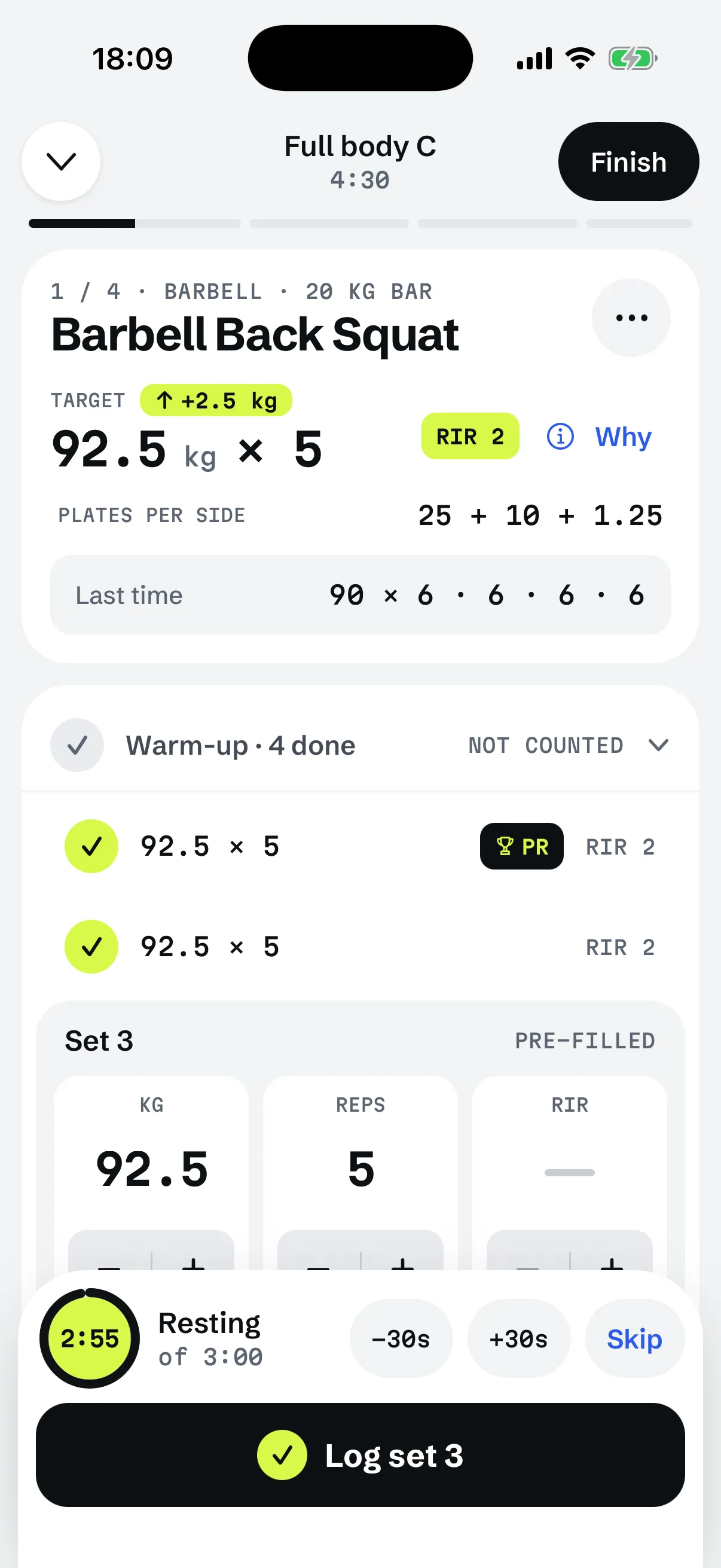
In your first session of a lift, the target is how you choose the weight. The app's line for a squat at 4 to 6 reps: "Pick a weight you can lift for 4–6 reps with about 2 left."
What does the number you log change?
It can hold the weight, and it sets your reps after the weight goes up. Logging it is optional: after a set you can enter 0, 1, 2, 3 or 4+, and a set without one is read as the planned effort. See logging a set and RIR.
RIGOR applies progressive overload by double progression: the weight goes up when every set reaches the top of the rep range. Effort is the second condition. Take a squat in week 1, with 3 in reserve planned.
Six reps with 3 in reserve counts as a set of 9. From that, RIGOR estimates the reps the heavier weight allows at the next session's target, 2 in reserve: 5. Had you logged 2 in reserve on every set, it would be 4. The estimate is the Epley formula, and the 1RM calculator takes reps in reserve the same way: 100 kg × 5 with 2 in reserve counts as a set of 7.
RELATED TOOL1RM calculatorEstimate the most you could lift once, from a set you have already done.Now the same reps later in the block, with 2 in reserve planned and nothing left after the last set.
The app's words: "You hit the reps, but it was harder than planned. Same weight." One rep below the plan does not hold the weight; it takes two. How weights go up shows each case.
The number has one more use. A first guess that was much too heavy or much too light is recalculated after one session from your best set, its reps in reserve included.
Can beginners use RIR?
Yes, with a margin. A 2022 review of 12 studies and 414 people found they guessed about one rep fewer than they really had left: 0.95 on average, with wide differences between studies. Training experience did not seem to change the accuracy.
The 2016 study behind the scale points the other way. It tested 29 squatters on a one rep max, a lift that should rate RPE 10. The 15 experienced lifters rated it 9.8 on average; the 14 novices rated it 9.0, as if a rep were left. The guide that followed advises a new lifter to record reps in reserve beside the normal log and practise before relying on it. One check it gives: rate a set, then take a later set at the same weight to failure and compare.
In RIGOR a set one rep below the plan does not hold the weight, and a beginner's targets never reach 0.
When does RIR mislead?
When the set is long, easy or not counted in reps. The cases:
- High-rep sets. In the 2022 review, guesses were less accurate when the set ran past 12 reps to failure.
- Sets far from failure. Guesses were slightly better the closer to failure they were made, and slightly better in later sets. The scale stops counting below RPE 5 for that reason.
- Timed holds. There are no reps to count. RIGOR sets no reps in reserve for a hold timed without weight.
- Lighter days. A deload week, or a workout you made easier, has more reps in reserve on purpose. Neither is used to judge progress.
RIGOR plans and reads your reps in reserve
Questions
What does RIR mean in lifting?
RIR stands for reps in reserve: how many more reps you could have done when you ended a set. RIR 2 means two more were there; RIR 0 means none.
RIR vs RPE: what is the difference?
They are the same scale read from opposite ends. RPE runs from 1 to 10 and RIR counts the reps left, so RPE 10 is 0 in reserve, RPE 9 is 1 and RPE 8 is 2.
How many reps in reserve is RPE 8?
Two. RPE 8 means you could have done two more reps. RPE 9 is one more and RPE 7 is three.
How many reps in reserve for hypertrophy?
There is no single agreed number. A 2024 analysis found more muscle growth as sets ended closer to failure, and a 2016 guide for coaches suggests 0 to 2 in reserve, with 2 to 4 on big lifts such as the squat.
Reps in reserve vs training to failure: which is better?
Training to failure has not been shown to build more muscle than stopping just short. A 2023 meta-analysis of 15 studies found no advantage for sets taken to momentary muscular failure over sets that stopped before it.
Can beginners use RIR?
Yes, with a margin. In a 2022 review people guessed about one rep fewer than they really had left, and training experience did not seem to change that. RIGOR gives a beginner one more rep in reserve in weeks 2 and 4.
Do you have to log reps in reserve in RIGOR?
No. It is optional. A set logged without one is read as the planned effort.