Studies do not show that training to failure is required. A 2022 meta-analysis of 15 studies found no significant difference overall in strength or muscle size against stopping short. RIGOR, the app behind this guide, plans 0 to 3 reps in reserve in its four training weeks, with 0 only on non-beginner isolation lifts in week 4.
Should you train to failure?
Not as a rule. Published studies have not shown that ending a set at failure is needed for strength or muscle size, and some analyses find a small edge for it on muscle. The studies are better read as asking how close to failure to get, which a plan can set week by week.
The rest of this guide covers what the studies found, how that sits with the numbers on a plan, and what RIGOR does when a set turns out harder than planned. RIGOR is the app behind this guide.
What does training to failure mean?
Training to failure means ending a set only when you cannot do another rep. It is the end of the scale of reps in reserve, the count of reps you could still have done: 0 in reserve is failure, 1 is one rep short of it.
The studies do not all mean the same thing by it. A 2022 scoping review found no agreed definition of failure, and that how close the "non-failure" groups got is often unclear. The 2023 meta-analysis below split its trials for that reason, into "momentary muscular failure" and "set failure", defined as anything other than momentary muscular failure.
RIGOR is a strength training app for iPhone that builds your plan and sets every weight by rules you can read.
YOUR IPHONE

What did the research find?
| Study | What it covered | Muscle size | Strength |
|---|---|---|---|
| Grgic 2022 | 15 studies, all of young adults | ES 0.22 (−0.11 to 0.55): no significant difference | ES −0.09 (−0.22 to 0.05): no significant difference |
| Refalo 2023 | 15 studies measuring hypertrophy | Momentary muscular failure: ES 0.12 (−0.13 to 0.37) | Not assessed |
| Robinson 2024 | Meta-regressions over estimated reps in reserve | Rose as sets ended closer to failure | Negligible relationship |
| Refalo 2024 | 18 resistance-trained people, 8 weeks | Quadriceps thickness +0.181 cm to failure, +0.182 cm at 1 to 2 in reserve | Not assessed |
Grgic 2022. No significant difference for strength or hypertrophy overall. Two subgroups differ. Where training volume was not equated between groups, non-failure training was favoured for strength (ES −0.32, −0.57 to −0.07). In resistance-trained people, failure was favoured for hypertrophy (ES 0.15, 0.03 to 0.26). The authors conclude that training to muscle failure "does not seem to be required" for gains in strength and muscle size, and "does not seem to have detrimental effects on these adaptations, either".
Refalo 2023. With every definition of set failure pooled there was a trivial advantage for set failure on muscle growth (ES 0.19, 0.00 to 0.37). Limited to momentary muscular failure there was no advantage either way. The authors found no evidence that it beats non-failure for hypertrophy, and suggest the link may not be a straight line.
Robinson 2024. For strength the slopes contained zero, a negligible relationship. For hypertrophy they were negative and did not contain zero: muscle size rose as sets ended closer to failure. The reps in reserve were estimated from the studies' descriptions, and the authors call the work exploratory, with the exact relationship unclear.
Refalo 2024. In 8 weeks of training twice a week, 12 men and 6 women each did leg press and leg extension to failure with one leg and to a perceived 2 and 1 reps in reserve with the other. Mean volume was similar, and lifting velocity loss and repetition loss were consistently greater with failure.
The first two compare groups and the third fits a line across estimated reps in reserve, so they need not conflict. The last is one trial of 18 people and two exercises.
Training to failure vs RIR: which should you use?
They are not rivals: reps in reserve says how close to failure a set should end. A target of 2 means stop two reps short, and a logged 0 means the set went to failure. A number for each week gives you something to aim at and to compare next session. That is how RIGOR works, and the double progression rule it follows reads the number you log.
How close to failure does RIGOR plan?
It plans a number for each exercise and week, the same on every set of that exercise. A block is four training weeks, and the target falls through it: 0 appears only on non-beginner isolation lifts in week 4.
| Week 1 | Week 2 | Week 3 | Week 4 | Deload | |
|---|---|---|---|---|---|
| Compounds | 3 | 2 | 2 | 1 | 5 |
| Isolations | 2 | 1 | 1 | 0 | 4 |
| Beginner compounds | 3 | 3 | 2 | 2 | 5 |
| Beginner isolations | 2 | 2 | 1 | 1 | 4 |
A hold timed without weight, such as a plank, has no reps in reserve target. The 3 day full body workout applies these rules; its sample plan for an intermediate lifter runs five weeks, four of training and a deload week.
What does RIGOR do when a set was harder than planned?
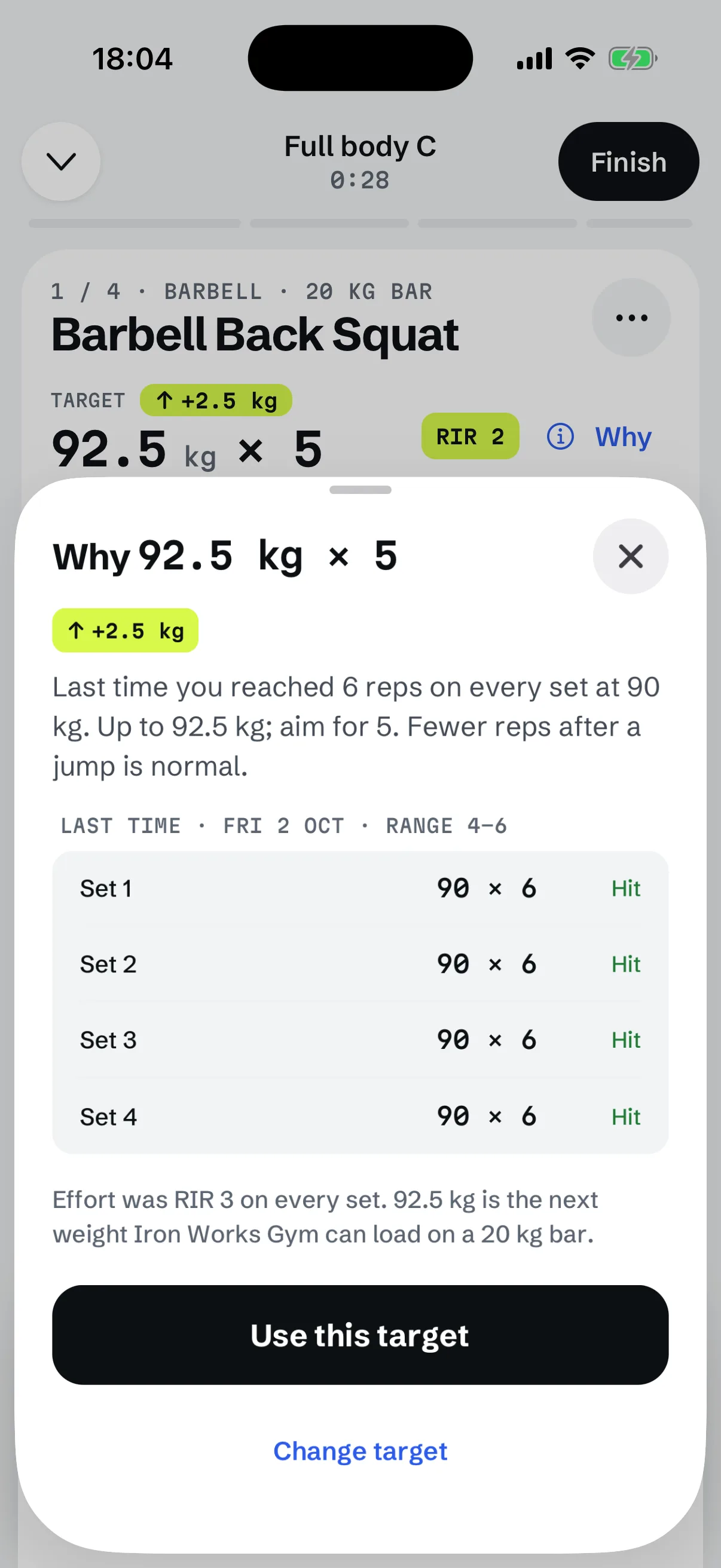
It holds the weight. This is rule 8 of the training rules. It applies when every set reached the top of the rep range, but a logged set had more than one rep fewer in reserve than the plan. With 2 planned that means a logged 0, and with 3 planned a logged 0 or 1. The next target repeats the weight, with the top of the range on every set.
Take a non-beginner's squat in week 2, at 92.5 kg after a first week at 90 kg, with 2 in reserve planned. All four sets reach 6, but one is logged at 0:
The rule has limits. It holds once: if the session before was also every set at the top at that weight, the weight goes up as usual. It does not apply when 1 or 0 is planned, since no logged number is more than one below that. A set logged with no number counts as the planned effort. A logged number also feeds the strength estimate: the reps you did plus the reps you had left, as in the 1RM calculator.
So when every set still reaches the top of the range, going to failure on a set planned with 2 in reserve repeats the weight; it does not lower it. The 10% cuts come from two misses in a row or a stall, as the strength plateau guide sets out. Otherwise the weight goes up by progressive overload once every set reaches the top at the planned effort.
What does the deload week ask for?
A deload week asks for the most reps in reserve of the block: the week-1 number plus 2, and never fewer than 4. That is 5 for compounds and 4 for isolations, for beginners as well. The week also takes half the sets, rounded up, and about 10% off the weight. It is on by default for intermediate and advanced lifters and off for beginners; the deload week guide has the full rule.
When does this not apply?
RIGOR plans the effort, and reads what you log
Questions
Should you train to failure every set?
Research has not shown that you need to. A 2022 meta-analysis of 15 studies found no significant difference in strength or muscle size between sets taken to failure and sets that stopped short. RIGOR plans 0 reps in reserve only on non-beginner isolation lifts in week 4.
Is training to failure good for hypertrophy?
The evidence is mixed. A 2023 meta-analysis found no evidence that momentary muscular failure beats stopping short. A 2024 meta-regression found muscle size rose as sets ended closer to failure, and its authors call it exploratory.
Does training to failure build more strength?
Not in the studies pooled. The 2022 meta-analysis found no significant difference in strength, and the 2024 meta-regression found a negligible relationship between proximity to failure and strength gains.
Is 1 rep in reserve the same as failure?
No. Failure is 0 in reserve: nothing left. With 1 in reserve you could have done one more rep. In an 8-week trial, sets stopped at a perceived 1 or 2 reps in reserve gave similar quadriceps growth to sets taken to failure.
Do you have to log reps in reserve in RIGOR?
No. After a set you can enter 0, 1, 2, 3 or 4+, or nothing. A set logged without a number is read as the planned effort.