To track workouts, write down three numbers for every working set: the weight, the reps and the reps in reserve. Note how the weight is counted, such as per dumbbell or total with the bar. Then read last time's line before you train. RIGOR uses the same three numbers to set your next target.
How do you track workouts?
Write down three numbers for every working set: the weight, the reps and the reps in reserve. Add a note on how the weight is counted. With those, you can answer the one question that matters before each session: what did I do last time?
Reps in reserve (RIR) is how many more reps you could have done when the set ended. A set of 8 with 2 in reserve was a set you could have taken to 10. Reps in reserve explains the scale. It was written up for lifting in a 2016 article, and RIGOR plans every lifted set with it.
Only working sets go in the log. Warm-up sets are shown apart and never count toward progress, volume or records. Write each set when you finish it, one number per set rather than a total, so the set that stopped at 7 is not hidden inside an average. This page is the general log. For the progressive overload side, see how to track progressive overload. To read the log for progress, see how to track gym progress.
What does the weight mean on each lift?
Write it the same way every time, because RIGOR compares a session only with earlier ones of the same exercise and the same way of counting the load. Change the convention and last time no longer compares.
| Kind of lift | What you write | Example |
|---|---|---|
| Dumbbells | The weight of one | 22.5 kg for a pair of 22.5 kg dumbbells |
| Barbell | The total, bar included | 90 kg: a 20 kg bar and 35 kg a side |
| Machine | The setting you used | 55 kg on the stack |
| Weighted pull-up or dip | The weight added to bodyweight | +10 kg |
| Assisted pull-up or dip | The assistance | 25 kg of assistance |
| Bodyweight | Reps only | No weight |
If you change the weight inside a lift, write what you did on most sets. RIGOR takes the weight used on the most completed working sets as that session's weight. Your gym may not have the exact weight a plan asks for: the weights your gym can make are what RIGOR rounds to.
RIGOR is a strength training app for iPhone that builds your plan and sets every weight by rules you can read.
YOUR IPHONE

How do you track workouts in a notebook?
One page per day, one line per lift, in the same order each time. The date goes at the top, and a line holds the lift, the weight with its convention, then the reps and the reps in reserve of each set.
| Lift | Weight | Reps · RIR | Next time |
|---|---|---|---|
| Lat Pulldown | 55 kg stack | 11, 10, 10 · RIR 2, 2, 1 | 55 kg × 12, 11, 11 |
| Dumbbell Bench Press | 22.5 kg each | 10, 9, 8 · RIR 2, 1, 1 | Fill in before the session |
The last column is the useful one. Before you pick up the first weight, read last time's line and write today's target beside it, so the workout tests a number instead of a feeling. A pen and a page do the app's job slower, and only that: the rule below runs by hand.
How do you track workouts on an iPhone?
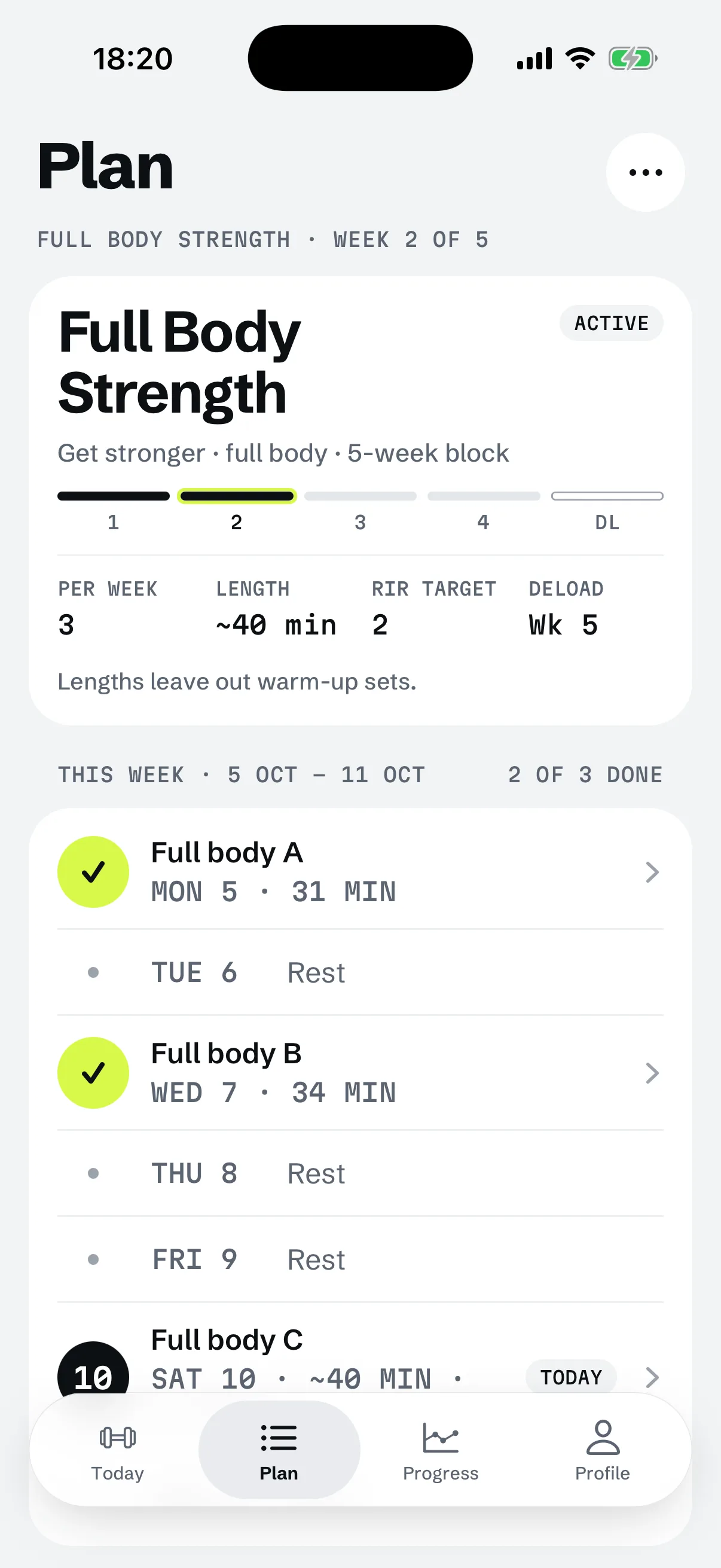
On a phone the target sits beside the numbers you log, so the comparison is already done. RIGOR is an iPhone app, and the three numbers are the boxes of a set: weight, reps and RIR.
Each exercise shows its target and the reps in reserve to leave. You change the weight or reps if you did something else, and add RIR if you want the extra signal.
Before a set is saved, the logger asks you to confirm if the weight is over 1.5 times or under half what it expected, or if the reps are more than twice the top of the range. It is there to catch a typed 550 for 55.
On a lift's first session there is no history: the weight is blank and the app asks you to pick one you can lift for the rep range with about the planned reps left. That session sets the starting point. See your first session.
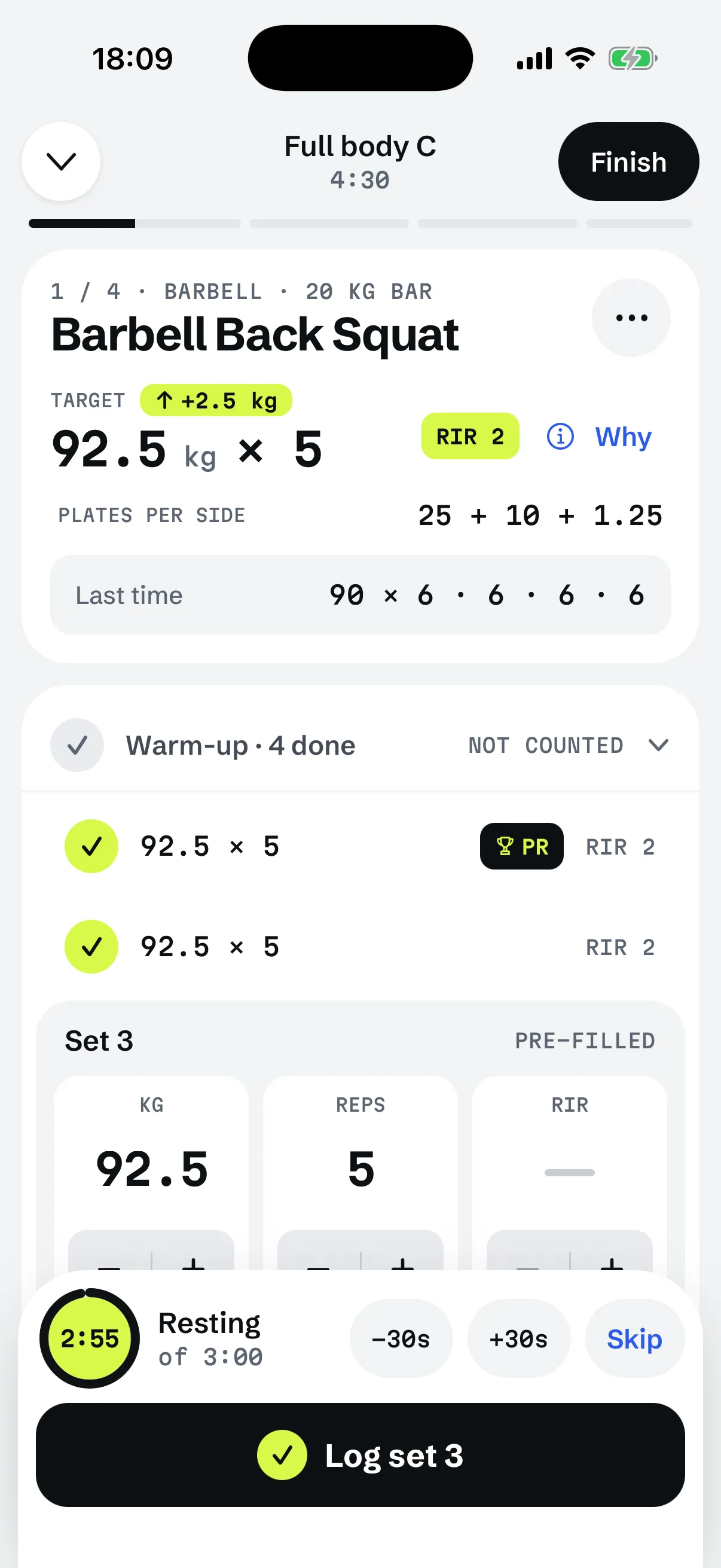
The target for each exercise is frozen with the session, so a later rule change never rewrites what you did. Logging a set and RIR shows the screen in short.
What does RIGOR do with your log?
It finds your last comparable session of that lift, judges it against the targets it had, and sets the next one by a fixed table. The rule is double progression: add reps until every set reaches the top of the range, then add weight, with RIR as a guard.
Take a Lat Pulldown, 3 sets, rep range 8 to 12, 2 in reserve planned. Your stack has 5 kg steps. You log 55 kg × 11, 10, 10 with RIR 2, 2, 1.
TOP OF THE RANGE8 REPS · BOTTOM
Two checks come first. The best set (11 reps with 2 left) counts as 13, far from "too heavy" (below 8) and from "too light" (18 or more), so the weight is not recalculated. Then the table: no set missed, all three sets logged, but not all at 12, so reps go up by one per set.
The same session logged differently gives different next targets:
| Reps | RIR | Next time |
|---|---|---|
| 12, 12, 12 | 2, 2, 2 | 60 kg × 8 |
| 12, 12, 12 | 0, 0, 0 | 55 kg × 12, 12, 12 |
| 11, 10, 7 | 2, 1, 0 | 55 kg × 12, 11, 8 |
| 11, 10 (two sets) | 2, 2 | 55 kg × 12, 11, 8 |
In the first row every set reached 12 at the planned effort, so the weight goes up one step. The reps come from an estimate: 12 reps with 2 left counts as 14, so the 55 kg estimates about 80.7 kg for one rep, and at 60 kg that leaves 10 reps, 8 after 2 are kept in reserve. This is the formula behind the 1RM calculator. In the second, the reps were there but every set was logged two below the plan, so the weight stays. In the third, one set fell short of 8: it aims for 8 again and the rest add a rep. In the fourth, a set you did not log aims for the bottom of the range.
Do you need an Apple Watch to track workouts?
No. The weight on the bar and the reps left in reserve are not something a wrist can know: you read the first and you judge the second. A notebook and a phone both hold everything a log needs.
RIGOR is an iPhone app, and this page does not describe a watch app. Whatever you wear, the log is the same three numbers per set.
Does keeping a log help?
Probably, though the evidence is not about lifting. A 2016 meta-analysis of 138 randomised studies and 19,951 people looked at monitoring progress toward a goal, any goal. It found monitoring promoted goal attainment (d+ = 0.40, 95% CI 0.32 to 0.48) and that the effect was larger when progress was physically recorded (Harkin 2016). None of the studies cited here tested logging sets in the gym, so there is no number for how much a lifting log adds.
What the lifting studies do show is what a log makes possible. In an eight-week study of 43 trained lifters, adding reps at a fixed weight and adding weight at fixed reps both appeared to be viable ways to progress (Plotkin 2022). Either way you need last time's numbers in front of you.
Keep the effort column honest, with some salt. A review of 12 studies and 414 people found lifters tended to underpredict the reps they had left by 0.95, with wide differences between studies (Halperin 2022). A number written down every time is still yours and steady.
When does a log not help?
A log also does nothing if it is never read. For a plan that applies this rule across a week, a 3 day full body workout is a place to start.
RIGOR keeps the log and sets the next step
Questions
How do you track your workouts?
Log each working set when you finish it: weight, reps and reps in reserve, one line per lift. Warm-up sets stay out. Read last time's line before the next session.
How do you track workouts without an Apple Watch?
The same way as with one. None of the three numbers comes from a sensor: you read the weight off the bar or the stack and you count the reps. A notebook or a phone is enough.
How do you track workouts on an Apple Watch?
This page does not describe a watch app. RIGOR is an iPhone app, and the numbers it needs are typed or tapped in on the phone.
Should the weight include the bar?
On a barbell lift, yes: write the total, bar included. On dumbbells write the weight of one. Pick one way for each lift and keep it, or last time stops being comparable.
Do I need to log reps in reserve?
No. In RIGOR it is optional, and a set without it is read as the planned effort. It is worth adding, because it tells a hard set from an easy one at the same reps.
What if I change the weight halfway through a lift?
RIGOR takes the weight used on the most completed working sets as that session's weight, and the heavier one if the sets are tied. Write what you did on most sets.
Does tracking workouts improve results?
Nothing cited here tested logging sets in the gym. A large review of goal monitoring in general found it helped people reach goals, more when progress was written down.