To track gym progress, log the weight and reps of every working set, then read each lift two ways: more reps at the same weight, then more weight. When the weight changes, compare estimated 1RM, which turns a set at any weight into one number you can set beside the last.
How do you track gym progress?
Write down the weight and the reps of every working set, and judge each lift by two moves in turn: more reps at the same weight, then more weight. A third number, estimated 1RM, joins the two so a session at one weight can be compared with a session at another.
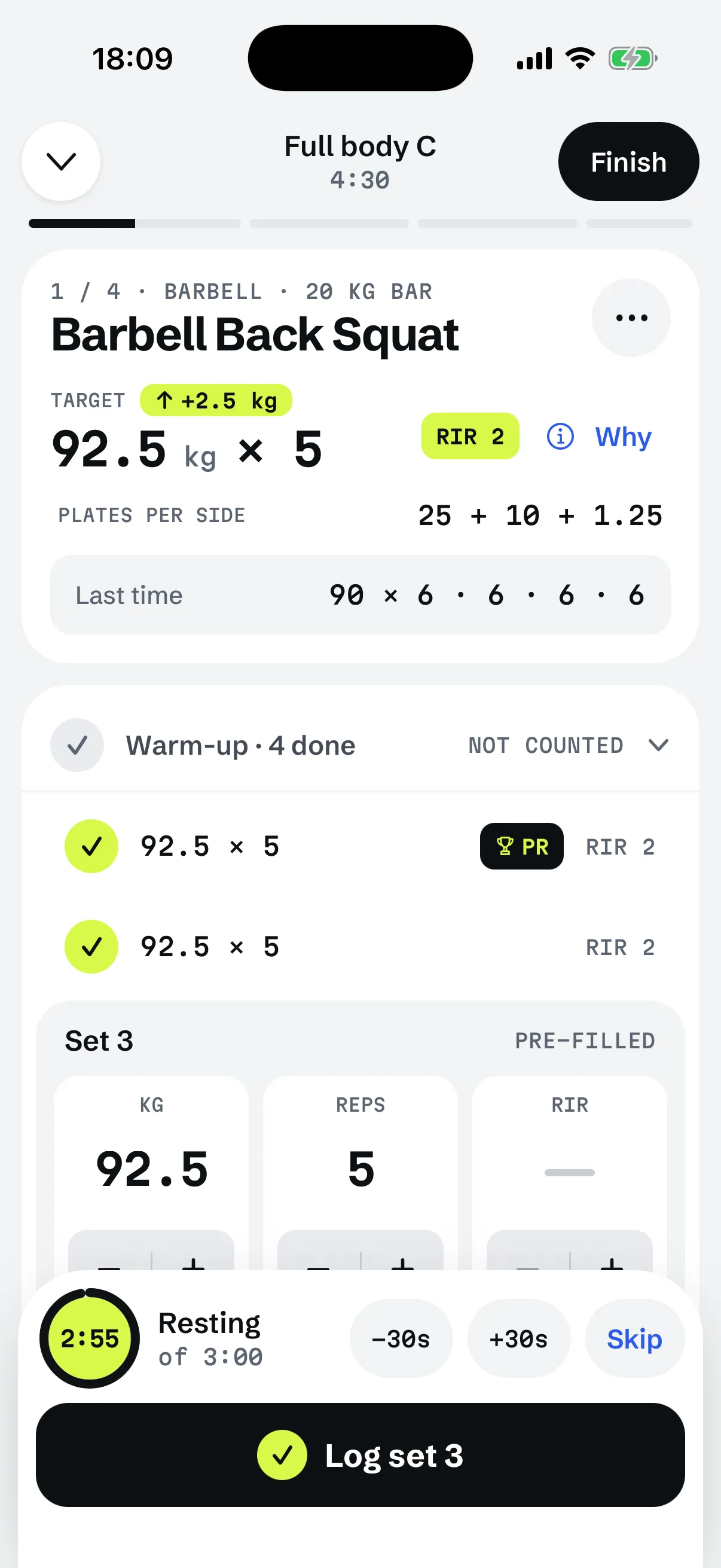
That is the measure RIGOR uses. Log the weight, the reps of each set and the reps you had left in reserve. At the same weight as last time, ask whether the reps went up. At a new weight, compare the estimated 1RM.
What counts as progress on a lift?
Two things, in order. First reps: the same weight, one more rep per set, up to the top of your rep range. Then weight: once every set reaches the top, the next step you can load. This is double progression, the rule RIGOR follows, one way to apply progressive overload. The columns to write down are in how to track progressive overload.
Adding reps is progress. In an eight-week trial of 43 people with at least a year of lower body training, one group added load at fixed reps and the other added reps at a fixed load. Growth in one thigh muscle modestly favoured reps, strength slightly favoured load (a difference of questionable practical significance, the authors said), and the authors concluded both are viable (Plotkin 2022).
The trouble comes at the step between the two moves. When the weight goes up, the reps come down, and two numbers that both changed are hard to compare by eye. That is the job of the third.
RIGOR is a strength training app for iPhone that builds your plan and sets every weight by rules you can read.
YOUR IPHONE

What is estimated 1RM, and how is it worked out?
Estimated 1RM (e1RM) is the heaviest weight you could lift once, worked out from a set you did. RIGOR uses the Epley formula, counting the reps you left in reserve as reps you could have done:
e1RM = weight × (1 + (reps + reps in reserve) ÷ 30)
Reps plus reps in reserve is the set's capacity. Take 60 kg for 10 reps with 2 in reserve: capacity 12, so 60 × (1 + 12 ÷ 30) = 60 × 1.4 = 84.0 kg. If you did not record the reps in reserve, RIGOR uses the effort the set was planned at, and a capacity above 25 counts as 25. Warm-up sets never count.
A session has one e1RM: that of its best set, the one with the highest number. The 1RM calculator does the sum for any set, and reps in reserve explains the scale. The app uses the same number to set the target reps after a weight increase, and to work out a new weight when your rep range or unit changes.
A worked log: the weight goes up and the reps go down
Barbell Bench Press, 3 sets, a rep range of 6 to 10, a smallest step of 2.5 kg and 2 reps in reserve planned every session. (A real plan varies the reserve by week; 2 keeps the sums plain.)
TOP OF THE RANGE6 REPS · BOTTOM
| Session | Weight | Reps | e1RM | Read as |
|---|---|---|---|---|
| 1 | 60 kg | 8, 8, 7 | 80.0 | Starting point |
| 2 | 60 kg | 9, 9, 8 | 82.0 | Up 2.0 from more reps |
| 3 | 60 kg | 10, 10, 9 | 84.0 | Up 2.0 from more reps |
| 4 | 60 kg | 10, 10, 10 | 84.0 | Flat: the best set is unchanged, the weakest set caught up |
| 5 | 62.5 kg | 8, 8, 8 | 83.3 | Weight up, reps down, strength about the same |
| 6 | 62.5 kg | 9, 8, 8 | 85.4 | Ahead of session 4 by 1.4 |
The sums: session 4 has capacity 10 + 2 = 12, so 60 × (1 + 12 ÷ 30) = 84.0. Session 5 has 8 + 2 = 10, so 62.5 × (1 + 10 ÷ 30) = 83.3. Session 6 has 9 + 2 = 11, so 62.5 × (1 + 11 ÷ 30) = 85.4.
Why 8 reps at 62.5 kg? After session 4 every set sat at 10 at the planned effort, so the weight goes up. The target reps at the new weight are floor(30 × (84.0 − 62.5) ÷ 62.5) − 2 = floor(10.32) − 2 = 8. The target rounds down to a whole rep, so meeting it reads a hair under 84.0: the same strength, not a step back. The extra rep in session 6 is the first sign of more.
The line catches the other case too. Had you jumped to 65 kg and managed 6 reps with 2 in reserve, the estimate would be 65 × (1 + 8 ÷ 30) = 82.3 kg: a heavier bar and less strength shown.
Session 4 shows why the app does not judge by e1RM alone. The line was flat, but the third set had come up from 9 to 10, and that earns the weight increase. The weight rule looks at every set; the e1RM looks at the best one.
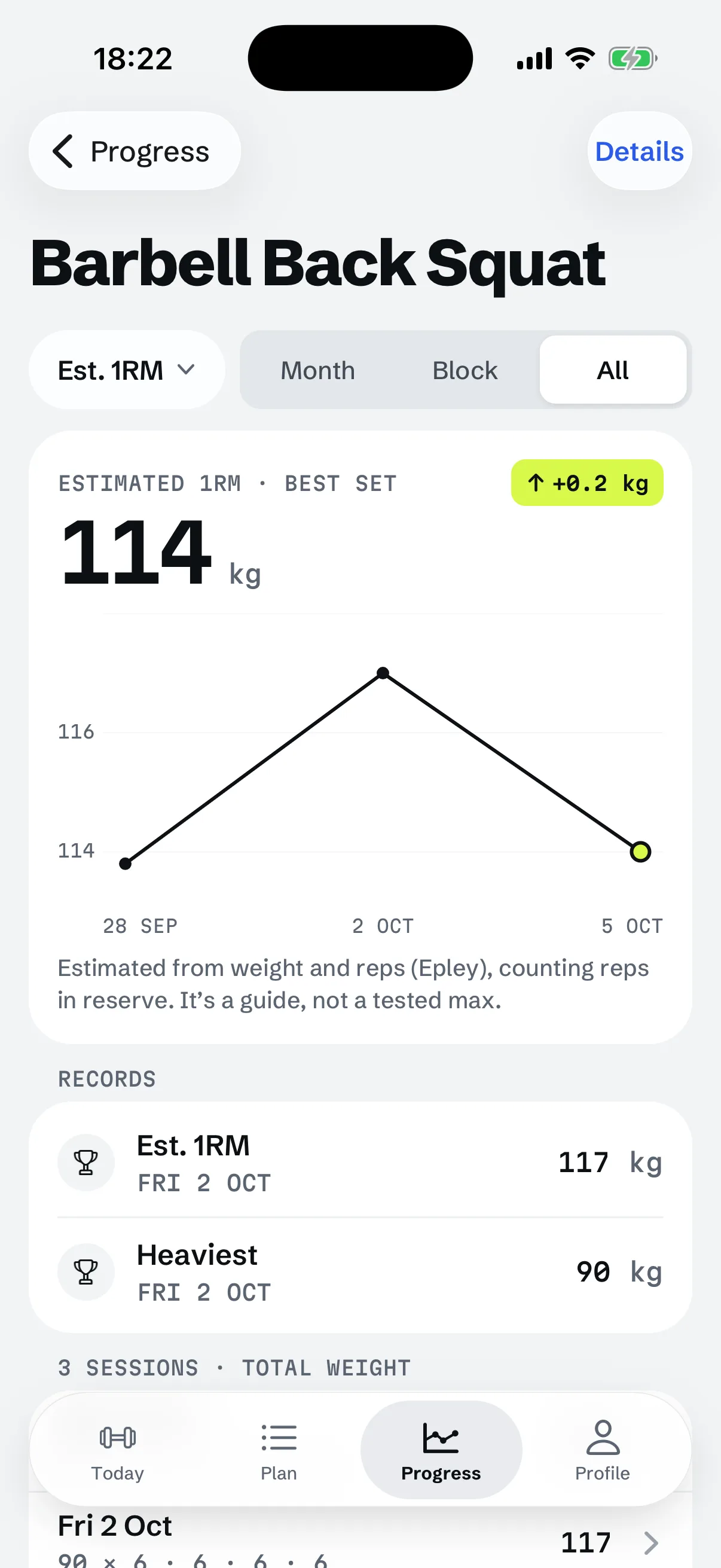
The Progress screen charts the estimated 1RM of each weighted lift's best set of 12 reps or fewer, by month, block or all time; tap a point to see that session. Its label calls it a guide, not a tested max.
Where does estimated 1RM mislead?
It is an estimate, and three things bend it.
- High reps. The formula assumes a straight line from reps to strength, and the real line bends. In a study of 70 adults who tested the chest press and leg press at 1, 5, 10 and 20 reps, 5 reps predicted the 1RM best, and the authors concluded that no more than 10 reps should be used in linear equations to estimate 1RM for those two lifts (Reynolds 2006). A set of 20 at 40 kg with nothing left reads 66.7 kg. RIGOR's Progress screen makes no estimate above 12 reps: for those lifts, follow reps and weight.
- Your reserve guess. One rep of reserve moves the number by the weight ÷ 30: at 60 kg for 10 reps, 82.0, 84.0 and 86.0 kg for 1, 2 and 3 in reserve. A review of 12 studies and 414 people found that lifters tended to underpredict the reps they had left by 0.95 reps, and predicted better close to failure and with heavier loads (Halperin 2022). Judge effort the same way each time and the line stays comparable.
- One session, or another lift. A session is one reading, so watch the line over several, and compare a lift only with itself.
It is a guide to strength, not a tested max, and it is not proof of muscle growth.
Paper, notes, a spreadsheet or an app: which one?
Any of them. No study opened for this page compared these tools or tested logging in lifters. The nearest evidence is general: 138 randomised studies of many goals (19,951 people) found that monitoring progress promoted goal attainment, more so when the information was physically recorded (Harkin 2016). The record matters more than the tool.
On paper
One line per lift per session: date, weight, the reps of each set and the reps in reserve. Work the e1RM out by hand only when the weight changes: add the reps and the reserve, add 30, multiply by the weight, divide by 30. For 60 kg, 10 reps, 2 left: 42 × 60 = 2,520, ÷ 30 = 84.
In a notes app
Copy last time's line, change the numbers and keep one format: "Bench 60 kg: 10, 10, 9 · RIR 2". Read the last line before the first set.
In Excel or another spreadsheet
One row per set: Date, Lift, Weight, Reps, RIR, e1RM. With Weight, Reps and RIR in columns C, D and E, the e1RM in row 2 is =C2*(1+MIN(D2+E2,25)/30). For 60, 10 and 2 it returns 84. Filter by lift and chart the best set of each date.
In an app
Pick one that shows last time beside today's target and charts the estimate.
What if the line goes flat?
A flat line is normal for a session or two while reps move. RIGOR acts by rule, not by feel:
- A set below the bottom of the range repeats the weight. Two sessions running with one, at the same weight, take 10% off that lift.
- Three sessions at the same weight where the newest has no more total reps than the oldest are a stall. The weight comes down 10% and you climb again.
The stall rule counts total reps, not e1RM, and a reduction is rounded down to a weight your gym can make. A planned lighter week is different: see the deload week.
A plan built on this rule, such as the 4 day upper lower split, sets a rep range and a target for every set.
RIGOR keeps the line and sets the next step
Questions
What is the simplest way to track gym progress?
One line per lift per session: weight, reps of each set and reps left. Next time, compare reps at the same weight first, then the weight.
How do you know you are getting stronger if the weight and the reps both change?
Work out the estimated 1RM of your best set: weight × (1 + (reps + reps in reserve) ÷ 30). If it rises, you are stronger at that lift, whatever the bar says.
Is more weight with fewer reps progress?
Only if the estimated 1RM went up. 60 kg × 10 and 62.5 kg × 8, both with 2 in reserve, give 84.0 kg and 83.3 kg: about the same.
How do you track gym progress on paper?
Write date, lift, weight, the reps of each set and reps in reserve on one line. Work out the estimated 1RM only when the weight changes.
How do you track gym progress in Excel?
Give each set a row, then add a column with =C2*(1+MIN(D2+E2,25)/30) for weight, reps and reserve in C, D and E. Chart it by date.
How do you track gym progress in a notes app?
Copy last time's line, change the numbers and keep one format, so last time is the first thing you read.
How do you track gym progress with an app?
Use one that shows last time beside today's target and charts an estimated 1RM for each weighted lift, as RIGOR's Progress screen does.