Straight sets use the same weight for every working set; pyramid sets change it, usually adding weight while cutting reps. Research finds no clear edge for pyramids in muscle or strength. RIGOR uses straight sets: one weight per exercise, with reps that still differ set to set.
What is the difference between straight sets and pyramid sets?
In straight sets every working set of an exercise uses the same weight, such as 3 sets at 60 kg. In pyramid sets the weight changes from set to set. In an ascending pyramid it climbs and the reps fall; in a descending one it falls and the reps rise.
Straight sets do not mean the same reps every set. The weight is fixed; the reps are whatever you can do at that weight, and they usually shrink as the sets add up. That is the part people miss when they set a "straight" set against a pyramid.
Are pyramid sets good for building muscle?
They build muscle, but the research does not show they build more of it than straight sets. A 2023 review of 15 studies, 6 of short-term responses and 9 of training over weeks, found pyramid training no better than traditional training for strength gains or muscle growth. The authors concluded that choosing between them could rest on periodization, motivation or personal preference (Cardozo 2023).
The best single test is Angleri 2017. Thirty-two trained men trained one leg with straight sets at 75% of their one-rep max and the other with an ascending pyramid (65 to 85%) or with drop sets, for 12 weeks, with total training volume matched. Muscle cross-sectional area rose 7.6% with straight sets and 7.5% with the pyramid; the leg press one-rep max rose 25.9% in both (Angleri 2017). So for hypertrophy, the pyramid and the straight sets tied.
RIGOR is a strength training app for iPhone that builds your plan and sets every weight by rules you can read.
YOUR IPHONE

What are the downsides of pyramid training?
The studies found no loss in results, so the downsides are practical, and they are reasoning rather than findings. Each set needs its own plates, which costs time on a busy floor. And a different weight on every set makes next time harder to set: which set do you compare, and which weight do you add to?
A pyramid also changes how hard each set is, because the weight rises as you tire. If you plan effort in reps in reserve, a single target for every set no longer fits a ramp. Straight sets keep one weight and one effort target for the whole exercise.
Can you give me an example of a pyramid set?
Here is an ascending pyramid and a straight-set version of the same bench press, 3 sets each. All the weights can be made with a 20 kg bar and plates from 1.25 kg up: 50 kg is 15 kg a side, 55 kg is 17.5 kg, 60 kg is 20 kg.
| Set | Pyramid | Straight |
|---|---|---|
| 1 | 12 × 50 kg | 10 × 60 kg |
| 2 | 10 × 55 kg | 9 × 60 kg |
| 3 | 8 × 60 kg | 8 × 60 kg |
| Total | 30 reps · 1,630 kg | 27 reps · 1,620 kg |
The sums: the pyramid is 12 × 50 = 600, 10 × 55 = 550 and 8 × 60 = 480, which add to 1,630. The straight sets are 27 reps × 60 kg = 1,620. The two plans end at the same weight on the last set; they differ in how they get there.
Why does RIGOR give one weight for every working set?
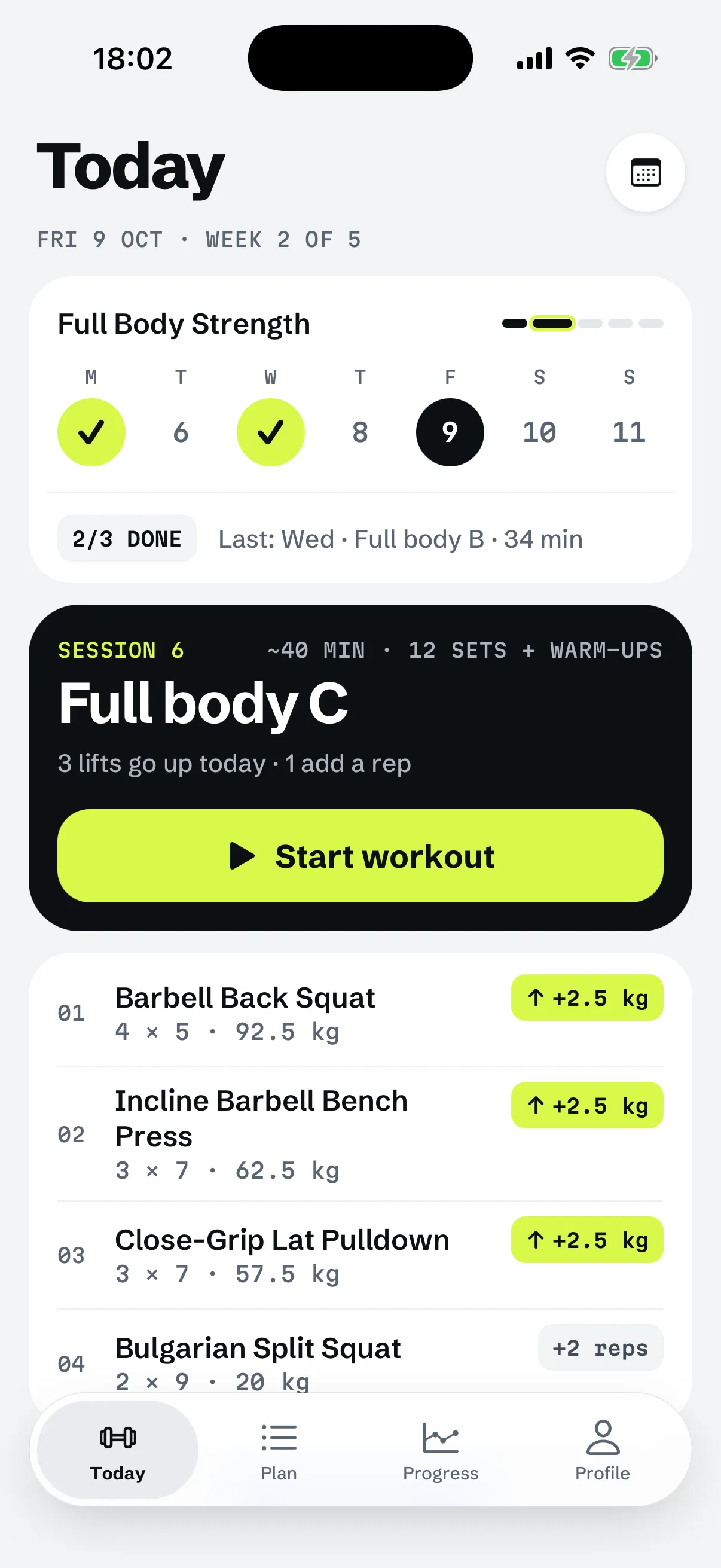
Because RIGOR's rule is double progression, and double progression needs one weight to count reps against. After a workout the app sets the next target as one weight for all the working sets of an exercise, and a rep target for each set. The training rules call this straight sets, and per-set weights are not part of the first version.
Two other rules lean on it. The effort target is the same on every set of an exercise in a given week, and a set counts as having reached the top of the rep range only at the exercise's weight or heavier. If you log a lighter weight on one set, as the first step of a ramp, that set does not count as at the top, so the weight will not go up on that exercise until every set is at the weight. The app takes the most-used weight of the session as the reference, and the heavier when two weights tie.
That is why a pyramid does not suit the rule, not because pyramids fail. A straight-set plan gives a clean question each session: did every set get more reps at the same weight?
How do the reps still differ from set to set?
Each set has its own rep target. The rule is "previous reps + 1" for each set position, capped at the top of the range, so a set that was at 8 aims for 9 while a set that was at 10 aims for 11. Take a bench press with 3 sets in an 8 to 12 range, at 60 kg:
TOP OF THE RANGE8 REPS · BOTTOM
Session 1 was 10, 9, 8 (the first set did most, the last the least). Each next target adds one rep per set, capped at 12: 11, 10, 9, then 12, 11, 10, then 12, 12, 11, then 12, 12, 12. When all three sets reach 12 at the planned effort, the weight goes up to the next one your gym can make and the reps come back down. How weights go up shows each step as the app words it.
So the straight set keeps the shape of a pyramid's reps (high first, low last) without changing the weight. A fixed weight and falling reps is what fatigue does by itself. Rest between sets covers how long to wait so the later sets stay close to the first.
Rep progression is a sound way to progress. In an 8-week trial of 43 trained lifters, one group added load at fixed reps and the other added reps at fixed load. Growth of the rectus femoris favored the reps group a little and strength the load group a little, and the authors called both differences of questionable practical significance (Plotkin 2022). The same guidance from the American College of Sports Medicine says to raise a load 2 to 10% once you can do one or two reps over the target (ACSM 2009). It is the shape of the rule above.
Pyramid sets vs drop sets, and back-off sets vs straight sets
All three change the weight within an exercise; they differ in the direction and the rest.
- Ascending pyramid: heavier each set, fewer reps, a normal rest between.
- Drop set: a set taken close to failure, then the weight is cut and more reps are done with little or no rest.
- Back-off set: one or more heavy sets, then a lighter set for more reps.
Angleri 2017 tested the pyramid and drop sets against straight sets with volume matched, and found no difference for any of the three. That is one study of leg exercises in trained men, so treat "all three tie" as the best current reading and not as settled. A back-off set has no matching trial among the sources used here. All three differ from straight sets in the one way that matters for the next session: the weight is not one number.
Is a warm-up ramp a pyramid?
The shape is similar, the job is not. A warm-up ramp is light sets before the work, each heavier, to rehearse the lift. A pyramid is made of working sets. In RIGOR warm-up sets are shown apart from working sets and never count toward volume, records or progress, so a ramp before your bench does not turn it into a pyramid. The warm-up calculator gives the ramp for any working weight: for 60 kg it is the empty bar, then 25, 35 and 47.5 kg.
Which should you use?
Use whichever you will do consistently, since the evidence does not separate them. If you want a rule that moves your weights for you, straight sets make it simplest: one number to beat. To choose the starting weight, the 1RM calculator estimates a one-rep max from a set, and a 3 day full body workout shows straight sets across a week. The general idea behind both is progressive overload.
When does this not apply?
- A lift with no load. Bodyweight and timed lifts have no weight to hold. Reps or seconds go up, and then added weight or a harder variation.
- A first session. There is no last time yet. You find the weight with light sets, and the first working weight becomes the baseline.
- Deload and easier days. They are lighter on purpose, so they do not set the next target.
- Advanced techniques by choice. Nothing here says a pyramid or a drop set is wrong. It says they need no special place in the progression rule, and the research gives no reason to switch.
RIGOR sets one weight, and the reps for each set
Questions
What does straight sets mean?
Every working set of an exercise uses the same weight, for example 3 sets at 60 kg. The reps may differ from set to set.
Are pyramid sets good for building muscle?
They work, but the studies found no edge over straight sets. A 2023 review of 15 studies found pyramids no better for strength or muscle.
What are the downsides of pyramid training?
No study found a loss in results. The costs are practical: more plate changes, and a different weight on each set to log and compare next time.
Can you give me an example of a pyramid set?
Bench press at 50 kg × 12, 55 kg × 10 and 60 kg × 8: the weight climbs a step each set and the reps fall.
What is a back-off set?
A lighter set done for more reps after one or more heavier sets. The weight changes within the exercise, so it is not a straight set.
Are warm-up sets a pyramid?
They look like one, but warm-up sets are not working sets. They never count toward progress, records or volume.