No single rep range is best for hypertrophy. Reviews find muscle growth similar across a wide spread of loads, while strength favours heavier ones. RIGOR gives each exercise a range a few reps wide, from 6 to 10 for a main compound on a muscle goal up to 12 to 20 for small muscles.
What is the best rep range for hypertrophy?
There is no single best one. Three reviews found muscle growth similar across a wide spread of loads, so the useful question is which range lets you keep adding work on a lift. RIGOR's answer for a muscle goal is 6 to 10 reps on a day's main compound, 8 to 12 on other compounds, 10 to 15 on isolation lifts and 12 to 20 on small muscles.
Here is what each review did and found.
- Schoenfeld 2017. A meta-analysis of 21 studies. Each compared low-load training (60% of a one-rep max or less) with high-load training (above 60%), took every set to momentary muscular failure and lasted at least 6 weeks. Gains in one-rep max were greater with high loads. Isometric strength did not differ, and neither did muscle growth (Schoenfeld 2017).
- Lopez 2021. A network meta-analysis of 28 studies and 747 healthy adults, all with sets to volitional failure. It split loads into low (more than 15 reps to failure), moderate (9 to 15) and high (8 or fewer). Muscle growth did not differ between them (Lopez 2021).
- Schoenfeld 2021. A review of the "repetition continuum", the idea that each rep zone suits one outcome. It concludes that similar whole-muscle growth can be had across loads of about 30% of a one-rep max and up, and that there is no ideal "hypertrophy zone" (Schoenfeld 2021).
The same review adds a practical point: moderate loads may be the most efficient, because light loads take many more reps and so more time.
What is the best rep range for strength?
Heavier, as far as the reviews go. In the Schoenfeld 2017 meta-analysis, one-rep max gains favoured high loads. In Lopez 2021, strength improved more with both high and moderate loads than with low, and high beat moderate by a margin that was not statistically significant (P = 0.068). The 2021 review adds that the repetition continuum holds for one-rep max tests on the trained lift, while isometric tests showed little difference between loads.
None of this says where inside the heavy zone gains peak: the high-load group in Lopez 2021 is simply 8 reps or fewer. RIGOR's strength goal puts a day's main compound at 4 to 6 reps, and other compounds at 6 to 8.
RIGOR is a strength training app for iPhone that builds your plan and sets every weight by rules you can read.
YOUR IPHONE

What do the rep ranges look like by goal?
RIGOR gives every exercise one of four slots, and the goal sets the range for each slot. This is the whole chart.
| Goal | Main compound | Other compound | Isolation | Small muscle |
|---|---|---|---|---|
| Strength | 4–6 | 6–8 | 8–12 | 10–15 |
| Muscle (hypertrophy) | 6–10 | 8–12 | 10–15 | 12–20 |
| Both | 5–8 | 8–12 | 10–15 | 12–20 |
Read across, the strength goal starts two reps lower than the muscle goal in every slot. The "both" goal sits between them on the main compound, 5 to 8, and matches the muscle goal in the other three slots.
What counts as a main compound?
In the code, the first compound exercise the generator puts on a day. A compound is an exercise whose catalogue entry says so; everything else is an isolation. Only that first compound takes the main slot, and it is sorted to the top of the day. So the range follows the position, not the lift.
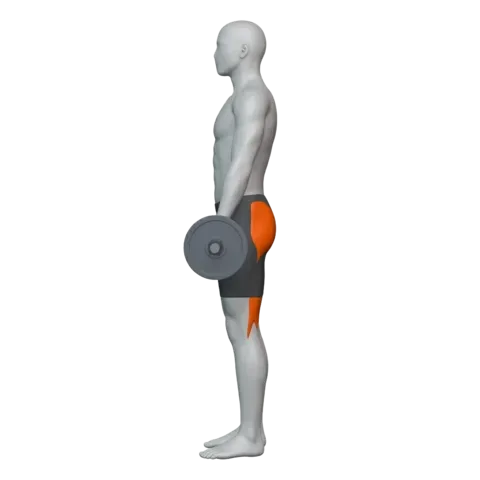
The sample plans show it. In the 3 day full body plan for muscle, the Romanian Deadlift opens Full body B with 3 sets of 6 to 10. In the 6 day push/pull/legs plan it comes after the squat on Legs A, with 2 sets of 8 to 12.
A small muscle is one whose primary muscles are all calves, side or rear delts, forearms or abs, and the exercise is not a compound. The same plans show it: Standing Calf Raise and Cable Crunch both carry 12 to 20.
| Day | Exercise | Sets | Range |
|---|---|---|---|
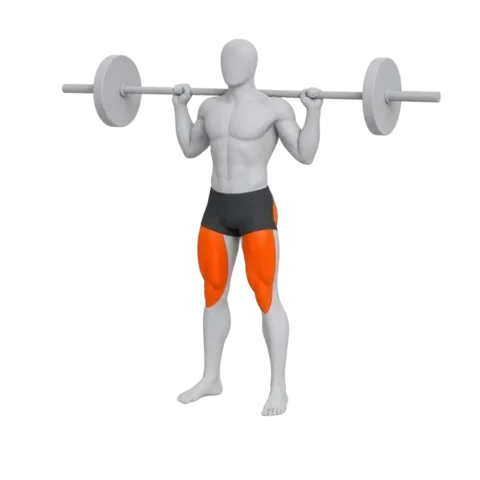
| Full body A | Barbell Back Squat | 4 | 6–10 |
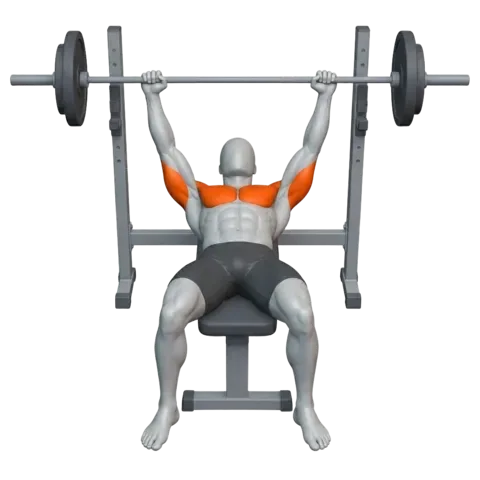
| Full body A | Barbell Bench Press | 3 | 8–12 |
| Full body A | EZ-Bar Curl | 3 | 10–15 |
| Full body C | Standing Calf Raise | 2 | 12–20 |
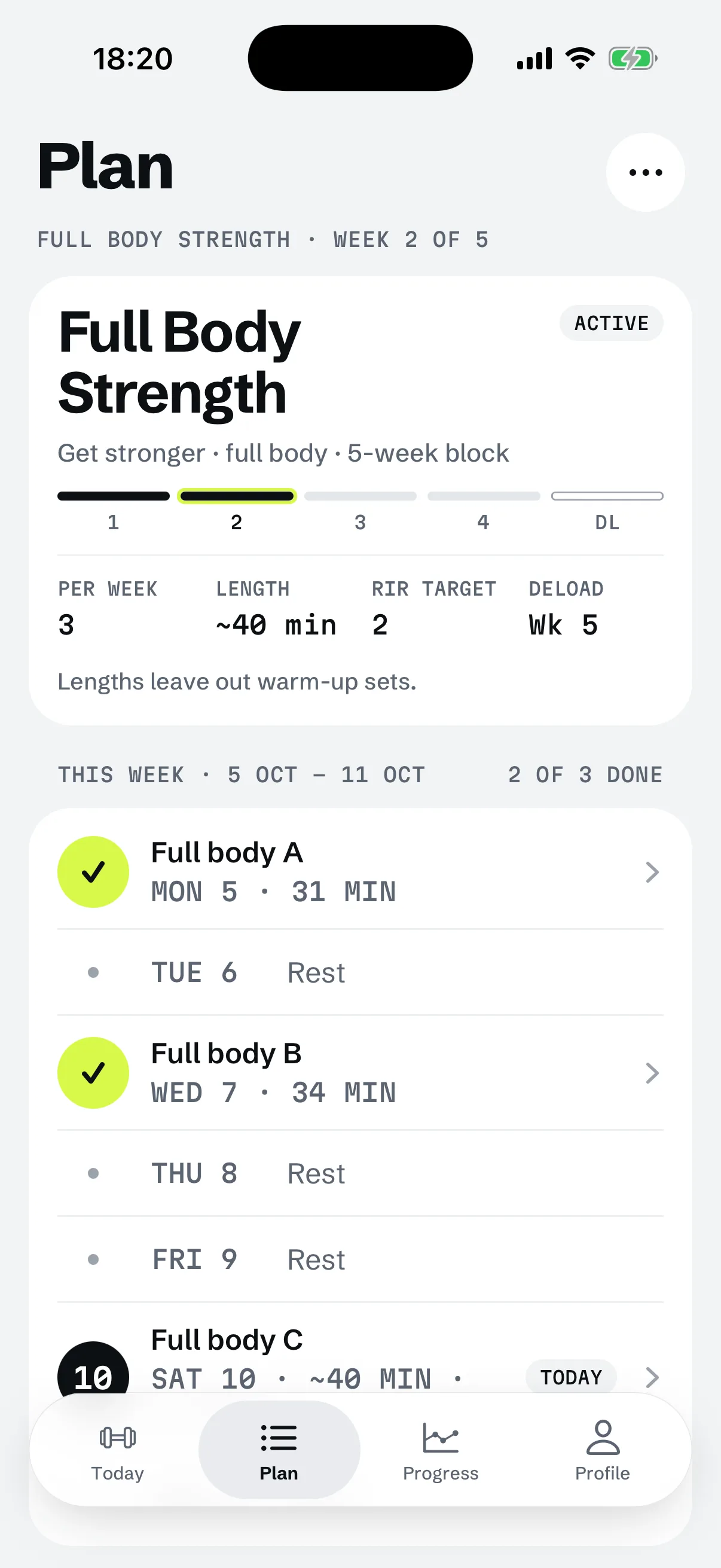
The 3 day full body program shows the plan across a week. A beginner plan on the "both" goal reads the same way with other numbers: in the sample 4 day plan, Upper A opens with Dumbbell Bench Press, 4 sets of 5 to 8, then Lat Pulldown at 8 to 12, EZ-Bar Curl at 10 to 15 and Dumbbell Lateral Raise at 12 to 20. The 4 day upper lower program has the rest. The sample plans hold no strength-goal plan, so the 4 to 6 slot has no plan row here.
For the compound and isolation split behind the slots, see compound vs isolation exercises.
Why does double progression need a range?
Because the rule has two thresholds, a bottom and a top, and a single number gives it only one. The double progression rule keeps the weight and adds a rep to each set until every set reaches the top of the range. Then it adds weight. A set below the bottom is a miss, and the weight repeats.
Take a Barbell Back Squat, 4 sets of 6 to 10, as in the plan above, on a barbell that makes 2.5 kg steps. The first session has no history, so each set is prefilled at the middle of the range, floor((6 + 10) / 2) = 8. Say the lifter logs 8, 7, 6, 6 at 80 kg, each set with 2 reps in reserve. To keep the sums simple, every session here has a target of 2 in reserve; in a real block the target changes week by week.
TOP OF THE RANGE6 REPS · BOTTOM
That is four sessions of added reps at 80 kg, with no change of weight, then a step. The target after session 5 comes from the best set: 10 reps with 2 in reserve is a capacity of 12, and 80 × (1 + 12 / 30) = 112 is the estimated one-rep max. At 82.5 kg that predicts floor(30 × (112 − 82.5) / 82.5) = floor(10.73) = 10 reps to failure, so 10 − 2 = 8 with 2 in reserve. The estimate is the one behind the 1RM calculator.
Now take away the range. On a range of 8 to 8, four sets of 8 are at the top as soon as they are at the bottom. The rule has no stretch of sessions in which to add a rep, so it goes straight to a heavier weight, or to extra reps past the 8 when the next step is too big. RIGOR's table has no such range for a loaded lift: the narrowest, 4 to 6, spans three rep counts.
Adding reps is not a lesser way to progress. In an 8-week trial of 43 resistance-trained lifters, one group raised load at fixed reps and the other raised reps at fixed load. Both were judged viable. Strength slightly favoured raising load, and one muscle measure modestly favoured raising reps (Plotkin 2022).
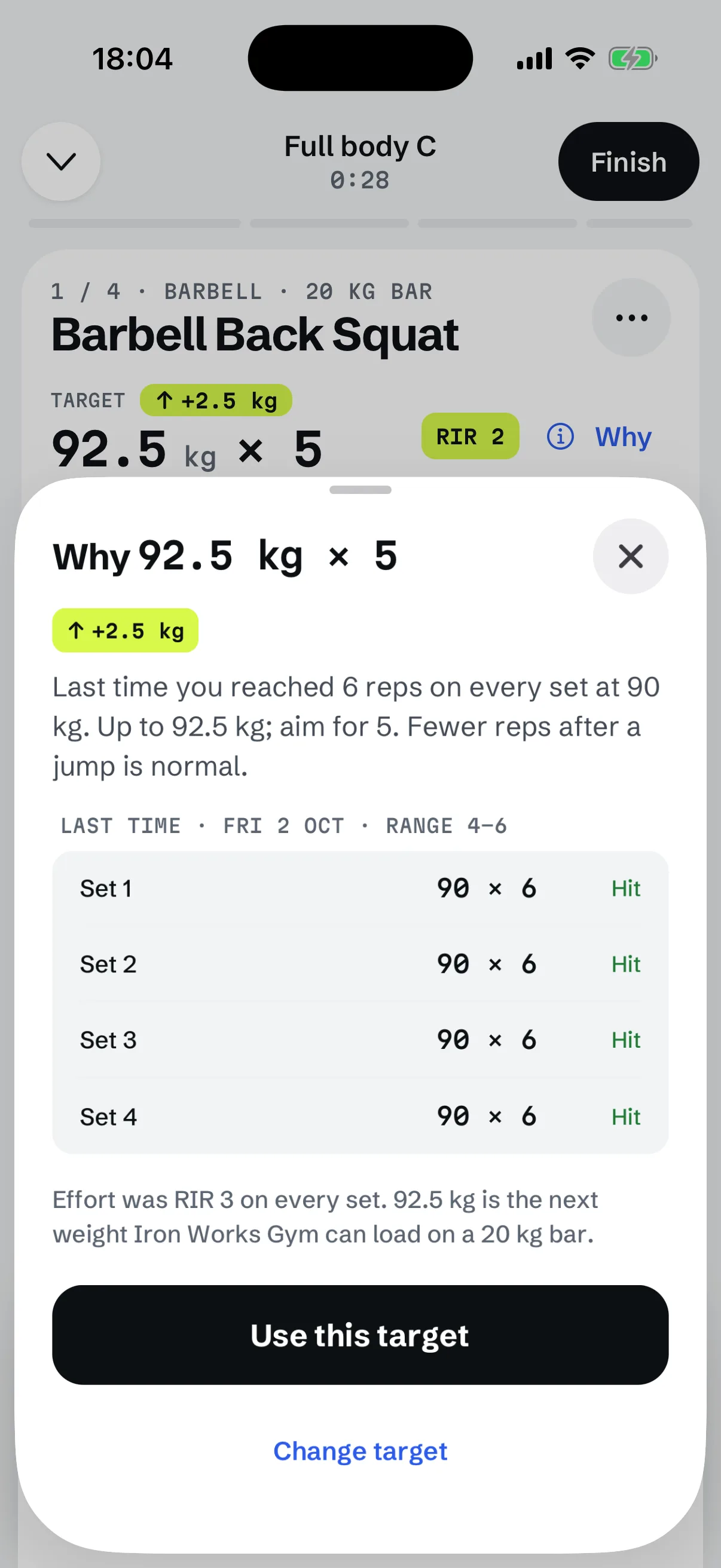
The Why sheet shows the range beside the reason for the target. This one is 4 to 6, the range a strength goal gives a main compound: every set hit the top, so the weight goes up.
Which exercises have a range of their own?
One exercise: negative pull-ups, at 3 to 5 reps whatever the goal or slot. The code lists it as an override, because a negative is a few slow, heavy reps. Its top is 5, so it rests 180 seconds, as does any exercise whose range tops out at 6 reps or fewer. Rest between sets covers the research on rest.
Timed holds are the other case. They have no rep range: the engine stores 1 to 1 and the target is seconds.
When does this not apply?
RIGOR picks the range for each lift
Questions
Are low reps or high reps better for muscle growth?
In the reviews cited here, neither. Muscle growth was similar between low and high loads when sets were taken to failure. Strength gains in the one-rep max favoured the heavier loads, with 8 reps or fewer counted as heavy in one review.
Is 8 to 12 the best rep range for hypertrophy?
The research names no best range. 8 to 12 is what RIGOR gives compounds that are not a day's first, on a muscle goal or on both, and it is the isolation range on a strength goal.
Are rep ranges different for strength and for muscle?
Yes in RIGOR, in every slot. A strength goal gives a day's first compound 4 to 6 reps and a muscle goal 6 to 10. Isolation lifts run 8 to 12 for strength and 10 to 15 for muscle.
How wide should a rep range be?
RIGOR's ranges are narrow for heavy lifts and wide for small muscles. The narrowest, 4 to 6, spans three rep counts and the widest, 12 to 20, spans nine. Each is wide enough to add reps before weight.
Does the rep range change during a block?
RIGOR keeps each exercise's range fixed through the block. What moves is the weight and the reps inside it. If the range or the unit changes, last time no longer compares and the weight is recalculated.