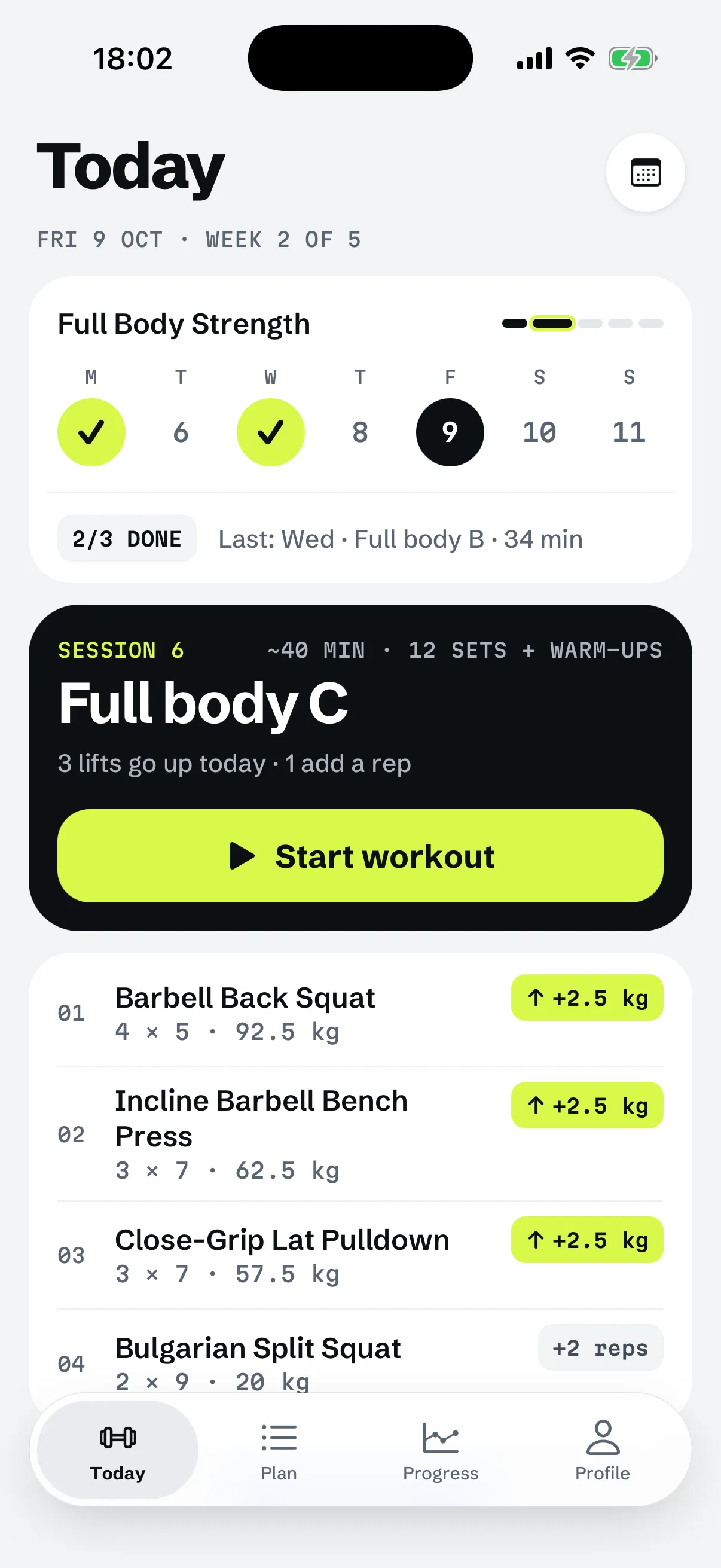
Take the bar's weight off the total and halve what is left. That is what goes on each side. This barbell plate calculator then makes it from the fewest plates, heaviest first, in kg or lb, and tells you the nearest weights when your plates cannot make it.
How many plates is 135, 225, 315 and 405 lb?
One, two, three and four 45 lb plates on each side of a 45 lb bar. Plate math explains what "2 plates" means and gives the same sums in kg. The chart is worked out by the calculator above, on its standard bar and plates.
| On the bar | Each side | Plates |
|---|---|---|
| 135 lb | 45 lb | 1 plate: 45 |
| 225 lb | 90 lb | 2 plates: 45 + 45 |
| 315 lb | 135 lb | 3 plates: 45 + 45 + 45 |
| 405 lb | 180 lb | 4 plates: 45 + 45 + 45 + 45 |
In kilograms the round numbers are 60, 100, 140 and 180 kg on a 20 kg bar. The calculator uses the fewest plates and, among equally few, the heaviest first, so 100 kg comes out as a 25 and a 15 on each side, not two 20s. Both make 40 kg a side; switch off the 25 kg plates above to see the other.
| On the bar | Each side | Plates |
|---|---|---|
| 60 kg | 20 kg | 1 plate: 20 |
| 100 kg | 40 kg | 2 plates: 25 + 15 |
| 140 kg | 60 kg | 3 plates: 25 + 25 + 10 |
| 180 kg | 80 kg | 4 plates: 25 + 25 + 25 + 5 |
How it is calculated
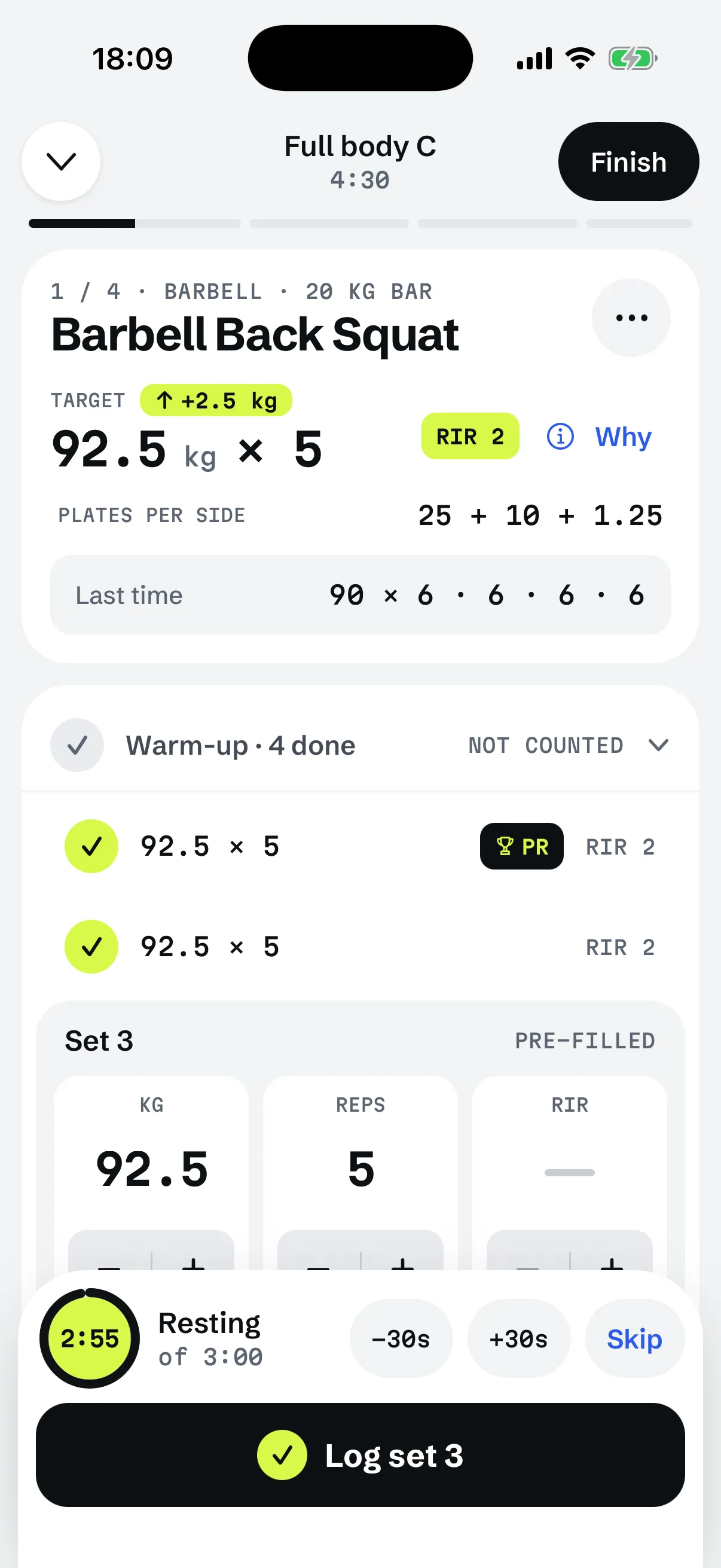
Take the bar's weight off the total and halve what is left: that is one side. The calculator then makes that side from the fewest of your plates, heaviest first. For 92.5 kg on a 20 kg bar, one side is 36.25 kg, which is 25 + 10 + 1.25.
Three things can be changed:
- The bar. It opens on the standard bar, 20 kg or 45 lb. Enter 15 for a lighter bar, or 0 for a plate-loaded machine, where the plates are the whole load.
- The plates. It opens with the app's standard rack: eight 25 kg plates and four of each smaller size down to 1.25 kg, or eight 45 lb plates and four of each smaller size down to 2.5 lb. Switch off a size your gym does not have.
- The unit. Changing between kg and lb changes the bar and the rack with it, and moves the weight to the nearest step.
When your plates cannot make the weight, the calculator says so and gives the nearest loads below and above. Ask for 101 kg on the standard rack and it offers 100 kg and 102.5 kg. Press either to use it.
How accurate it is
The sum is exact. The iron is not always. Plates and bars are made to a tolerance, so the real weight can differ a little from the number on them, and old or mixed plates differ more than calibrated ones. Collars add weight too if you use heavy ones.
None of this matters much for training, as long as you load the same way each time: the same bar, the same plates, collars on or off. What you are tracking is the change from last session, and a steady error cancels out.
The smallest step is the part that does matter. With 1.25 kg plates the bar goes up 2.5 kg at a time; in pounds, with 2.5 lb plates, 5 lb at a time. If your gym has no small plates, every jump is bigger, and a rule such as double progression has to earn more reps before each one. RIGOR only asks for the weights your gym can make.
What to use it for
Loading a weight without doing sums between sets, and checking that a weight can be loaded at all before you plan around it.
Before a set. Enter the target and read one side. Load the heaviest plate first, against the collar, as the drawing shows.
Working backwards. To find what is on a bar, add up one side, double it and add the bar.
Planning. If a program asks for a weight your plates cannot make, take the nearest one below. A 1RM calculator or a percentage often gives a number no bar can hold; this turns it into one you can load. For the lighter sets before it, the warm up sets calculator rounds every step the same way.
If you would rather an app worked out the plates for you, see RIGOR vs Strong.
RIGOR shows the plates for every set

Questions
How many plates is 225?
Two 45 lb plates on each side of a 45 lb bar: 45 + 4 × 45 = 225 lb. Lifters call it two plates.
How many plates is 135, 315 and 405?
On a 45 lb bar, 135 lb is one 45 lb plate a side, 315 lb is three and 405 lb is four.
How many plates is 100 kg?
On a 20 kg bar, 40 kg a side: a 25 kg and a 15 kg plate. With 20 kg plates only, it is two of them on each side.
How much does a barbell weigh?
A standard Olympic bar weighs 20 kg, and in gyms that work in pounds it is counted as 45 lb. Many gyms also have a lighter 15 kg bar. Other bars vary, so check the end cap or weigh it.
How do you calculate barbell weight?
Add up the plates on one side, double it and add the bar. A 20 kg bar with 25 + 10 + 1.25 kg on each side is 20 + 2 × 36.25 = 92.5 kg.
Does the bar count in the weight you lift?
Yes. The number you log for a barbell lift is the total: the bar and every plate on it. RIGOR counts it that way too.