A deload week in lifting is a planned lighter week between blocks of harder training. RIGOR, the app behind this guide, puts one after four training weeks: half the sets, about 10% less weight, the bottom of each rep range and 4 or more reps in reserve. It lasts one week, and you keep training.
What is a deload week?
A deload week is a planned lighter week of lifting: fewer sets, lighter weights and easier sets, placed between blocks of harder training. You still train. The work is cut so that fatigue can fall before the next block begins.
A 2023 consensus of strength and physique coaches defines deloading in the same terms: a period of reduced training stress, meant to ease fatigue, help recovery and prepare you for the training that follows. It is not a week off, and it is not a test: nothing you lift in it is used to judge progress.
How much to reduce in a deload week
In RIGOR, the app behind this guide, a deload week halves the sets and takes about 10% off the weight. Four things change, on every exercise.
| What changes | Training week | Deload week |
|---|---|---|
| Sets | 2 to 4 | Half, rounded up: 4 become 2, 3 become 2, 2 become 1 |
| Weight | Working weight | About 10% lighter |
| Reps | Up the range | The bottom of the rep range, on every set |
| Reps in reserve | 0 to 3 | 4 or more |
The weight is 90% of what you lifted in your last normal session of that exercise, rounded down to one of the weights your gym can make. Effort is counted in reps in reserve, the reps you could still have done when the set ended: a deload week asks for two more than week 1 of the block, and never fewer than 4.
The exercises stay the same, and so does how long to rest between sets. Warm-up sets are worked out from the first working set's weight, so they get lighter with it.
The numbers are RIGOR's rule, not a research finding. The shape matches what lifters report: in a 2024 survey, 246 competitive strength and physique athletes said they cut sets and reps, lifted lighter loads and left more reps in reserve, while keeping how often they trained and their exercises.
RIGOR is a strength training app for iPhone that builds your plan and sets every weight by rules you can read.
YOUR IPHONE

A worked example: one lift, then a whole week
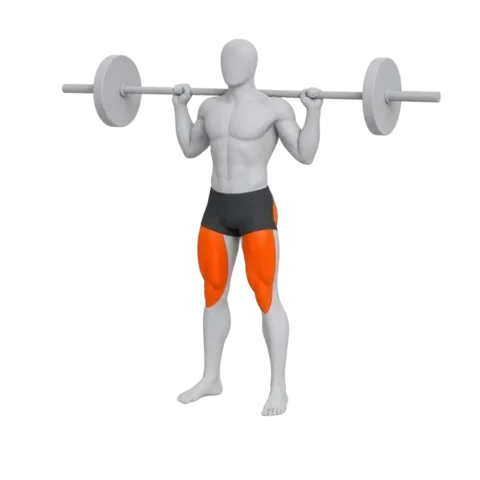
Take a Barbell Back Squat, 3 sets of 4 to 6 reps, that reached 100 kg in week 4 of a block.
TOP OF THE RANGE4 REPS · BOTTOM
Ninety per cent of 225 lb is 202.5 lb, which rounds down to 200 lb on a bar that loads in 5 lb steps. The app's line that week: "Deload week: fewer sets and lighter weights to recover."
Now a whole week. The 6 day push pull legs routine has 84 working sets in a training week. Each exercise does half its sets, rounded up, so its deload week has 50. This is its first legs day.
| Exercise | Training week | Deload week |
|---|---|---|
| Barbell Back Squat | 4 × 6–10 | 2 × 6 |
| Romanian Deadlift | 2 × 8–12 | 1 × 8 |
| Bulgarian Split Squat | 3 × 8–12 | 2 × 8 |
| Leg Extension | 2 × 10–15 | 1 × 10 |
| Seated Calf Raise | 3 × 12–20 | 2 × 12 |
| Standing Calf Raise | 2 × 12–20 | 1 × 12 |
Halving rounds up, so the week keeps more than half: 50 sets, not 42. The six sessions go from 12 to 16 sets each to 7 to 10.
RELATED TOOLWarm-up calculatorWarm-up sets from your first working weight.How often should you deload?
There is no tested answer; every four to six weeks is common practice. The athletes in the 2024 survey deloaded every 5.6 weeks on average, with a wide spread. Eighteen coaches interviewed for a 2022 study typically programmed one every 4 to 6 weeks, and said it varied a great deal.
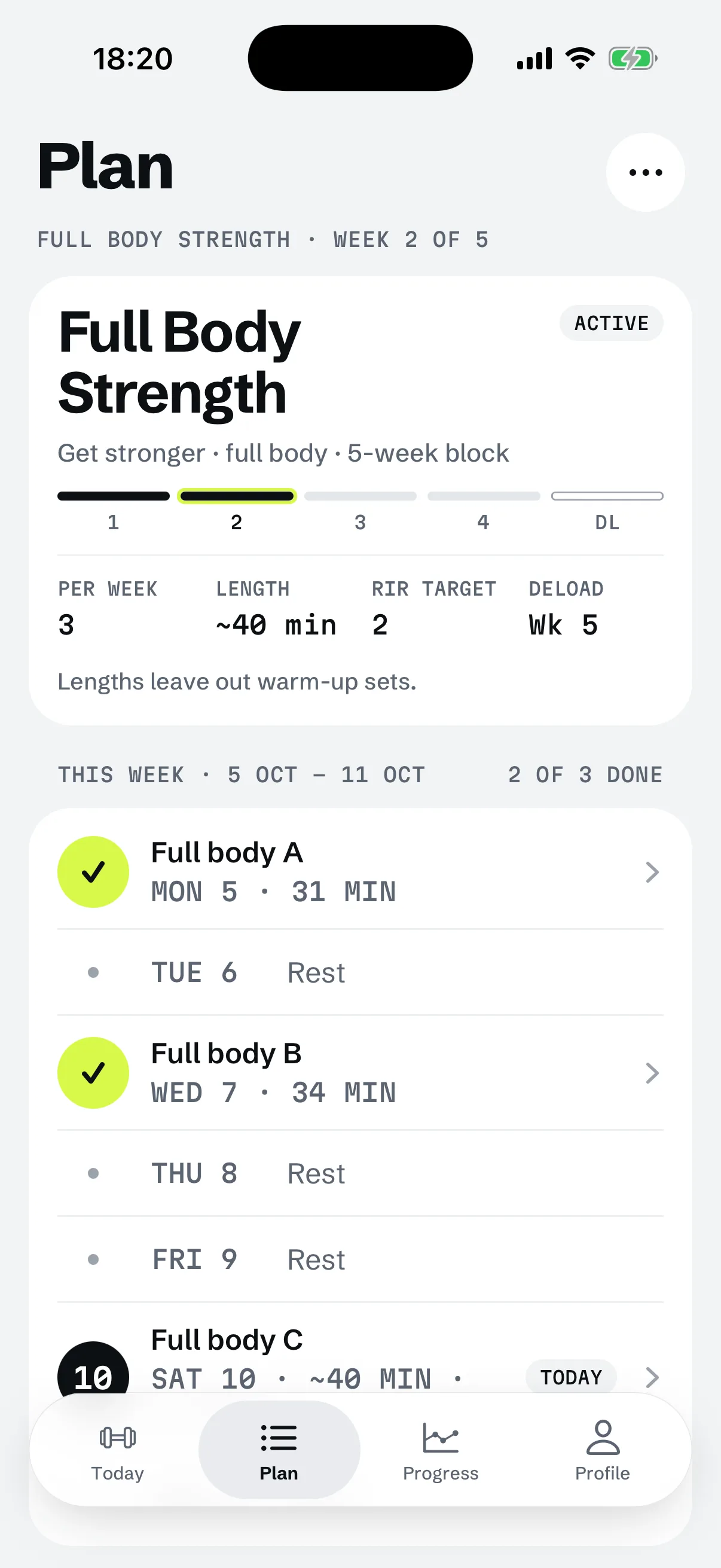
In RIGOR a block is four training weeks. With deload on, a fifth week follows, so one week in five is lighter.
- WEEK1
- WEEK2
- WEEK3
- WEEK4
- DELOAD5
The effort rises through the four weeks: a compound lift such as a squat goes from 3 reps in reserve in week 1 to 1 in week 4, or 2 for a beginner. The deload week comes straight after the hardest one. The 3 day full body workout is built the same way: its 52 working sets fall to 31 in week 5.
How long should a deload last?
One week. The surveyed athletes averaged 6.4 days, and the coaches in the 2022 interviews typically prescribed 5 to 7.
In RIGOR it is one week of the plan: each of the week's workouts, once, in its lighter form. The next block starts from your last normal week: in the example, from 100 kg × 6, 5, 5, not from 90 kg × 4, 4.
Deload week vs a week off
A deload week keeps you lifting at lower stress; a week off is no lifting at all. A 2024 controlled trial of a one-week deload tested the week off, not the lighter week.
Its researchers split 39 trained men and women into two groups for a nine-week program. One group trained straight through. The other stopped lifting for a week at the midpoint. The paper calls it a deload, but nobody lifted.
Lower-body muscle growth, muscular endurance and power ended about the same in both groups. Lower-body strength improved more in the group that never stopped. The trial cannot say whether a lighter week, with the training kept, does better or worse than training straight through.
How do you deload properly?
Cut the work, not the exercises: half the sets, about 10% less weight, the bottom of the rep range and 4 or more reps in reserve. RIGOR does this for you. By hand:
- Keep the same exercises and days.
- Do half the working sets of each exercise, rounded up.
- Load 90% of your last normal session, rounded down to a weight you can make.
- Stop each set at the bottom of the rep range, with 4 or more reps in the tank.
- Next week, return to your last normal week, not to the deload weights.
Deload vs taper: what is the difference?
A taper cuts training before one competition, to peak on that date. A deload week sits inside a running block and clears fatigue so training can go on. RIGOR plans deloads and has no taper.
The research on tapering for strength is thin. A 2020 review found evidence on peaking for strength and power athletes lacking, so coaches rely on trial and error. The best-known data come from interviews with 11 elite New Zealand raw powerlifters: they cut volume by about 59% while keeping intensity or lowering it slightly, and lifted last about 3.7 days before the meet. Those who took a week or more off had a poor taper.
Does a deload week work?
Nobody can say yet. The 2023 consensus paper calls deloading under-researched and says how best to fit it into a program is unknown. What stands behind the practice:
- The 2023 consensus is expert opinion: 34 coaches began a three-round questionnaire and 21 finished it. It records what experienced coaches agree on, not the result of an experiment.
- The 2024 survey describes what 246 athletes do. All of them deloaded, mainly to manage energy and fatigue. It cannot say how they would have done without.
- The 2024 trial tested a week off, in one nine-week program with only the lower-body sessions supervised.
So a deload week is a planning choice, not a proven method.
Do beginners need a deload week?
Not by default. In RIGOR the deload week is off for beginners and on for intermediate and advanced lifters. It is one of the answers a plan is built from, so a beginner who wants one can choose it when building a plan. See deload weeks in the app's help.
A beginner's weeks are lighter to begin with: a target of 10 sets a week for each big muscle group, against 13 for an intermediate lifter and 16 for an advanced one, and one more rep in reserve in weeks 2 and 4. The 4 day upper lower split, a beginner's plan, runs in four-week blocks with no deload week.
When a deload week is not the answer
A deload week is for the fatigue of a whole block. Three other cases have their own rule in RIGOR:
- One lift keeps missing. Below the rep range two sessions running at the same weight takes 10% off that lift alone, and you build back by double progression. RIGOR has no unplanned deload of a whole workout.
- One hard day. Easier today eases a single workout: about 10% less weight, one set fewer per exercise and one more rep left in reserve.
- Two weeks or more away. After 14 days without a logged set, the app offers to continue as planned or start lighter. See missed days and time off.
RIGOR plans the deload week for you
Questions
What is a deload week?
A planned lighter week of lifting: fewer sets, lighter weights and easier sets, so that you recover before the next block of harder training.
How often should you deload?
There is no tested answer. In a 2024 survey of 246 competitive strength and physique athletes the average was every 5.6 weeks, and RIGOR plans a deload week after four training weeks.
How long should a deload last?
About a week. The athletes in the 2024 survey deloaded for 6.4 days on average, and RIGOR's deload is one week of the plan.
How much should you reduce in a deload week?
RIGOR halves the sets of every exercise, rounded up, and takes about 10% off the weight. Each set stops at the bottom of the rep range, with 4 or more reps in reserve.
Deload week vs week off: which is better?
A deload week keeps you lifting at lower stress; a week off is no lifting. In a 2024 trial, a week off in the middle of nine weeks made no appreciable difference to lower-body muscle growth, and the group that trained straight through gained more lower-body strength.
Will I lose muscle during a deload week?
Nothing in the evidence suggests it. In a 2024 trial of 39 trained lifters, even a full week without lifting made no appreciable difference to lower-body muscle growth over nine weeks.
Do beginners need a deload week?
Not by default in RIGOR: the deload week is off for beginners and on for intermediate and advanced lifters. A beginner can still choose one when the plan is built.