Your one rep max (1RM) is the most you could lift once. This calculator estimates it from a set you have already done. It uses the Epley formula and counts the reps you left in reserve.
The same strength at other rep counts
| REPS | WEIGHT | % OF 1RM | |
|---|---|---|---|
| 2 | 109.4 kg | 94% | |
| 3 | 106.1 kg | 91% | |
| 4 | 102.9 kg | 88% | |
| 5 | 100 kg | 86% | YOUR SET |
| 6 | 97.2 kg | 83% | |
| 8 | 92.1 kg | 79% | |
| 10 | 87.5 kg | 75% | |
| 12 | 83.3 kg | 71% |
Your one rep max and your ten rep max are two readings of the same strength. The table turns the estimate above back into the weight you could lift for 2 to 12 reps, each as a share of your 1RM. Change the set in the calculator and the table follows it. The row for your own set is marked.
For 100 kg × 5 with nothing left, the estimate is 116.7 kg. Five reps is then 86% of the one rep max, 8 reps is 79% and 10 reps is 75%. To see how to load a row, put its weight into the barbell plate calculator.
What is e1RM, and which formula does it use?
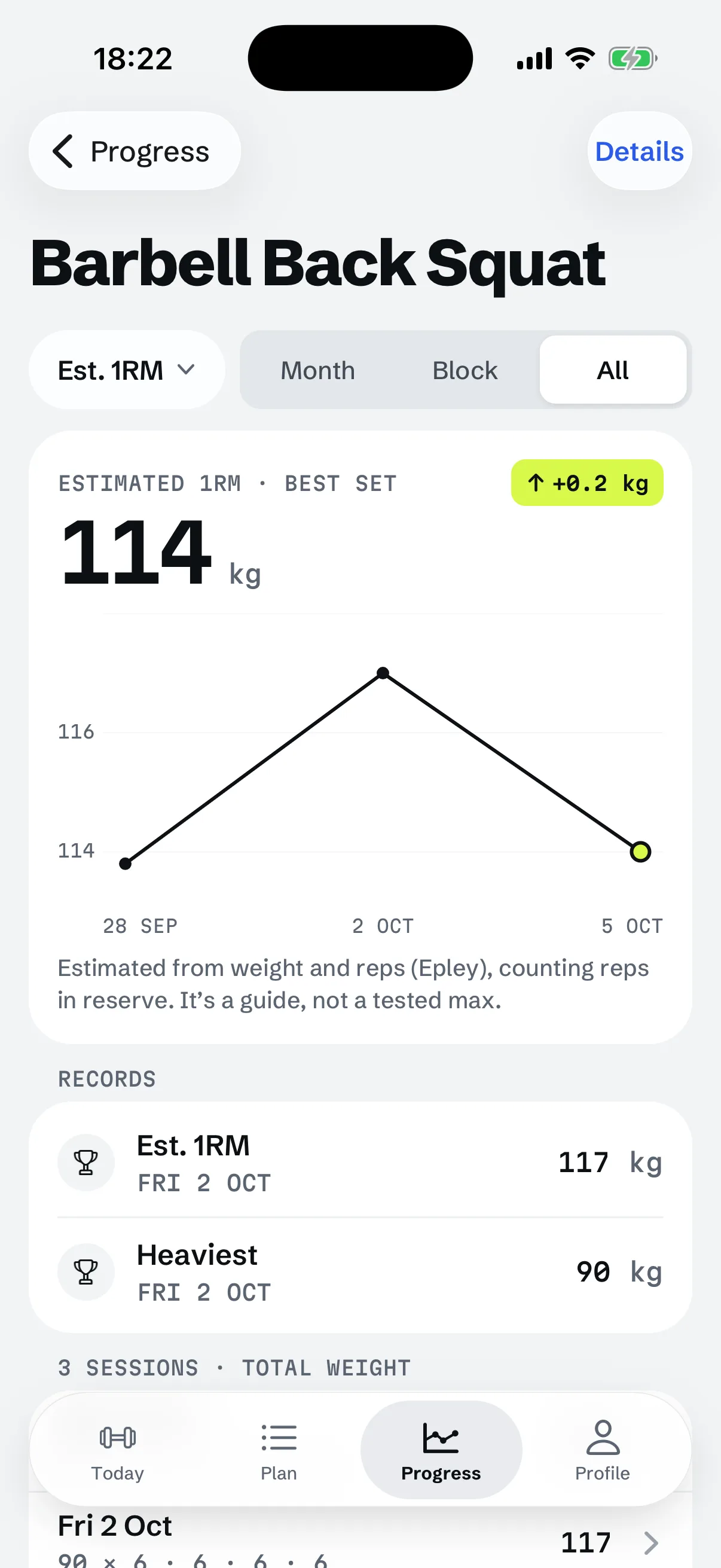
e1RM is an estimated one rep max: the most you could lift once, worked out from a set and not lifted. This calculator's e1RM is the Epley formula, weight × (1 + (reps + reps in reserve) ÷ 30), and RIGOR uses the same formula for the e1RM it charts for each lift.
How it is calculated
This calculator uses the Epley formula: weight × (1 + reps ÷ 30). Each rep adds one thirtieth of the weight, so 100 kg × 5 gives 100 × (1 + 5 ÷ 30), which is 116.7 kg, and 225 lb × 5 gives 262.5 lb.
Reps left in reserve are added to the reps, because a set stopped two reps short was worth two more. Enter 100 kg × 5 with 2 in reserve and it counts as a set of 7: 123.3 kg. If you rate sets by RPE, RPE 10 is no reps in reserve, RPE 9 is one and RPE 8 is two.
Two limits keep the number honest. The calculator counts at most 25 reps in all and at most 6 in reserve; past either, the set says little about a single. And a single is not its own one rep max here: 100 kg × 1 gives 103.3 kg, because the formula adds a thirtieth for every rep, the first included. If you have lifted a true maximum single, that lift is your 1RM and you need no estimate.
How accurate it is
It is an estimate, not a tested max. Estimates from sets of 10 reps or fewer are the most reliable. In a study of 70 adults who tested the chest press and the leg press at 1, 5, 10 and 20 reps, the 5 rep sets predicted the tested max best, and the prediction got worse as the reps rose. The study lists 10 reps or fewer as the range its authors gave for the Epley formula.
Three things move the number:
- The lift. The same study found that a formula fits one exercise better than another. Compare a lift with itself, not your squat with your press.
- The effort. Reps in reserve are your own guess. An honest count matters more than the choice of formula.
- The day. One set is one reading. A tired day reads low, so watch the trend and not a single number.
What to use it for
Comparing sets done at different weights, following a lift over months, and choosing a starting weight for a new rep range. You don't need to test a true max to train well.
Comparing sets. 100 kg × 5 and 92.5 kg × 8 look different in a log. As estimates they are 116.7 kg and 117.2 kg: the same strength, shown two ways.
Following a lift. When the estimate rises, you are getting stronger, even in weeks when the weight on the bar stays put. That is how double progression moves: reps first, then weight. It is one form of progressive overload, which means doing a little more over time.
Choosing a starting weight. Read the row for the reps you plan, then take a little off. The table is sets to failure, and training sets usually stop a rep or two short. In RIGOR, your first session of a lift sets the starting point, and a guess that was far off is recalculated after it. Back after two weeks or more away? The app offers an easier first session back. Before a heavy set, the warm up sets calculator gives the lighter sets that lead up to it.
It is not a promise that the single is there on the day. Treat it as a number to plan with, not one to load and attempt.
RIGOR tracks this for every lift

Questions
How do you calculate your 1RM?
Multiply the weight by 1 plus the reps divided by 30. That is the Epley formula: 100 kg for 5 reps gives 100 × (1 + 5 ÷ 30), about 116.7 kg.
How do you calculate 1RM from a 5RM?
Multiply your 5 rep max by 1 + 5 ÷ 30, which is about 1.17. A 5RM of 100 kg is an estimated 1RM of 116.7 kg; 225 lb is 262.5 lb.
What percentage of 1RM is 5, 8 or 10 reps?
By the Epley formula a set of 5 to failure is about 86% of your one rep max, 8 reps is about 79% and 10 reps is 75%.
Can you estimate a 1RM with RPE or reps in reserve?
Yes. Add the reps you had left to the reps you did. RPE 8 is about 2 reps in reserve, so 100 kg × 5 at RPE 8 counts as a set of 7: about 123.3 kg.
How accurate is a 1RM calculator?
It is an estimate, not a tested max. It is most reliable from hard sets of 10 reps or fewer, and it drifts as the reps go up.