Progressive overload means asking a little more of each lift over time. Add reps first. Keep the weight until every set reaches the top of your rep range, such as 8 to 12, then add the smallest step you can load, usually 2.5 kg or 5 lb on a barbell. When the next weight is a big jump, add reps past the range first.
What is progressive overload?
Progressive overload is doing a little more over time than you did before: another rep, a little more weight, now and then another set. Lift the same weight for the same reps every week and the training stops asking for anything new. The American College of Sports Medicine's guidance says to keep adapting, the training has to keep progressing.
The idea does not say what to add or when. The rest of this page does.
How to progressive overload: what you can add
Add one of three things you can count in a training log: reps, weight or sets. They are not equal steps.
| Add | Step | When |
|---|---|---|
| Reps | 1 per set | Most sessions, up to the top of the rep range |
| Weight | 2.5 kg / 5 lb | When every set is at the top of the range |
| Sets | 1 set | With a new plan, not week by week |
Reps and weight have been tested against each other. In an eight-week study of 43 trained lifters, one group added weight at fixed reps and the other added reps at a fixed weight. The differences were small, and the authors judged both workable. A ten-week study from 2024 trained each leg of 39 untrained young adults one of the two ways: strength and muscle size rose in both, with no difference between them. Both studies were short and measured the legs only.
Sets are a different kind of step. A 2017 meta-analysis of 15 studies found that more weekly sets for a muscle went with more growth. It says how much to do, not when to add a set. In RIGOR the sets come from the plan, and the rule that runs after each workout moves reps and weight only.
RIGOR is a strength training app for iPhone that builds your plan and sets every weight by rules you can read.
YOUR IPHONE

Should you increase weight or reps first?
Reps first, then weight. The studies above say either works, so the choice is practical: a rep is a smaller step than a plate. The smallest step on most barbells is 2.5 kg or 5 lb, about 5% more on a 50 kg (110 lb) row. One more rep asks for less, so most sessions have a step.
Put the two in order and you have a method: double progression, which goes through the rep ranges, the exact rule and every case where a set falls short.
When to increase weight
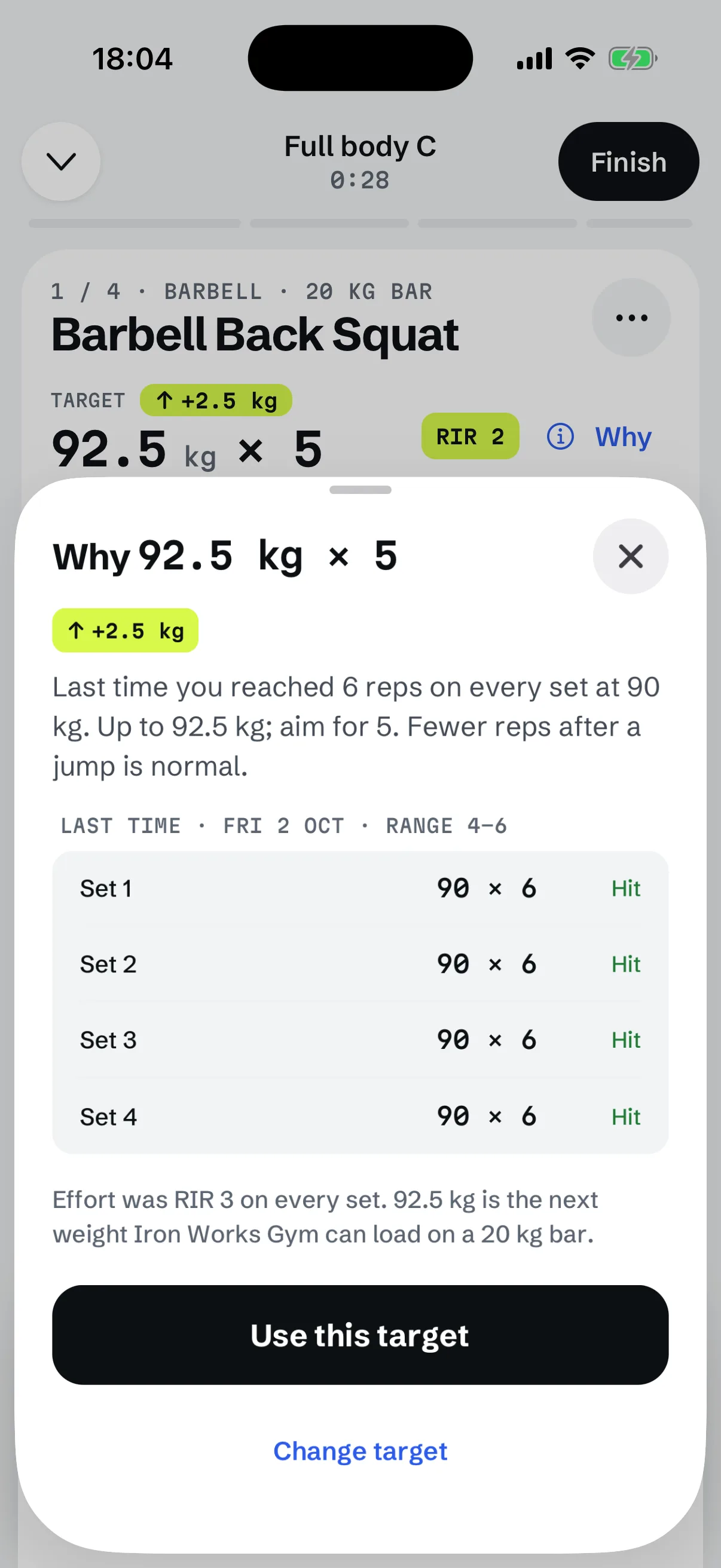
Increase the weight when every working set has reached the top of its rep range, at about the effort you planned. Not when the first set gets there, and not by the calendar.
The screen shows the rule for a squat with a rep range of 4 to 6: all four sets reached 6 at 90 kg, so the next target is 92.5 kg.
Effort is the second condition. RIGOR plans each set with a number of reps in reserve, the reps you could still have done. Reach the top of the range but log a set two or more below the plan, and the weight stays for another session.
The American College of Sports Medicine's version is close: raise the load by 2 to 10% once you can do one or two reps more than the target.
When to increase weight on the bench press
Raise the bench press once every set is at the top of its range, no set was harder than planned, and the next weight still leaves room in the range. RIGOR checks those in order. Take Push A of its 6-day push, pull and legs plan: Barbell Bench Press, 4 sets, 6 to 10 reps, with 2 reps in reserve planned in week 3 and 1 in week 4.
| Check | Result |
|---|---|
| Every set at the top | All four sets are at 10: pass |
| No set harder than planned | 2 left was planned. A set with 1 left still passes; a set with 0 left holds the weight |
| Next weight still fits | 82.5 kg (20 kg bar, 25 + 5 + 1.25 kg a side). The best set was 10 reps with 2 left, so 12 were possible: 80 × (1 + 12/30) = 112 kg. At 82.5 kg with 1 left: floor(30 × (112 − 82.5) / 82.5) − 1 = 9 reps, above the bottom of 6: pass |
Week 4 is 82.5 kg × 9. Had the next weight predicted fewer than 6 reps, the weight would stay and the reps would climb past 10 first, as in double progression.
How often should you increase weight at the gym?
When the rule is met, not on a schedule: the bench press above went up in week 4, after week 3 met it, and a harder set than planned pushes it back a session. Take the smallest step your equipment makes; RIGOR takes the next of the weights your gym can make.
Expect fewer reps after the jump. RIGOR estimates them from your last sets, with the Epley formula behind the 1RM calculator.
RELATED TOOL1RM calculatorEstimate the most you could lift once, from a set you have already done.A progressive overload example: 50 kg to 52.5 kg
Barbell Row, 3 sets, rep range 8 to 12, at 50 kg (110 lb). A RIGOR plan repeats each workout once a week, and a lift's next target comes from the last time that workout was done, so the example runs through the four training weeks of a block.
TOP OF THE RANGE8 REPS · BOTTOM
| Week | Weight | Reps | Next time |
|---|---|---|---|
| 1 | 50 kg | 11, 11, 10 | Same weight, +1 rep per set |
| 2 | 50 kg | 12, 12, 11 | Same weight, 12 on every set |
| 3 | 50 kg | 12, 12, 12 | Up to 52.5 kg × 10 |
| 4 | 52.5 kg | 10, 10, 10 | Same weight, +1 rep per set |
The reps after the jump follow the planned effort. Past the beginner stage, 2 reps in reserve are planned in week 3 and 1 in week 4: 12 reps with 2 in reserve at 50 kg works out to 10 with 1 in reserve at 52.5 kg. A beginner keeps 2 in reserve in week 4 and is asked for 9.
How to progressive overload with the same weight
Add reps. Dumbbells are the common case: a rack goes up 2 kg or 5 lb a hand, so 14 kg to 16 kg is 14% more and 30 lb to 35 lb is 17%. A step that size can be too big to take at once.
RIGOR works out the reps the heavier weight should allow. If that falls under the bottom of the rep range, the weight stays and every set gets one more rep, past the top of the range.
The extra reps have a limit: 5 past the top of the range, or 2 when the range tops out at 8 or fewer. Reach it on every set and the weight goes up anyway. A 3 day dumbbell workout built on this rule shows it across a whole plan.
What to do when progress stops
Repeat the weight after one bad session, and take 10% off a lift that falls below its rep range two sessions running at the same weight.
- One session with a set under the bottom of the range. Same weight next time. The sets that fell short aim for the bottom of the range, the others for one more rep.
- Under the range two sessions running at the same weight. That lift comes down 10%, rounded down to a weight you can load, and builds back by the same rule: 100 kg becomes 90 kg, and 225 lb becomes 200 lb.
Only that lift changes. How weights go up shows each case as the app words it.
A planned lighter week is different. In RIGOR's deload week every exercise does half its sets, rounded up, with about 10% less weight, at the bottom of the rep range, with 4 or more reps in reserve. It is the last week of a block when the plan has one, and it is off by default for a beginner.
Progressive overload vs training to failure
They are different things. Progressive overload is what changes from one session to the next; training to failure is how hard a single set is taken. You can overload without reaching failure. A 2023 meta-analysis of 15 studies found no clear advantage for muscle growth in sets taken to momentary muscular failure over sets that stopped before it.
Effort still has a place: RIGOR plans 0 to 3 reps in reserve in training weeks, falling through a block.
When does this not apply?
Reps, then weight, fits almost any lift with a weight and a rep range. These cases need something else:
- Your first session of a lift. There is no last time to beat. Your first session sets the starting point.
- Bodyweight lifts. There is no weight to add. Reps go up, then at the top of the range comes added weight or a harder variation.
- A deload week or an easier session. Both are lighter on purpose, and neither is used to judge progress.
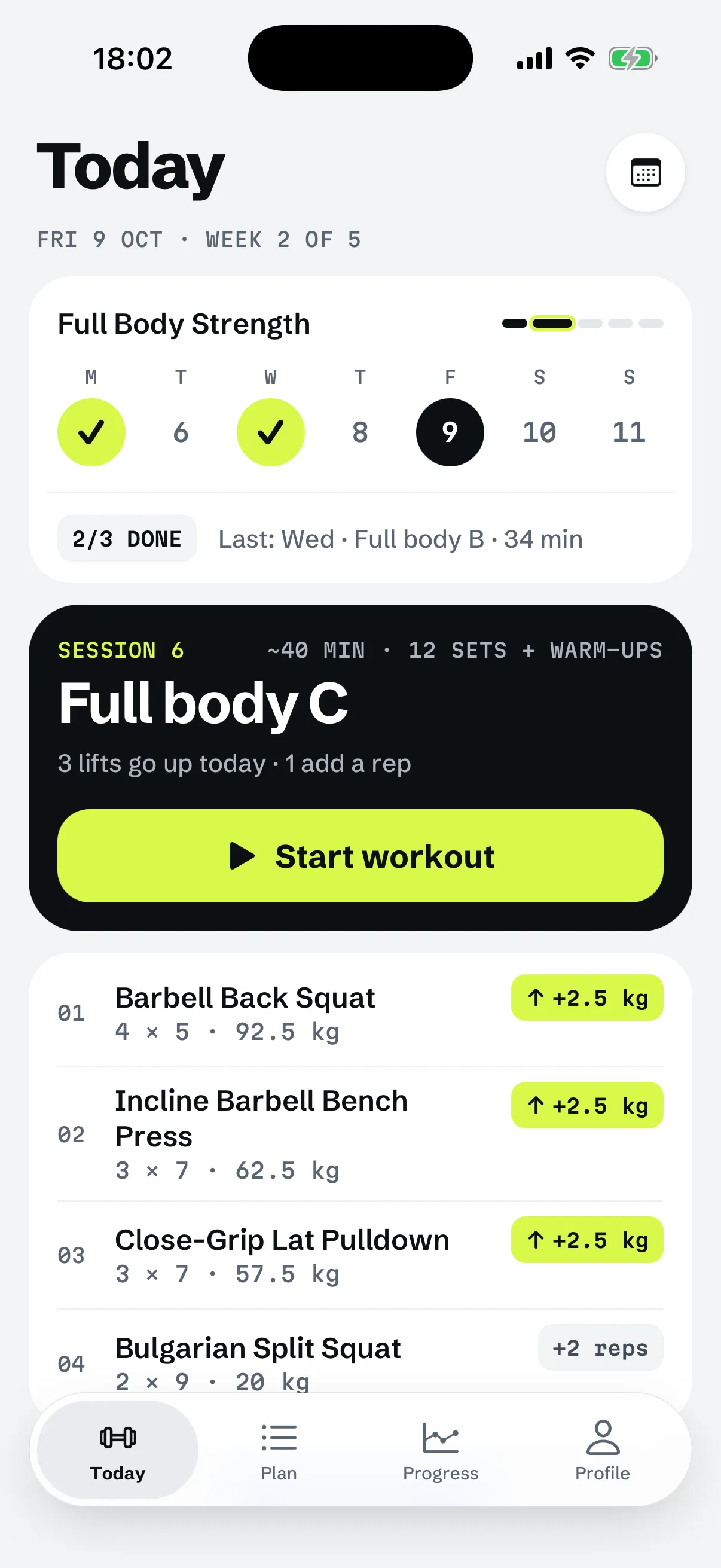
RIGOR works out the next step for every lift
Questions
What is progressive overload?
Doing a little more over time than you did before: another rep, a little more weight, now and then another set.
How do you progressive overload?
Give each lift a rep range, such as 8 to 12. Keep the weight and add reps until every set reaches the top, then add the smallest weight you can load and build the reps back up.
Should you increase weight or reps first?
Reps first. Studies that compared the two found similar gains from both, and one rep is a smaller step than the 2.5 kg or 5 lb a barbell goes up by.
When should you increase weight?
When every working set has reached the top of its rep range at about the planned effort. Add the smallest step your equipment makes and expect fewer reps at the new weight.
How do you progressive overload with the same weight?
Add reps. Add one rep to each set each session, up to the top of the rep range, and past it when the next dumbbell or machine setting is too big a jump.
Progressive overload vs training to failure: what is the difference?
Progressive overload is what changes from one session to the next. Training to failure is how hard one set is taken. You can overload without reaching failure.