Neither wins outright. Studies find muscle growth similar across light and heavy loads, while strength gains favour heavier ones. So 3x10 suits building muscle with lighter weights, and 5x5 suits strength with heavier ones. 3x10 is 30 reps and 5x5 is 25. Either needs a rule for when to add weight.
Is 3x10 or 5x5 better?
Neither, taken alone. The two schemes ask for different loads, and the research finds the choice matters for strength more than for muscle size. Three sets of ten (3x10) is 3 sets of 10 reps with a weight you could lift about 12 times. Five sets of five (5x5) is 5 sets of 5 reps with a heavier weight, one you could lift about 7 times. Both are straight sets: the same weight on every working set.
The part that decides how well either works is what happens next session. A classic 5×5 plan adds weight when you finish all five sets. A 3x10 plan does the same after the ten reps. Both are one rule underneath: a rep range, and a trigger to add weight. That is the angle of this page, and the double progression rule runs both.
What does the research say about muscle and strength?
Muscle size does not depend much on load, and strength favours heavier loads. In a 2017 meta-analysis of 21 studies, with every set taken to failure for at least 6 weeks, gains in one-rep max were greater with high loads (above 60% of a one-rep max) than low ones (60% or less). Muscle growth was similar between the two (Schoenfeld 2017).
A 2021 network meta-analysis of 28 studies and 747 adults split the loads into three: low (more than 15 repetitions to failure), moderate (9 to 15) and high (8 or fewer). Muscle growth did not differ between them. Strength improved more with both high and moderate loads than with low, and high beat moderate by a margin that was not statistically significant (P = 0.068) (Lopez 2021). A separate review argues that growth is possible across a wide spectrum of loads (Schoenfeld 2021).
RIGOR is a strength training app for iPhone that builds your plan and sets every weight by rules you can read.
YOUR IPHONE

Is 3X10 enough to build muscle?
Yes, when the sets are hard. Three sets of ten at a weight that leaves about two reps in reserve are real working sets, and muscle growth was similar across loads in both reviews above.
The limit is sets, not reps. A 2017 meta-regression of 15 studies found that each extra weekly set was linked to a 0.37% larger gain in muscle size, and the higher-volume groups gained 3.9% more than the lower ones (Schoenfeld 2017). So three sets for a muscle is a start, and more sets across the week do more than more reps in each.
Is 5x5 enough to build muscle?
Yes, with the same condition. Five sets of five is five working sets at a heavy load, and the load reviews found growth independent of load. It also has two more sets than 3x10, which the volume work counts in its favour.
It moves fewer reps per session: 25 against 30. For a single lift, the sums below show what that comes to.
What do the sums look like?
Take a lifter whose one-rep max on a lift is 100 kg. By the Epley estimate (the one behind the 1RM calculator), the most reps at 70 kg is 12 and the most at 80 kg is 7, rounded down. So 10 reps at 70 kg and 5 reps at 80 kg each leave 2 reps in reserve on the first set.
| 3x10 | 5x5 | |
|---|---|---|
| Weight | 70 kg | 80 kg |
| Working sets | 3 | 5 |
| Total reps | 30 | 25 |
| Load moved | 2,100 kg | 2,000 kg |
| Reps left, set 1 | 2 | 2 |
The sums: 3 × 10 = 30 reps, and 30 × 70 = 2,100 kg. 5 × 5 = 25 reps, and 25 × 80 = 2,000 kg. The two schemes move nearly the same load, 100 kg apart. 3x10 spends it on more reps at a lighter weight; 5x5 spends it on more sets at a heavier one.
Which is better for strength, 3 reps or 5 reps?
Heavier is better for strength, as far as the load reviews go, but the reviews do not compare 3 with 5. The high-load group in the 2021 review was 8 reps or fewer, and the 2017 review compared above and below 60% of a one-rep max. Neither says where inside the heavy zone gains peak.
RIGOR's rep ranges follow this. For a strength goal, a day's first compound lift gets 4 to 6 reps. Other compounds get 6 to 8, isolation lifts 8 to 12 and small muscles 10 to 15. For a muscle goal the same slots are 6 to 10, 8 to 12, 10 to 15 and 12 to 20. A goal of both is 5 to 8 for the first compound. A set of 5 sits inside the first compound's range for strength, and in the range for both goals. A set of 10 is the top of the muscle-goal range for a first compound and inside the range for other compounds.
How does one rule run both?
You pick a rep range, keep the weight, and add reps until every set reaches the top. Then you add the smallest weight your gym can make. This is double progression, and a fixed scheme is the same rule with the range pinned.
Here is 3x10 with a range of 6 to 10 on a bench press at 60 kg. Each set aims for one more rep than last time, and the weight goes up only when all three sets reach 10.
TOP OF THE RANGE6 REPS · BOTTOM
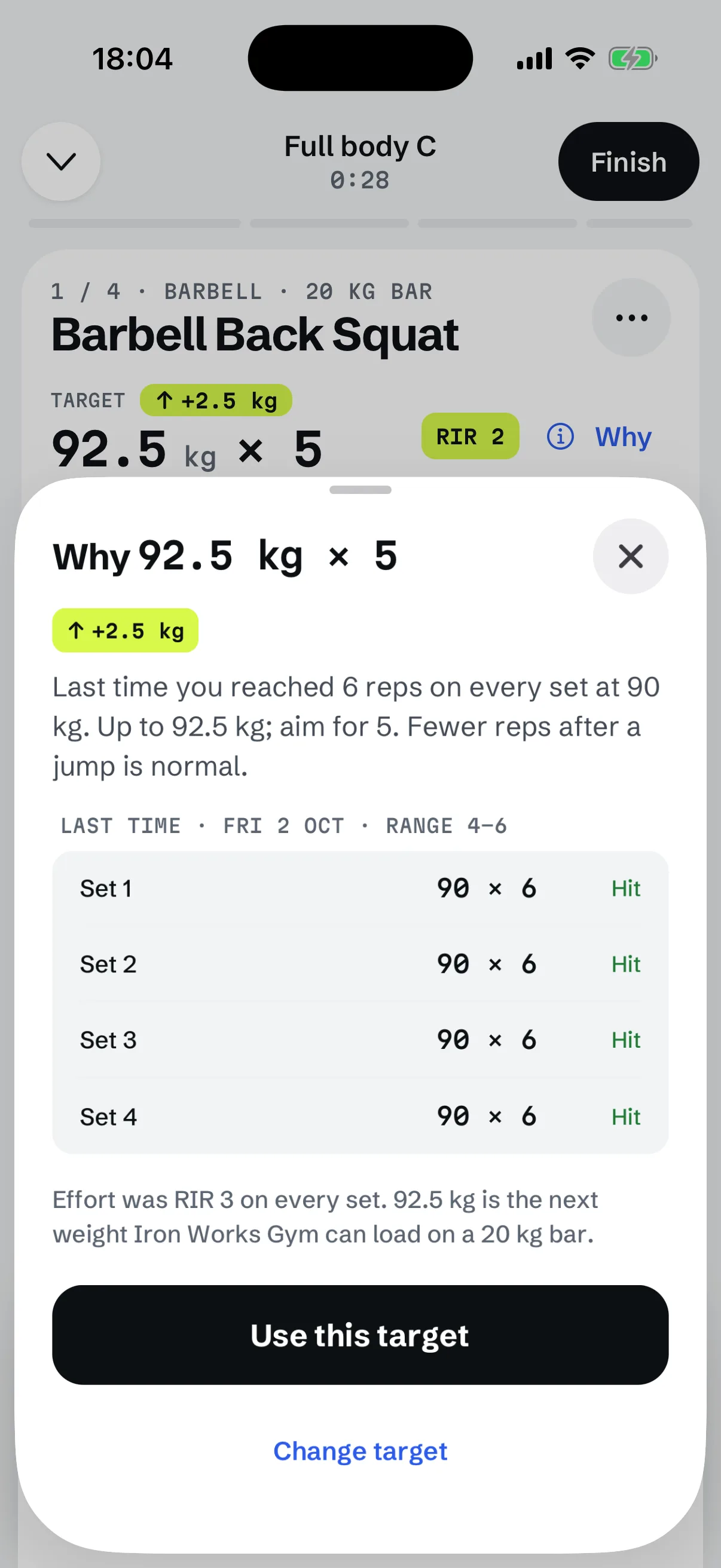
The same rule for a 5x5-style lift uses a range of 4 to 6: once every set reaches 6, the weight goes up and the reps come back down. RIGOR shows the reason on the Why sheet. A fixed weight with reps that differ set to set is the case straight sets vs pyramid sets covers.
What do real RIGOR plans use?
They use ranges, not fixed schemes. In the sample plans on this site, a full body workout for muscle gives Barbell Back Squat 4 sets of 6 to 10 and Barbell Bench Press 3 sets of 8 to 12. A 4 day upper/lower plan for a beginner on a goal of both gives Dumbbell Bench Press 4 sets of 5 to 8. A dumbbell plan opens with Goblet Squat, 3 sets of 6 to 10. The 3 day full body program shows the first of these across a week, and the 4 day upper lower program the second.
The day's first compound gets 3 or 4 sets in these plans. None of them is 5 sets of 5. A range of 4 to 6 over 4 sets is close to it.
How long should you rest between sets?
Longer for heavy sets. RIGOR rests any exercise with a top of 6 reps or fewer for 180 seconds. Otherwise it is 180 seconds for a lower-body compound, 120 for an upper-body compound and 90 for an isolation lift. So 5x5 at a 4 to 6 range rests 3 minutes between sets, and a 3x10 upper-body press rests 2. Rest between sets covers the research.
When does this not apply?
- A first session of a lift. There is no last time yet, so you pick the weight with the reps in reserve in mind, and that first session becomes the baseline.
- Bodyweight and timed lifts. There is no weight to hold, so reps or seconds go up first.
- Deload and easier days. They are lighter on purpose and do not set the next target.
- Switching a range. Change it and last time no longer compares; RIGOR recalculates the weight when it happens.
Which should you pick?
Pick the one you will do hard and keep logging. If your goal is muscle, 3x10 and 5x5 tie on the evidence, so choose by what fits your schedule and equipment. If your goal is strength, lean toward the heavier scheme. Whichever you choose, add weight by a rule and not by feel; the progressive overload page covers the idea behind it.
RIGOR sets the weight and the reps
Questions
Is 3X10 enough to build muscle?
Yes. Muscle growth was similar across light and heavy loads in two meta-analyses, so three sets of ten at a hard effort can build muscle. More weekly sets are linked to more growth, so three sets is a floor, not a ceiling.
Is 5 sets of 5 better than 3 sets of 10?
Not for muscle: the load reviews found it similar. For strength, heavier loads came out ahead. 5 sets of 5 also has two more sets, but five fewer reps, than 3 sets of 10.
Which is better for strength, 3 reps or 5 reps?
Heavier loads, in the 8-rep-or-fewer range, gave larger strength gains than lighter ones. The sources used here do not compare 3 reps with 5 directly, so treat the gap between them as unknown.
Is 5x5 enough to build muscle?
Yes, if the sets are hard. The load reviews found muscle growth independent of load, and 5x5 is five working sets of a heavy load. It moves fewer reps per session than 3x10.
Can you switch between 3x10 and 5x5?
Yes. Keep each rep range fixed while you run it, because a new range makes last time hard to compare.