Add the next weight your gym can make, not a fixed amount. On a barbell the default step is 2.5 kg or 5 lb, about 2 to 10% of the usual loads; dumbbells and stacks jump more. When the next weight would drop you below the bottom of your rep range, add reps first.
How much should you increase weight for progressive overload?
By the next weight your gym can make. That is RIGOR's rule: an increase takes the next achievable load above the weight you used. The amount is not chosen first and rounded later. It comes from the plates, dumbbells and stack settings the gym has, so it changes with the equipment. How other apps choose the next weight is set out in workout apps with automatic progression.
Progressive overload answers when to add. This page answers how much, and the answer is a percentage that varies a lot between a barbell and a dumbbell rack. The American College of Sports Medicine's position stand points at a range: its abstract recommends a 2 to 10% increase in load once a lifter can do one or two repetitions over the target. The tables below show which equipment fits inside it and which does not. A linear progression program skips the question and fixes one step in advance.
How big is the next jump on each kind of equipment?
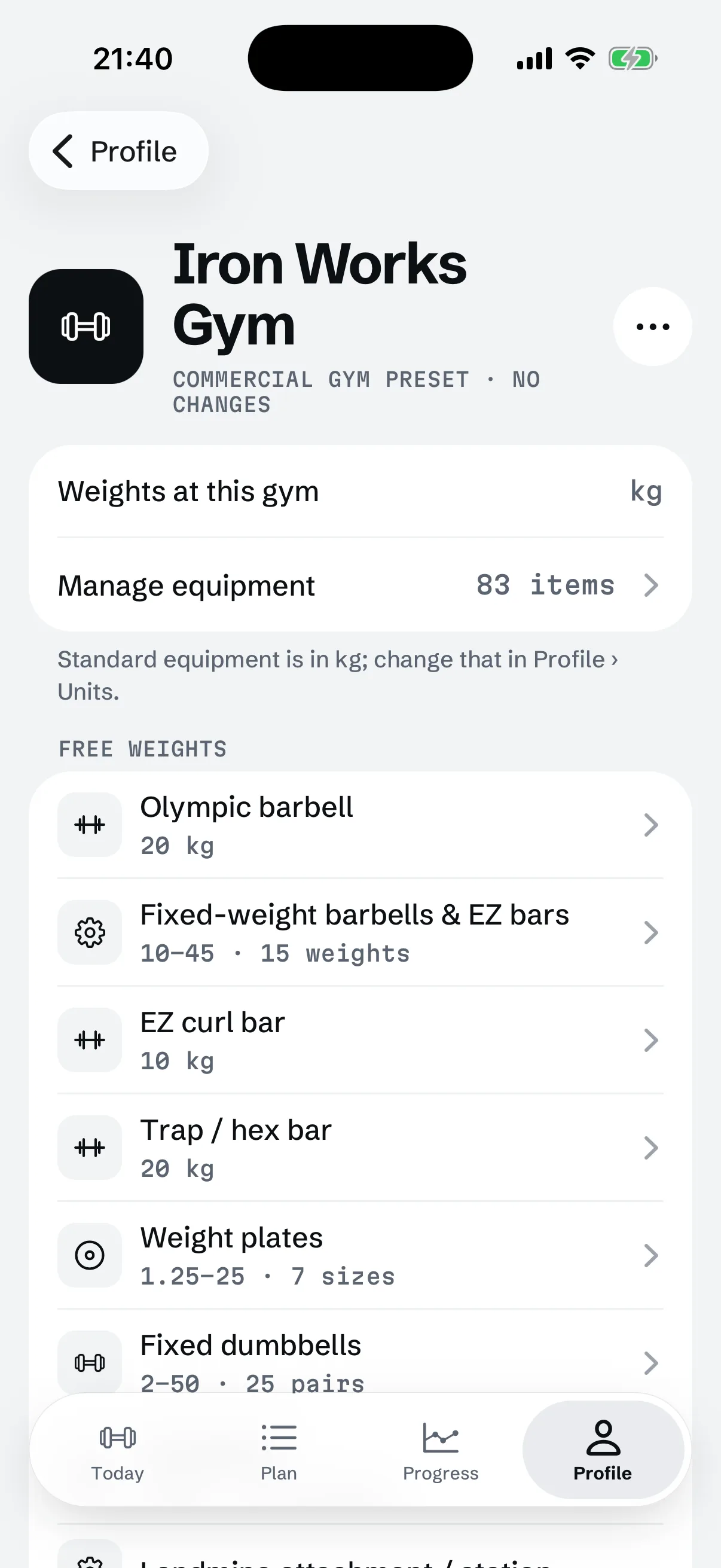
The jump in percent is the step divided by the load you are on, times 100. RIGOR's default gym, from its equipment defaults and training rules, has these steps:
- Barbell: plates of 25, 20, 15, 10, 5, 2.5 and 1.25 kg, or 45, 35, 25, 10, 5 and 2.5 lb. Plates go on in pairs, so the smallest step is two of the smallest plate: 2 × 1.25 = 2.5 kg, and 2 × 2.5 = 5 lb. A trap bar loads from the same plates, so its step is the same; only the bar's own weight differs.
- Fixed dumbbells: every 2 kg from 2 to 50 kg, and every 5 lb from 5 to 120 lb.
- Cable stack: every 5 kg or 10 lb, plus an add-on of half a step (2.5 kg or 5 lb) that sits between two plates.
| Equipment | Step | Light | Middle | Heavy |
|---|---|---|---|---|
| Barbell, kg | 2.5 kg | 20 kg: 12.5% | 60 kg: 4.17% | 100 kg: 2.5% |
| Barbell, lb | 5 lb | 45 lb: 11.11% | 135 lb: 3.7% | 225 lb: 2.22% |
| Dumbbell, kg | 2 kg | 10 kg: 20% | 20 kg: 10% | 40 kg: 5% |
| Dumbbell, lb | 5 lb | 20 lb: 25% | 50 lb: 10% | 80 lb: 6.25% |
| Stack, kg | 2.5 kg | 20 kg: 12.5% | 40 kg: 6.25% | 60 kg: 4.17% |
| Stack, lb | 5 lb | 40 lb: 12.5% | 100 lb: 5% | 150 lb: 3.33% |
Two checks: 2.5 ÷ 60 = 0.041666…, so 4.17%, and 5 ÷ 135 = 1 ÷ 27 = 0.037037…, so 3.7%. The lighter the load, the bigger the jump. A heavy barbell sits inside the 2 to 10% range. A light dumbbell does not, and a 10 kg dumbbell going to 12 kg is a 20% jump.
Without a stack add-on the step is the full 5 kg or 10 lb, which doubles those two rows: 5 ÷ 20 = 25% and 10 ÷ 40 = 25%. If your gym differs, the weights your gym can make are set in gym setup. Cable machine weights covers stacks in more detail.
RIGOR is a strength training app for iPhone that builds your plan and sets every weight by rules you can read.
YOUR IPHONE

When is the jump too big for the rep range?
When the heavier weight would predict fewer reps than the bottom of your range. RIGOR tests this instead of capping the jump at a percentage. If the next achievable load predicts at least the bottom of the range, it adds weight (rule 6). If it predicts fewer, it keeps the weight and adds one rep per set, up to 5 over the top of the range, or 2 over when the range tops out at 8 reps or fewer (rule 7). At that ceiling on every set, it adds the weight anyway.
The prediction uses the Epley formula, the one behind the 1RM calculator. A set's capacity is its reps plus the reps in reserve you logged. The estimated max is load × (1 + capacity ÷ 30), and the reps predicted at a new load are the whole number below 30 × (estimate − new load) ÷ new load, minus the reps in reserve planned for next time. The effort scale is reps in reserve.
Here are five lifts, each with every set at the top of the range at 2 reps in reserve, as planned. Take a range of 8 to 12 first: capacity is 12 + 2 = 14.
| Last time | Next weight | Jump | Predicted reps | What the app does |
|---|---|---|---|---|
| Bar 60 kg × 12 | 62.5 kg | 4.17% | 88 est.; 12.24 → 12 − 2 = 10 | 62.5 kg × 10 |
| Dumbbell 20 kg × 12 | 22 kg | 10% | 29.33 est.; 10.0 → 10 − 2 = 8 | 22 kg × 8 |
| Dumbbell 10 kg × 12 | 12 kg | 20% | 14.67 est.; 6.67 → 6 − 2 = 4 | 10 kg × 13 |
| Bar 100 kg × 6 (4–6) | 102.5 kg | 2.5% | 126.67 est.; 7.07 → 7 − 2 = 5 | 102.5 kg × 5 |
| Bar 40 kg × 6 (4–6) | 42.5 kg | 6.25% | 50.67 est.; 5.76 → 5 − 2 = 3 | 40 kg × 7 |
The fifth row is the same case on a barbell: the jump is only 6.25%, but a range of 4 to 6 has no room for it, so the app asks for 7 reps (the ceiling there is 6 + 2 = 8).
That gives a rule of thumb for a set at the top of the range. With 2 in reserve, the largest jump that still lands on the bottom of an 8 to 12 range is (30 + 14) ÷ (30 + 10) = 1.10, which is 10%. For 4 to 6 it is (30 + 8) ÷ (30 + 6) = 1.0556, which is 5.56%. A narrow, heavy range tolerates smaller jumps. The same formula gives 20 kg × 3 reps at 0 in reserve as 20 × (1 + 3 ÷ 30) = 22 kg, which is what the 1RM calculator returns for it.
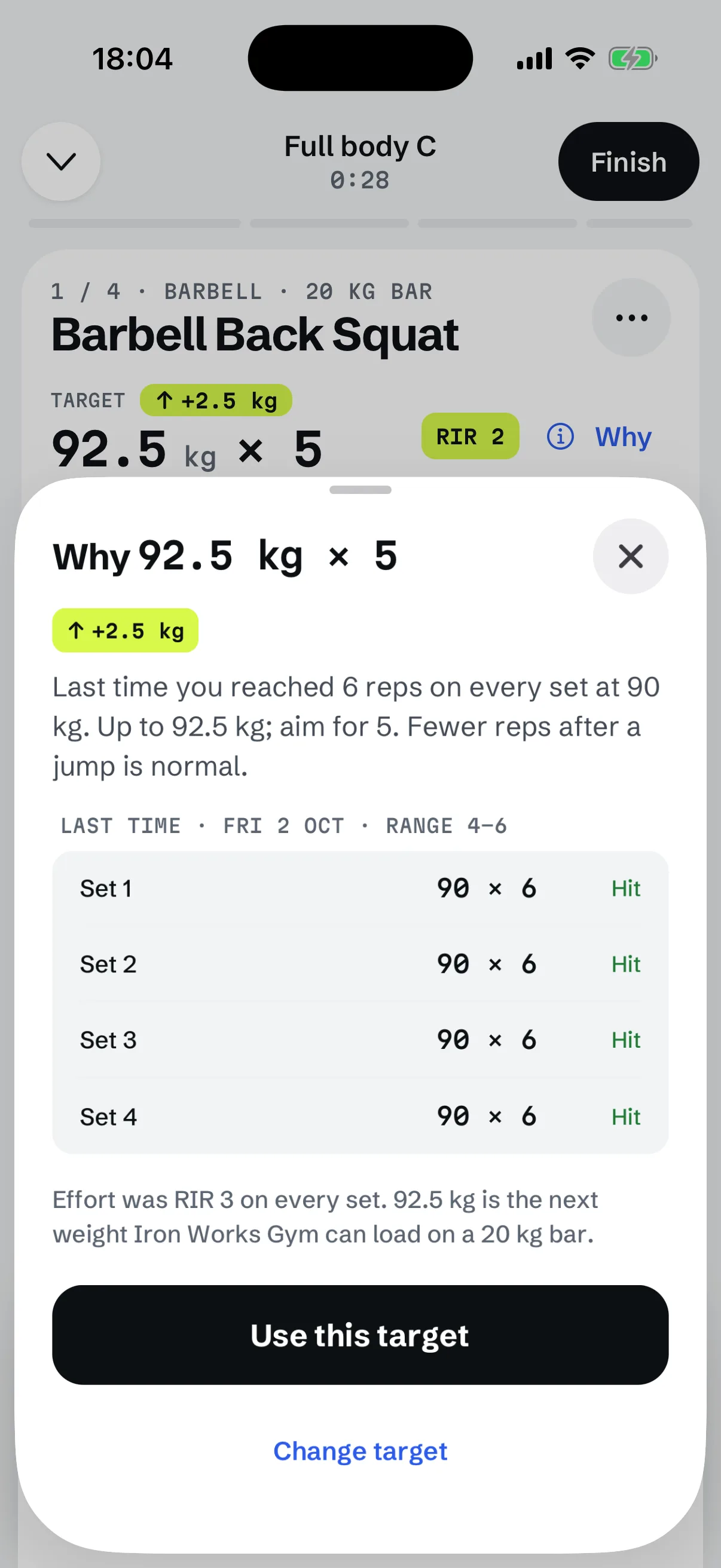
Open the Why sheet on any target and it shows the last result, the weight chosen and the reps expected. After a jump the reps are lower on purpose: 90 kg × 6 becomes 92.5 kg × 5 here, a 2.78% jump (2.5 ÷ 90). The app's line for it is "Fewer reps after a jump is normal." See double progression for the full session-by-session example.
What does the research say about how much to add?
Not much about the exact amount. The one number comes from the ACSM position stand above: a 2 to 10% increase. On whether to add load or reps, Plotkin and colleagues randomised 43 resistance-trained adults to eight weeks of training in which one group added load at fixed reps and the other added reps at fixed load. Rectus femoris growth slightly favoured the repetition group, dynamic strength slightly favoured the load group, and other outcomes showed no notable difference. The authors concluded that both are viable strategies for muscular adaptations over an eight-week cycle. So adding reps is not a lesser option when the jump is too big.
The prediction is an estimate. A 2022 review by Halperin and colleagues pooled 12 studies of 414 participants and found that lifters underpredicted the reps they had left by 0.95 on average (95% confidence interval 0.17 to 1.73), with very different results across studies. Hence the app holds the weight when a set was harder than planned, instead of adding on a guess.
How much weight should you add each week?
There is no weekly amount. The step happens when every set of an exercise reaches the top of its rep range at about the planned effort, which can take one session or many. The amount is the next step in the table above. The rep ranges page shows the ranges RIGOR plans use, and the what weight to lift page covers the first session, when there is no last time.
A fixed percentage would not work either: a 2% jump on 60 kg is 1.2 kg, and the default plates make 2.5 kg.
How do you make the jump smaller?
Add something smaller than the default step. On a barbell that is a pair of fractional plates: what they do to a barbell jump is worked through in its own guide, and the plate calculator turns a total into plates per side. On a stack it is the add-on. On fixed dumbbells there is no fix, which is the case for adding reps first.
RELATED TOOLPlate calculatorWhat to load on each side of the bar.RIGOR picks the step for you
Questions
How much weight should I add each week?
There is no weekly amount. RIGOR adds weight in the session after every set reached the top of the rep range, and the amount is the next step your equipment can make. If that takes three weeks or one, the step is the same.
How much should you increase weight on the bench press?
The same rule as any barbell lift: the next weight the plates can make. With the default plates that is 2.5 kg or 5 lb, which is 4.17% of a 60 kg bar and 3.7% of a 135 lb bar.
How much should I increase weight when lifting?
By the smallest step the equipment allows, unless that step would leave you below the bottom of your rep range. Then add reps at the same weight and go up later.
Is 2.5 kg too small to add?
On a heavy barbell no: it is 2.5% of 100 kg. On the empty 20 kg bar it is 12.5%, which is why light loads feel stuck sooner.
What if my gym's smallest weight is a big jump?
Add reps at the same weight first, up to 5 over the top of the range (2 over when the range tops out at 8 or fewer). Small plates or a stack add-on can also make the jump smaller.