Cable machine weight increments follow the plates you select with the pin: the numbers step by the plate size, 10 lb on one maker's functional trainer. A pulley ratio such as 2:1 sits between the stack and your hands. RIGOR stores a stack as a range, a step and an add-on, and only picks weights it can make.
What are cable machine weight increments?
An increment is the jump between one stack setting and the next. On a cable machine it is the weight of one plate in the stack, so a stack with 10 lb plates goes 10, 20, 30 and so on. The pin you move picks the setting.
Titan Fitness prints it that way for its functional trainer: dual 200 lb enclosed stacks in 10 lb increments. Not every page gives a step. The Body-Solid and Life Fitness pages below print a stack size and no step, so the step for those two is on the machine or in the manual.
What do the cable machine weight stack numbers mean?
Three different numbers can sit on or beside a stack, and they are easy to mix up.
- The plate number. What the label beside the pin says. It is the weight selected on the stack.
- The stack total. The heaviest setting, such as Titan's 200 lb per stack. A two-stack trainer lists both: Titan's page lists a total dual weight stack of 400 lb.
- The starting resistance. Titan lists 20 lb as a figure of its own, and its page does not say how it relates to the plate numbers.
Then there is the pulley ratio, which sits between the stack and the cable in your hand. It is the subject of a section further down.
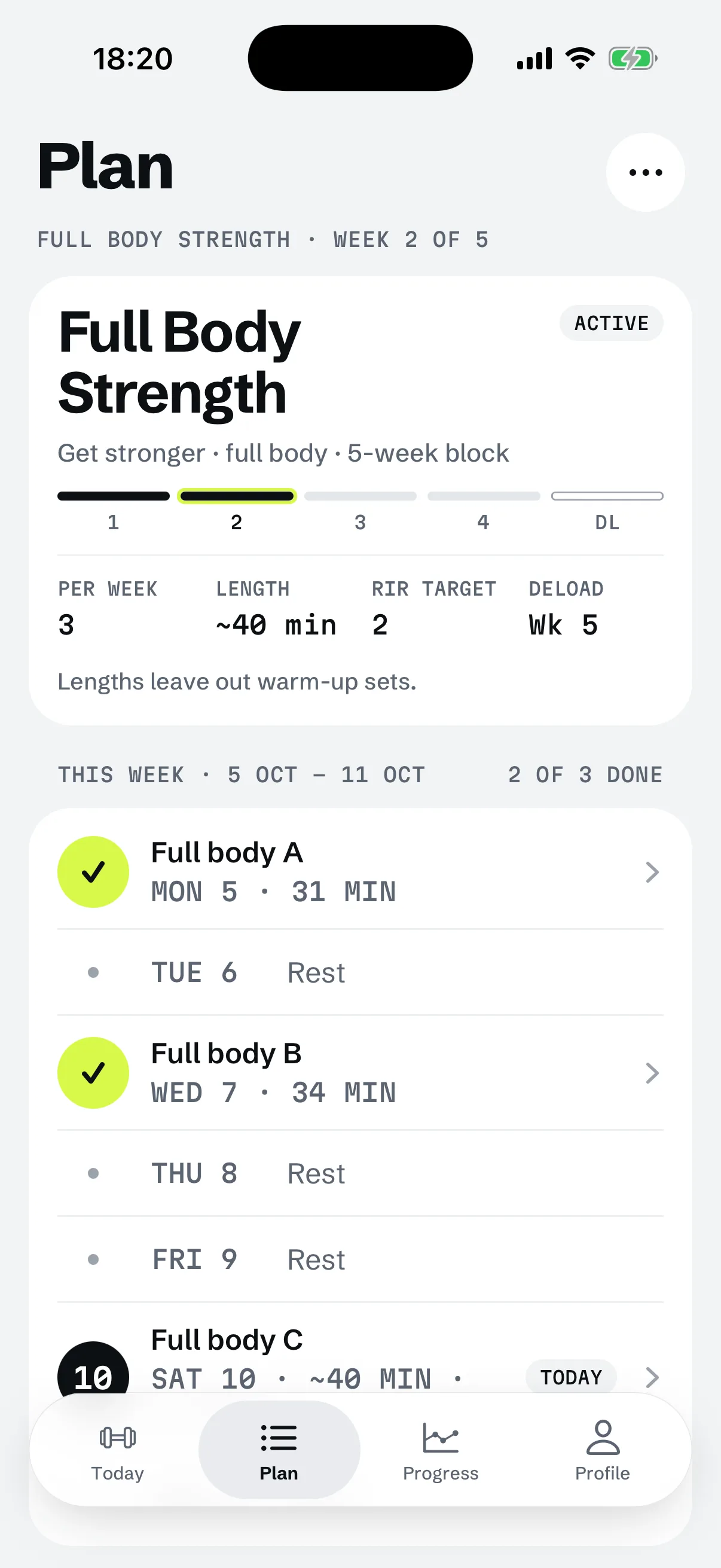
RIGOR is a strength training app for iPhone that builds your plan and sets every weight by rules you can read.
YOUR IPHONE

Cable machine weights explained: what do makers print?
Three makers' own pages, copied as they print their figures. This is not a survey: each row is one model, and another model from the same maker can differ.
| Model | Stack | Step and start | Pulley ratio |
|---|---|---|---|
| Titan Fitness Functional Trainer | 200 lb per stack (90.7 kg), 400 lb total (181.4 kg) | 10 lb steps (4.5 kg), starts at 20 lb (9.1 kg) | 2:1 |
| Body-Solid GDCC250B Deluxe Cable Crossover | 160 lb per stack (72.6 kg), 210 lb optional (95.3 kg) | - | 2:1 |
| Life Fitness Signature Series Dual Adjustable Pulley | 195 kg and 390 lb, both printed | - | 4:1 resistance level |
Check the sums: 200 × 0.45359237 = 90.72, 10 × 0.45359237 = 4.54, 20 × 0.45359237 = 9.07, 160 × 0.45359237 = 72.57, 210 × 0.45359237 = 95.25 and 400 × 0.45359237 = 181.44.
Life Fitness prints the stack in both units, and the two are not a conversion of each other: 390 lb is 176.9 kg, not 195 kg. The page does not say why. Read the label on your machine for its unit, and do not convert a stack figure from one unit to the other.
Do cable machines have add-on weights?
Some can. An add-on is a small weight placed on top of the stack to fall between two plates. Torque Fitness sells weight stack adder pins at 2.5 lb each, listed as a pair, and says they work on its own functional trainer or on any other cable stack. A pair is 5 lb in all (2.27 kg).
The add-on is optional equipment. Titan, Body-Solid and Life Fitness do not list one on the pages above, so do not assume your gym has any. Look for small plates or magnets near the stack, or ask. This is why a stack's step and its add-on are two numbers, not one.
Are double cable machines half the weight?
No, not because there are two stacks. A dual adjustable pulley or a cable crossover has one stack on each side, so each arm has its own stack. Titan's page says dual 200 lb stacks, 400 lb in all, and Body-Solid calls its machine a dual independent weight stack system.
What the pages add is a pulley ratio. Titan and Body-Solid both print 2:1, and Titan describes it as split weight cabling for increased cable travel. Life Fitness prints a 4:1 resistance level, which it says provides lower starting resistances. None of the three pages prints what the handle weighs at a given setting, so this page gives no handle figure.
So the same plate number on two machines with different ratios is not the same pull, and your own log should say which machine it came from. Treat the number as a setting on that machine.
Cable machine weight increments in kg or lb?
Whichever unit the plates are marked in. A gym with kilogram plates steps in kilograms, and one with pound plates steps in pounds. RIGOR keeps a separate default for each, and neither is a conversion of the other: 10 lb is 4.5 kg, not the 5 kg step of its kilogram default.
| Gym unit | Step | Add-on |
|---|---|---|
| kg | 5 kg | 2.5 kg |
| lb | 10 lb | 5 lb |
If your machine steps differently, set its own range in gym setup.
How does RIGOR store a cable stack?
As a range, a step and an add-on, per machine. The catalogue's cable stations, copied from its equipment file:
| Station | Kilogram gym | Pound gym |
|---|---|---|
| Dual adjustable pulley / functional trainer | 5 to 100 kg | 10 to 200 lb |
| Cable crossover station | 5 to 100 kg | 10 to 200 lb |
| Single adjustable cable column | 5 to 100 kg | 10 to 200 lb |
| Lat pulldown station | 5 to 150 kg | 10 to 300 lb |
| Seated cable row station | 5 to 150 kg | 10 to 300 lb |
RIGOR's training rules read a stack this way: each range gives its first value, then first plus step, and so on up to the top, and the top itself, and add-ons combine freely, each at most once. The pin-loaded machines in the catalogue follow the same pattern: a leg extension machine runs 5 to 100 kg or 10 to 200 lb, and a pin-loaded leg press 5 to 200 kg or 10 to 400 lb. The assisted pull-up and dip machine has the stack and no add-on.
A commercial-gym preset seeds these ranges for you, and the editors are optional. A load your machine can make that the range does not is still accepted when you log it.
How does RIGOR pick the next weight on a stack?
It takes the next weight the stack can make above your last one. The rule, from the training rules: an increase takes the next achievable load above the reference load, and reductions take the heaviest achievable load at or below the computed value.
This works like the fractional plates on a barbell: a small piece makes the smaller jump possible. When the jump is too large for your rep range, the app keeps the weight and aims for one more rep per set, which is double progression at work. For the first weight, see what weight to lift, and for a target from a set, the 1RM calculator. How other apps set the next weight is in workout apps with automatic progression.
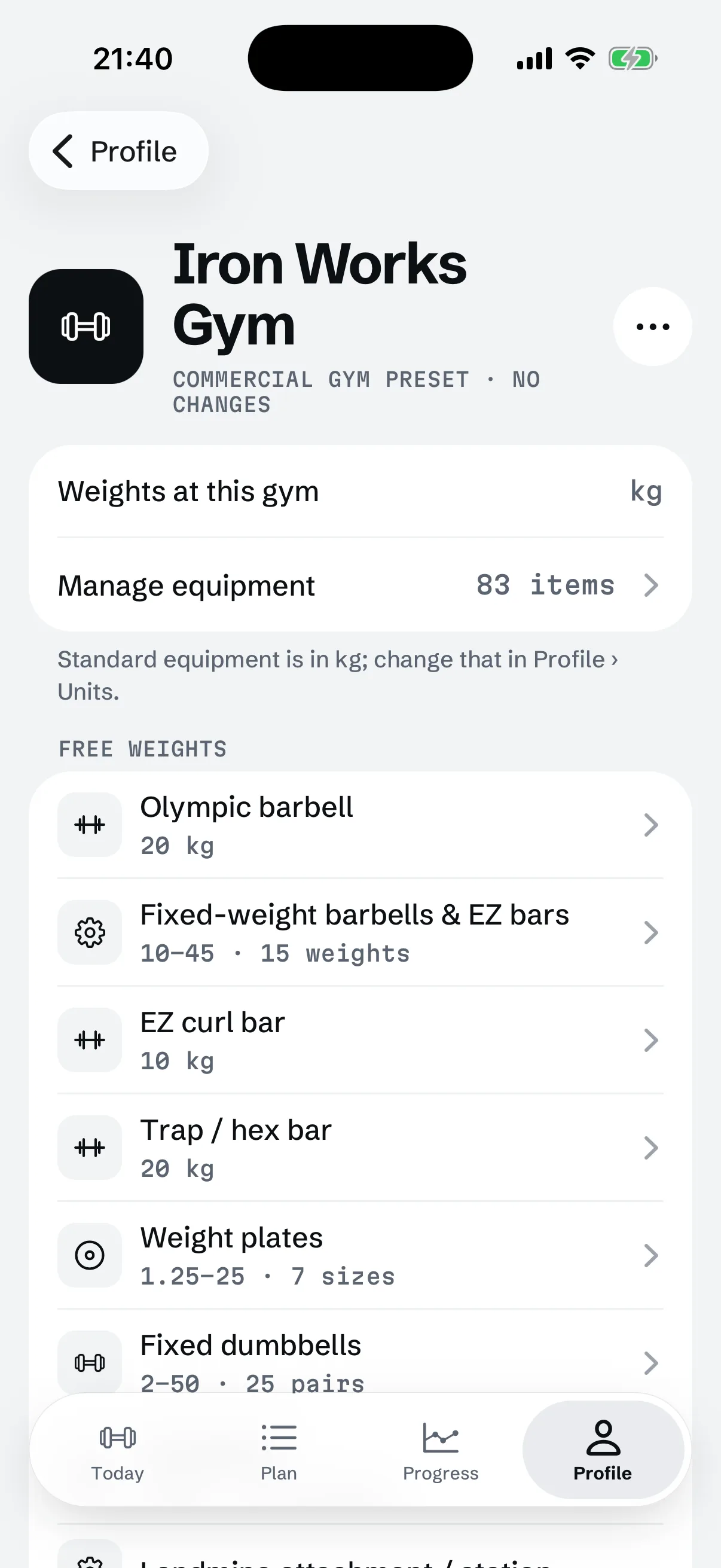
Set your own stack once
Is this the same as a plate-loaded machine?
No. A stack machine has a pin and fixed plates, so you pick a setting. A plate-loaded machine takes plates you load yourself: see the leg press sled and the Smith machine, where the machine's own weight is a separate question. For a barbell, the plate calculator turns a total into plates per side.
When does this not apply?
Questions
How much do cable machine add-ons weigh?
It depends on the add-on. Torque Fitness sells weight stack adder pins at 2.5 lb each, sold as a pair. RIGOR's default add-on is 2.5 kg in a kilogram gym and 5 lb in a pound gym.
Is there a 5 lb add-on weight for cable machines?
RIGOR's pound default has one: a 5 lb add-on on a 10 lb step. A maker's add-on varies. Torque Fitness lists a pair of 2.5 lb adder pins.
How much weight do leg extension machines go up to?
It depends on the machine. RIGOR's default for a leg extension machine runs 5 to 100 kg in 5 kg steps, or 10 to 200 lb in 10 lb steps, and you can change the range in gym setup.
Does a dual cable machine split the weight?
The second stack does not halve anything: each side has its own stack. The pages also print a pulley ratio: 2:1 for Titan and Body-Solid, and a 4:1 resistance level for Life Fitness, which it says gives lower starting resistances.
What do I log on a cable machine?
The number you set on the stack. RIGOR names the load convention of each exercise, and for a machine it is the machine setting.