Dumbbell jumps too big are met with reps first: RIGOR keeps the weight and adds one rep a set, up to 5 over the top of the range, or 2 over when the range tops out at 8 or fewer. The jump is too big when the next dumbbell predicts fewer reps than the bottom of the range.
Why are dumbbell jumps too big?
Because a dumbbell rack goes up in whole steps, and a step is a larger share of a light weight than of a heavy one. RIGOR's default adjustable dumbbells (selector or dial) go up by 2.5 kg, from 2.5 to 32.5 kg, or by 5 lb, from 5 to 70 lb. Its default rack of fixed dumbbells goes from 2 to 50 kg in steps of 2 kg and from 5 to 120 lb in steps of 5 lb. These lists are the app's catalogue defaults, and gym setup changes them.
The jump in percent is the step divided by the weight you are on. Going from 10 kg to 12.5 kg on a 2.5 kg step is 2.5 ÷ 10 = 25%. Going from 25 kg to 27.5 kg is 2.5 ÷ 25 = 10%. The American College of Sports Medicine's position stand recommends a 2 to 10% increase in load once a lifter can do one to two repetitions over the target, so the light end of a dumbbell rack sits well outside it. More on that in how much weight to add.
How big is the jump at each dumbbell weight?
It is 100% at the lightest weight and falls as the dumbbell gets heavier. The table takes the 2.5 kg step and the 5 lb step, one unit per block.
| Unit | Weight now | Next weight | Jump |
|---|---|---|---|
| kg | 2.5 kg | 5 kg | 100% |
| kg | 5 kg | 7.5 kg | 50% |
| kg | 7.5 kg | 10 kg | 33.33% |
| kg | 10 kg | 12.5 kg | 25% |
| kg | 12.5 kg | 15 kg | 20% |
| kg | 15 kg | 17.5 kg | 16.67% |
| kg | 20 kg | 22.5 kg | 12.5% |
| kg | 25 kg | 27.5 kg | 10% |
| kg | 30 kg | 32.5 kg | 8.33% |
| lb | 5 lb | 10 lb | 100% |
| lb | 10 lb | 15 lb | 50% |
| lb | 15 lb | 20 lb | 33.33% |
| lb | 20 lb | 25 lb | 25% |
| lb | 25 lb | 30 lb | 20% |
| lb | 30 lb | 35 lb | 16.67% |
| lb | 40 lb | 45 lb | 12.5% |
| lb | 50 lb | 55 lb | 10% |
| lb | 60 lb | 65 lb | 8.33% |
A large jump in percent is not always too big for your range. The next section says when it is.
RIGOR is a strength training app for iPhone that builds your plan and sets every weight by rules you can read.
YOUR IPHONE

When is the next dumbbell too heavy for the rep range?
When it would predict fewer reps than the bottom of your range. RIGOR tests this in training-rules rule 7: "As 6, but the next achievable load predicts < rep_min (the jump is too big for the range)". Rule 6 is the case where every set reached the top of the range, no recorded reps in reserve were below the target minus 1, and the next achievable load predicts at least rep_min; then the app adds weight.
The prediction is the Epley formula. A set's capacity is its reps plus its reps in reserve. The estimated max is load × (1 + capacity / 30), and the predicted reps at a new load are floor(30 × (estimate − new load) / new load) minus the reps in reserve planned. Take a range of 8 to 12 reps at 2 reps in reserve, and every set at the top, 12 reps.
Now the same lifter on 25 kg × 12, 12, 12. Estimate = 25 × (1 + 14 ÷ 30) = 36.67. At 27.5 kg: 30 × (36.67 − 27.5) ÷ 27.5 = 10, minus 2 is 8. That is not under 8, so the app takes the 2.5 kg jump. At 20 kg going to 22.5 kg the same sum gives 9, minus 2 is 7, and the jump is too big. With a 2.5 kg step and this range, the break sits at 25 kg. For the 5 lb step it sits at 50 lb: 50 × (1 + 14 ÷ 30) = 73.33, and 30 × (73.33 − 55) ÷ 55 = 10, minus 2 is 8.
A narrow range has less room. On 4 to 6 reps at 2 in reserve with 30 kg × 6, 6, 6: capacity is 8, the estimate is 30 × (1 + 8 ÷ 30) = 38, and 32.5 kg predicts 30 × (38 − 32.5) ÷ 32.5 = 5.08, rounded down to 5, minus 2 is 3. Under 4, so the 8.33% jump is too big. For a top-of-range set at 2 in reserve, the largest jump that still lands on the bottom is (30 + 8) ÷ (30 + 6) − 1 = 5.56% on 4 to 6, against 10% on 8 to 12. The prediction uses the reps in reserve you log, and lifters tend to underpredict them: a 2022 review of 12 studies and 414 participants found an average of 0.95 reps too few, with a 95% confidence interval of 0.17 to 1.73 and large differences between studies (Halperin 2022). See reps in reserve.
What does RIGOR do when the jump is too big?
It keeps the weight and adds reps. The table's rule 7 says "previous reps + 1 per set, up to rep_max + 5; at rep_max + 5 on every set, rule 6 applies regardless". A later amendment changes the climb: "Rule 7 climbs to rep_max + 2 when rep_max ≤ 8 (else + 5) before the jump applies regardless." So there are two limits:
- A range topping out at 8 or fewer reps climbs to
rep_max+ 2. For 4 to 6 that is 8 reps. - A range topping out above 8 climbs to
rep_max+ 5. For 8 to 12 that is 17 reps.
At the limit on every set the weight goes up anyway. For the 10 kg lifter above, the app's text for the hold reads "The next weight available is 12.5 kg (+25%). Aim for 13 reps at 10 kg first."
A jump forced that way is expected to feel hard. The rules give misses within three sessions of a forced jump a grace: "repeat · after_jump (same load, rep_min on missed sets, + 1 on the rest)", with rules 9 and 10 applying from the fourth session. The app's text says the last step up was big, that sets short of the bottom of the range are expected, and to stay at the same weight to build up. Reps first is also double progression.
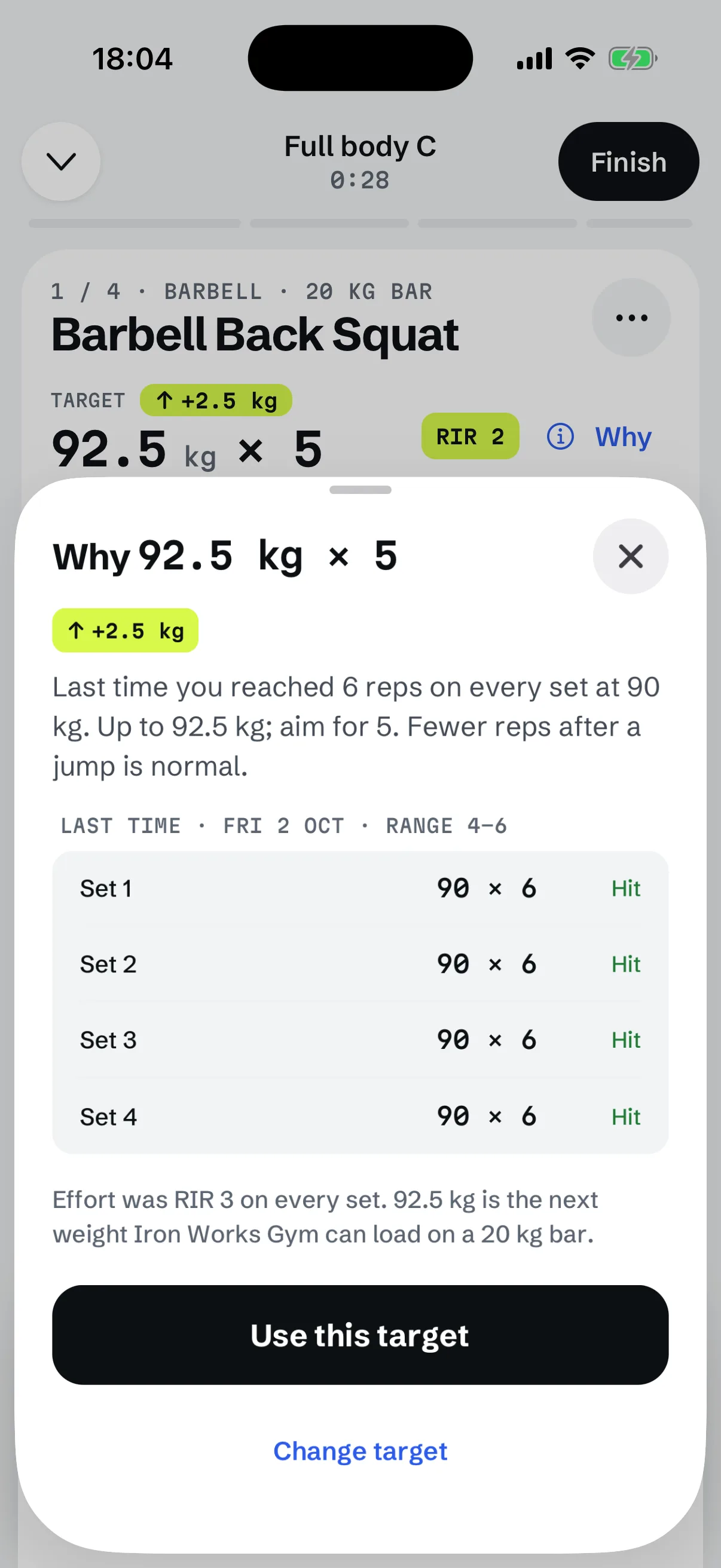
The Why sheet on a target with a last session shows the last result, the weight chosen and the reps expected. This one is a barbell lift, not a dumbbell, and its jump is small: 2.5 ÷ 90 = 2.78%, so the weight goes up and the target is 5 reps. When the next weight is too big for the range, the sheet shows the hold and the reps instead.
How can you bridge a big dumbbell jump?
Start with the reps. That is what the rule does and needs nothing from the gym.
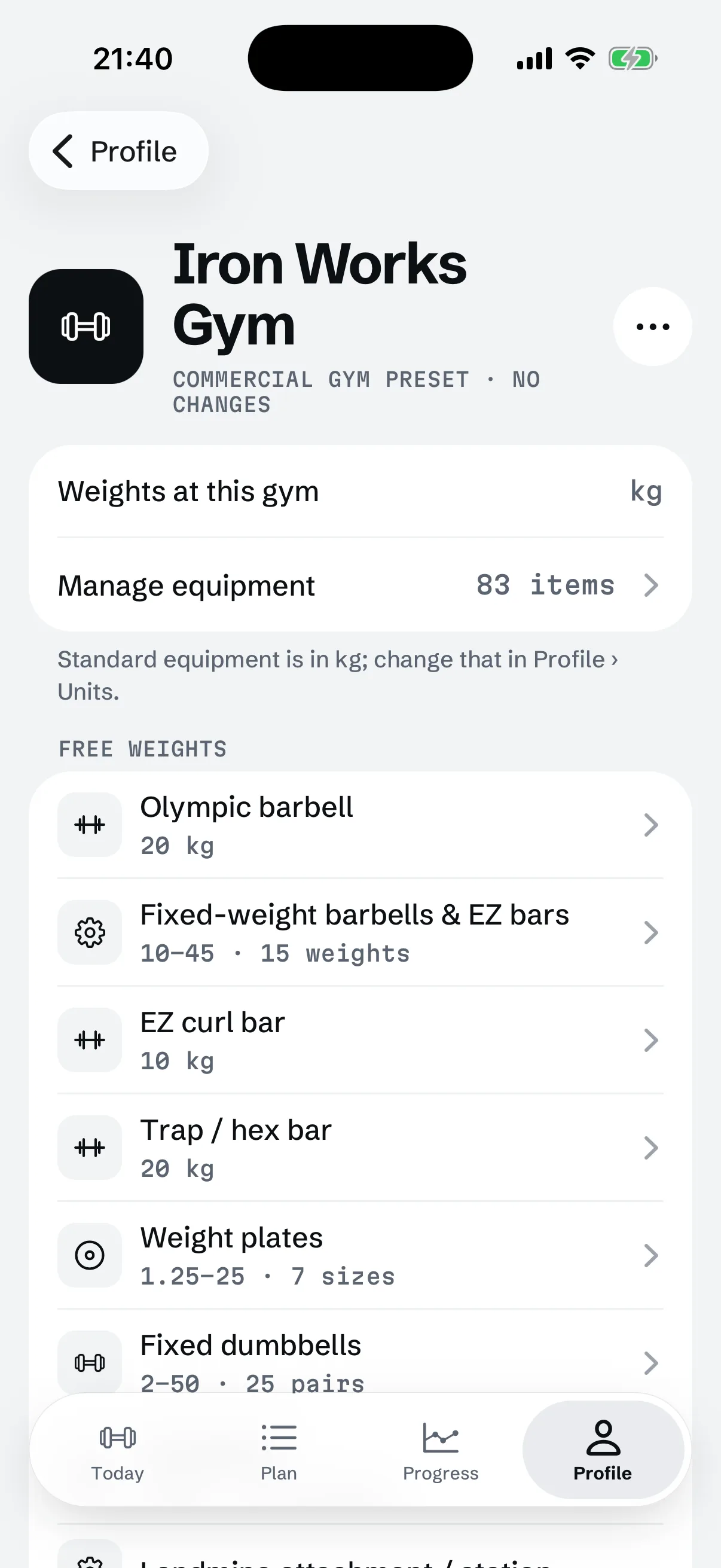
Then change the list, if the gym allows it. RIGOR builds targets from the dumbbell weights saved in gym setup, and a dumbbell item has an "Add a weight" action. Add only a weight you can pick up. An entry that is not on the rack gives a target you cannot lift. Adjustable dumbbells whose steps are smaller than the default 2.5 kg or 5 lb make each jump a smaller share of the load; the sums are the table above with a smaller step.
Plates for dumbbells are a separate question. Fractional plates are small plates loaded in pairs on a bar, and the guide covers a barbell and a plate-loaded machine. In RIGOR dumbbells step through their own list of weights, so a plate size does nothing for them. Loadable (spin-lock) dumbbell handles sit among RIGOR's fixed weights with the same default list as the rack. A handle with small plates on it would be an entry in that list, not a plate size. This page has no source for how small a plate such a handle takes.
If you are choosing between dumbbells and a bar, dumbbell to barbell covers what three studies measured. A program built on a dumbbell rack, the 3 day dumbbell workout, runs this rule on every dumbbell lift.
What does the research say about adding reps instead of weight?
It supports reps as a way to progress, over eight weeks, on the legs. Plotkin and colleagues randomly assigned 43 participants with at least one year of consistent lower-body training to eight weeks of two kinds of training. One group aimed to add load at constant repetitions (22 people), the other to add repetitions at constant load (21). Both did four sets of four lower-body exercises (back squat, leg extension, straight-leg calf raise, seated calf raise) twice a week. Rectus femoris growth modestly favoured the repetition group. Strength gains slightly favoured the load group, by 2.0 kg (90% interval −2.4 to 7.8), which the authors called of questionable practical significance. No other notable differences were found across the outcomes. The authors concluded that both strategies appear viable for 8 weeks (Plotkin 2022).
The abstract names only lower-body exercises, and says nothing of dumbbells or of the size of a weight jump.
Tell RIGOR which weights your gym has
Questions
Do adjustable dumbbells with small increments fix it?
They make the step smaller, and so the jump in percent smaller. RIGOR's default list for selector or dial dumbbells moves by 2.5 kg or 5 lb, from 2.5 to 32.5 kg and from 5 to 70 lb. A step of 2.5 kg at 10 kg is 25%; at 25 kg it is 10%.
What about adjustable dumbbells with 2.5 lb increments?
RIGOR's default adjustable list has no 2.5 lb step. A 2.5 lb step would be 2.5 ÷ 20 = 12.5% at 20 lb and 2.5 ÷ 10 = 25% at 10 lb. Gym setup has an Add a weight action for a dumbbell list.
Can fractional plates be used on dumbbells?
RIGOR's fractional plates guide covers barbell and plate-loaded loads. In RIGOR a plate size you add does nothing for dumbbells, which step through their own list of weights.
Are microplates for dumbbells a thing in RIGOR?
No. Microplates are another name for fractional plates, which RIGOR adds as a plate size for a bar. A dumbbell is an entry in a list of weights, so each weight you can make is a number in that list.
Does RIGOR cap a jump at a percentage?
No. It tests whether the next dumbbell would predict fewer reps than the bottom of your range, with the Epley formula. For an 8 to 12 range at 2 reps in reserve the break is at 10%; for 4 to 6 it is 5.56%.