Fractional plates are small plates, loaded in pairs, that make a barbell jump smaller than 2.5 kg or 5 lb. In RIGOR the default plates go down to 1.25 kg, so the smallest step on the bar is 2.5 kg. Add a pair of 0.5 kg plates in gym setup and the smallest step becomes 1 kg.
What are fractional plates?
Fractional plates are plates lighter than the smallest ones in an ordinary set. They go on the bar in pairs, one on each side, to make a jump smaller than the usual 2.5 kg or 5 lb. People also search for them as microplates. Plates this small exist: Wikipedia's Barbell article lists 0.5 kg and 0.25 kg plates, and a 1.25 lb one, in its table of plate colours.
If you came to buy some, this page names no brands, shops or prices. It covers what the plates do to your numbers, and what RIGOR, the app behind this guide, does when you add them to your gym setup.
What are fractional plates used for?
They make the smallest jump on a barbell smaller. A bar takes plates in pairs, so the smallest jump is twice the smallest plate. In RIGOR's default plate list the smallest plate is 1.25 kg, which makes the jump 2 × 1.25 = 2.5 kg, and in pounds the smallest is 2.5 lb, which makes it 2 × 2.5 = 5 lb.
Whether that jump is too big depends on the load. A 2.5 kg step is a bigger share of a light total than of a heavy one:
| Total on the bar | 2.5 kg step | 1 kg step |
|---|---|---|
| 20 kg (the empty bar) | 12.5% | 5% |
| 25 kg | 10% | 4% |
| 30 kg | 8.33% | 3.33% |
| 40 kg | 6.25% | 2.5% |
| 60 kg | 4.17% | 1.67% |
The American College of Sports Medicine's position stand recommends a 2 to 10% increase in load, when training at a specific rep-maximum load, once a lifter can do the current load for one to two repetitions over the target. By that range, 2.5 kg is 10% of a 25 kg total and more than 10% of anything lighter. In pounds, 5 lb is 5.26% of a 95 lb total. A pair of 1.25 lb plates halves it: 2.5 lb is 2.63%.
RIGOR does not cap a jump at a percentage. It estimates the reps you would get at the next weight your plates can make. If that is below the bottom of your rep range, the jump is too big for the range and it keeps the weight and adds reps first (training rules, rule 7). The rest of this page runs that rule.
RIGOR is a strength training app for iPhone that builds your plan and sets every weight by rules you can read.
YOUR IPHONE

How do fractional plates work on a barbell?
The bar counts, and the plates go on in pairs: total = bar + 2 × the plates on one side, as in does the bar count as weight. Take a 20 kg bar with 5 kg on each side: 20 + 2 × 5 = 30 kg. Put a 0.5 kg plate on each side and it is 20 + 2 × 5.5 = 31 kg. Plate math covers the sums for a whole bar, and the barbell plate calculator works out what to load for a target total.
With one pair of 0.5 kg plates in a gym that has the default plates, the totals near 40 kg run 40, 41, 42.5, 43.5, 45 and 46 kg. The steps alternate between 1 kg and 1.5 kg, because the 0.5 kg pair combines with the 1.25 kg pair. The smallest step is 1 kg.
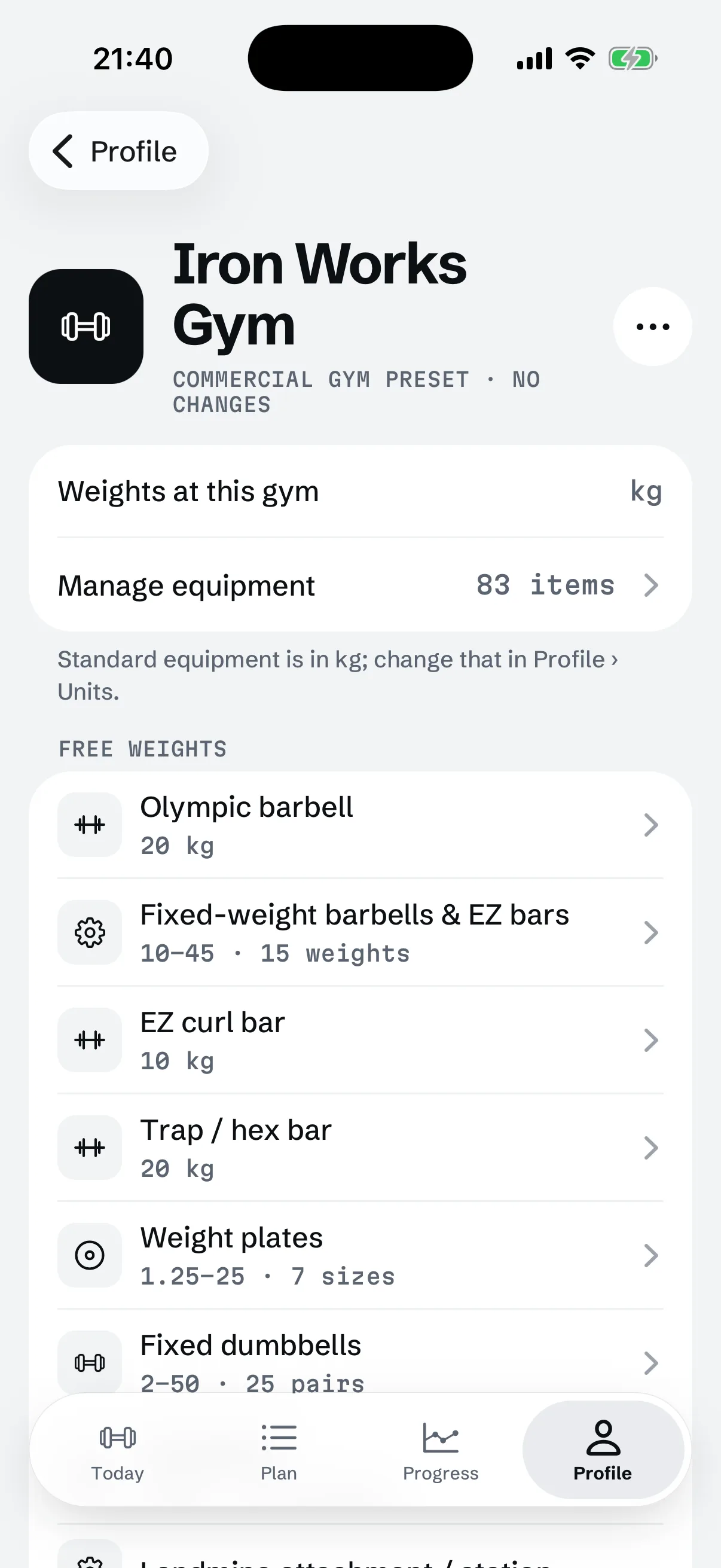
In RIGOR you add the size in gym setup, on the weight plates item. The prompt reads "Add a kg plate size" and takes up to 2 decimals, and the size must be between 0.5 and 200 kg, or between 1 and 440 lb. A new size is added as one pair, and the stepper beside it moves by two plates. Kilograms and pounds are separate lists, and RIGOR does not turn a target into plates you do not own: see the weights your gym can make.
Add only plates you can really load. RIGOR builds its suggestions from the list you save, so a size on the list that is not on the rack gives a target you cannot make. A plate-loaded machine loads from the same list, so a new size applies there too.
What changes in RIGOR when you add 0.5 kg plates?
The next target moves in smaller steps. The runs below use RIGOR's own progression code and its own list of achievable loads. The lifter logs exactly the target each session, three sets with 3 reps in reserve, on a 20 kg bar. The default plates are the catalogue's list, 25 down to 1.25 kg. The second run adds one pair of 0.5 kg.
Take a barbell lift on 4 to 6 reps at 30 kg, after a session of 6, 6, 6. The next default load is 32.5 kg, a jump of 2.5 ÷ 30 = 8.33%. The engine predicts fewer than 4 reps there, so with the default plates it holds 30 kg and asks for more reps. With the 0.5 kg pair the next load is 31 kg, a jump of 1 ÷ 30 = 3.33%, and the target is 4, 4, 4.
TOP OF THE RANGE4 REPS · BOTTOM
Session by session, the targets from the engine are:
| Session | Default plates | With 0.5 kg pair |
|---|---|---|
| 1 | 30 kg × 7, 7, 7 | 31 kg × 4, 4, 4 |
| 2 | 30 kg × 8, 8, 8 | 31 kg × 5, 5, 5 |
| 3 | 32.5 kg × 4, 4, 4 | 31 kg × 6, 6, 6 |
| 4 | 32.5 kg × 5, 5, 5 | 32.5 kg × 4, 4, 4 |
| 5 | 32.5 kg × 6, 6, 6 | 32.5 kg × 5, 5, 5 |
| 6 | 32.5 kg × 7, 7, 7 | 32.5 kg × 6, 6, 6 |
Both runs reach 32.5 kg, the default one a session earlier. What the pair changes is the path. The default run asks for 7 and 8 reps on a 4 to 6 range before it jumps 2.5 kg. The pair's run stays inside the range and takes two smaller steps, 1 kg and then 1.5 kg. At session 6 the default run is at 32.5 kg × 7: the next load, 35 kg, is again too big a jump for the range, so the engine adds reps again.
A second run shows the other case. A lift on 8 to 12 reps at 40 kg, after 12, 12, 12, is at the top of its range. The next default load is 42.5 kg, 2.5 ÷ 40 = 6.25%, and the engine takes it: 42.5 kg × 9, 9, 9. With the pair it takes 41 kg, 1 ÷ 40 = 2.5%, at 10, 10, 10. Both then add a rep a session. The default list reaches 45 kg at session 5, by way of 42.5 kg. The 0.5 kg pair reaches 45 kg at session 10, by way of 41, 42.5 and 43.5 kg. The same 5 kg takes more sessions, in steps of 1 to 1.5 kg instead of 2.5 kg.
So fractional plates do not make you progress faster. They change the size of each step, and they leave the order alone. That order is double progression: reps first, then the smallest step your plates allow.
Reps are a workable way to progress too. In an 8-week study of 43 lifters with at least a year of lower-body training, one group aimed to add load at constant reps and the other to add reps at constant load, over four sets of four lower-body exercises twice a week. Strength gains slightly favoured adding load, a muscle measure modestly favoured adding reps, and the authors concluded that both are viable strategies over 8 weeks (Plotkin 2022). The sources used here did not test small plates themselves.
Add the plate size you own in gym setup
Questions
What are microplates in a gym?
Another name for fractional plates: plates lighter than the smallest ones in an ordinary set, loaded in pairs. Wikipedia's Barbell article lists plates of 0.5 kg and 0.25 kg in its table of plate colours.
How much do 0.5 kg plates add to the bar?
1 kg for a pair, one on each side. A 20 kg bar with 5 kg on each side is 20 + 2 × 5 = 30 kg. With a 0.5 kg plate added on each side it is 20 + 2 × 5.5 = 31 kg.
What is the smallest jump on a barbell in RIGOR?
With the default plates, 2.5 kg: a 1.25 kg plate on each side. In pounds it is 5 lb, from 2.5 lb plates. Plates you add to the gym setup can make it smaller.
Can RIGOR use plates lighter than 0.5 kg?
Not as a plate size. A size must be between 0.5 and 200 kg, or between 1 and 440 lb, with up to 2 decimals.
Do small plates make you progress faster?
No. They make each step smaller. In the run below on 8 to 12 reps, a 5 kg climb from 40 kg took 5 sessions with the default plates and 10 sessions with a pair of 0.5 kg plates added.