Linear progression adds a fixed amount of weight every session at the same reps, such as 2.5 kg more on 3 sets of 5. It works while every session can be finished. When a session cannot, the rule has no smaller step. Double progression has one, since it adds reps first and then weight.
What is linear progression?
Linear progression is a rule for the next session: the sets and reps stay the same, and the weight goes up by a fixed step every time. A typical shape is 3 sets of 5 with 2.5 kg more on the bar each session. The line on a chart of weight against sessions is straight, which is where the name comes from.
It is one way to apply progressive overload, the general idea of asking for a little more over time, and many beginner barbell programs are built on it.
RIGOR does not use it. RIGOR, a strength training app for iPhone, uses double progression, which adds reps inside a range before it adds weight. The eight sessions below run under both rules.
When is linear progression the better tool?
For a new lifter on barbell lifts, when each session can still be finished at the planned weight. A fixed step needs no range, no estimate and no decision, and a barbell can make small steps: the smallest pair of plates RIGOR assumes a gym has is 1.25 kg, so a barbell moves in steps of 2.5 kg.
The step is also a small share of the bar early on: 2.5 kg on 60 kg is 4.2%. The American College of Sports Medicine's position stand recommends a rise of 2 to 10% once a lifter can do one or two reps more than the target. Linear progression applies a step of that size without waiting for the extra reps, which is a fair bet only while sessions keep succeeding.
In the example below it is also the faster rule while it lasts. That is arithmetic on assumed numbers, not a finding from a study.
RIGOR is a strength training app for iPhone that builds your plan and sets every weight by rules you can read.
YOUR IPHONE

A worked example: eight sessions, two rules
This is an example, not engine output and not measured results. It uses a Barbell Back Squat on a 20 kg bar, two sessions a week. It assumes the lifter starts at 60 kg and hits every target at the effort the rule plans, and logs 3, 3, 2 and 2 reps in reserve across the four weeks, the beginner compound row of RIGOR's effort table. Real sessions miss. This one does not, which is generous to both rules.
Linear: 3 sets of 5 reps, and the assumed step is 2.5 kg a session. The weight is 60 + 2.5 for each session after the first.
Double progression: 3 sets in a 5 to 8 rep range, the range RIGOR uses for a main compound when the goal is both strength and size. The rule has two steps, copied from RIGOR's written rules:
- If every set reached the top of the range, it moves to the next weight the gym can make, 2.5 kg up on a barbell, and sets the reps to what the lifter is predicted to manage at that weight, kept inside the range.
- Otherwise it keeps the weight and asks for one more rep on every set, up to the top of the range.
The prediction uses the Epley estimate behind the 1RM calculator: estimated max = weight × (1 + (reps + reps in reserve) ÷ 30). Predicted reps at a new weight = (30 × (estimated max − new weight) ÷ new weight), rounded down, minus the reps in reserve planned for that session.
TOP OF THE RANGE5 REPS · BOTTOM
| Session | Linear | Double progression |
|---|---|---|
| 1 | 60 kg × 5 | 60 kg × 5 |
| 2 | 62.5 kg × 5 | 60 kg × 6 |
| 3 | 65 kg × 5 | 60 kg × 7 |
| 4 | 67.5 kg × 5 | 60 kg × 8 |
| 5 | 70 kg × 5 | 62.5 kg × 7 |
| 6 | 72.5 kg × 5 | 62.5 kg × 8 |
| 7 | 75 kg × 5 | 65 kg × 6 |
| 8 | 77.5 kg × 5 | 65 kg × 7 |
The linear column needs no explanation: 60 + 7 × 2.5 = 77.5. The double progression column follows the rule step by step.
- Sessions 2 to 4: every set goes up by one rep, 5, 6, 7, 8, and the weight stays at 60 kg.
- Session 5: all sets reached 8, the top. Reps in reserve were 3 in session 4, so the estimated max is 60 × (1 + (8 + 3) ÷ 30) = 82 kg. The next weight is 62.5 kg. With 2 reps in reserve planned for week 3, predicted reps are 30 × (82 − 62.5) ÷ 62.5 = 9.36, rounded down to 9, minus 2 = 7. So 62.5 kg × 7.
- Session 6: 7 is below the top, so one more rep per set: 8.
- Session 7: all sets reached 8 again. The estimated max is 62.5 × (1 + (8 + 2) ÷ 30) = 83.33 kg. The next weight is 65 kg. Predicted reps are 30 × (83.33 − 65) ÷ 65 = 8.46, rounded down to 8, minus 2 = 6. So 65 kg × 6.
- Session 8: one more rep per set: 7.
Second check: 60 × 11 ÷ 30 = 22, and 60 + 22 = 82; 62.5 × 10 ÷ 30 = 20.83, and 62.5 + 20.83 = 83.33. Total reps across the three sets are 15, 18, 21, 24, 21, 24, 18 and 21 under double progression, against 15 every session under the linear rule.
The linear lifter is ahead on the bar. The double progression lifter did more reps and took two jumps instead of seven. The linear column works only if every one of those seven jumps goes.
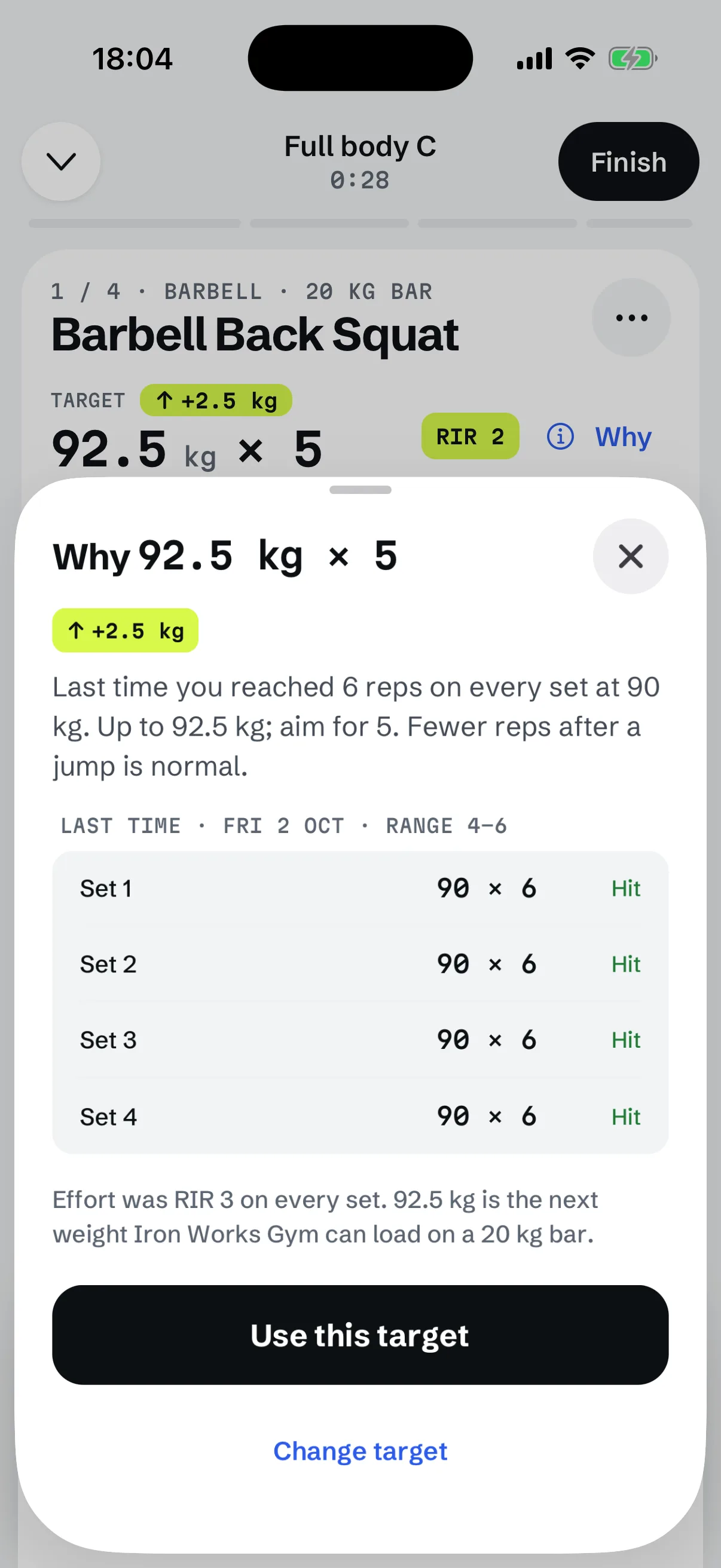
The Why sheet on an exercise states last time's result and the rule that set the new weight, so a jump like session 5 is explained in words. Fewer reps after a jump is normal.
How long does linear progression last?
It lasts until a session cannot be finished at the planned weight, and no source opened for this page gives a number of weeks. It depends on the lifter and on the step.
Research on this is thin. A study of progression choices, Plotkin and colleagues in 2022, compared adding load with adding reps over 8 weeks in 43 lifters who had at least a year of lower-body training. It did not test a novice. Its conclusion was that progressing either load or repetitions looks viable for muscular adaptations over an 8-week cycle.
You can read the end of the run from your own log. See strength plateau for what counts as stuck, and how to track gym progress for the numbers to watch.
Is linear progression bad?
No. It does one job well, and its one weakness is built into the rule. A fixed step has no smaller version: when the next 2.5 kg does not go, the rule offers only the same jump again or a stop. Nothing in it uses the extra reps a lifter might have left.
There is a second limit: it assumes you know whether the set was hard. A guess at reps in reserve is rough. In a 2022 review of 12 studies and 414 participants, lifters tended to underpredict the reps they had left by 0.95 reps on average. Reps in reserve covers how RIGOR handles that.
What comes after linear progression?
A rule with a smaller step. Double progression is one: keep the weight, climb the reps, then take the smallest jump. Its rep ranges make the unit of progress one rep instead of one plate.
RIGOR also handles the stop itself. These are its rules when progress ends:
- One miss. A set under the bottom of the range repeats the weight. The sets that fell short aim for the bottom of the range, the others for one more rep.
- Two misses in a row at one weight. The weight comes down 10% on that lift, rounded down to a weight the gym can make. In the example, 65 kg × 0.9 = 58.5 kg, so the lift goes to 57.5 kg.
- A stall. Three full sessions at one weight and effort target in which the newest has no more total reps than the oldest. Down 10% too.
Only the lift that triggered the rule changes. After a cut, the climb starts again by double progression. A planned lighter week is a different thing; see deload weeks.
RELATED TOOL1RM calculatorEstimate the most you could lift once, from a set you have already done.When does this not apply?
The example is a barbell squat. Dumbbells and machines move in bigger jumps for their load than a barbell, so a fixed linear step often does not exist for them. Bodyweight lifts have no weight to add. Neither fits a linear rule, and the RIGOR rule for them is on the double progression page. The example also assumes a lifter who hits every target; on a day that goes badly, the written rules above apply, not the table.
To see the double progression rule across a week of training, the 3 day full body workout is built on it.
RIGOR picks the next weight for you
Questions
What is a linear progression program?
A program in which the weight on the bar goes up by a fixed step every session while sets and reps stay the same, such as 3 sets of 5 with 2.5 kg more each time.
What is the opposite of linear progression?
No single rule is its opposite. The one this guide sets beside it is double progression, which adds reps before weight.
Is linear progression just for beginners?
Many beginner barbell programs are built on it, but nothing limits it to them. It works for anyone only while each session at the new weight still succeeds.
What happens when linear progression stops working?
Sessions start to fall short at the planned weight. Repeat the weight, then take a smaller step or lighter load. RIGOR repeats after one miss and takes 10% off after two.
Can you do linear progression on every lift?
In principle any lift with a weight that can go up by a fixed step. Dumbbells and machines move in bigger jumps than a barbell, so a fixed step often does not fit them.