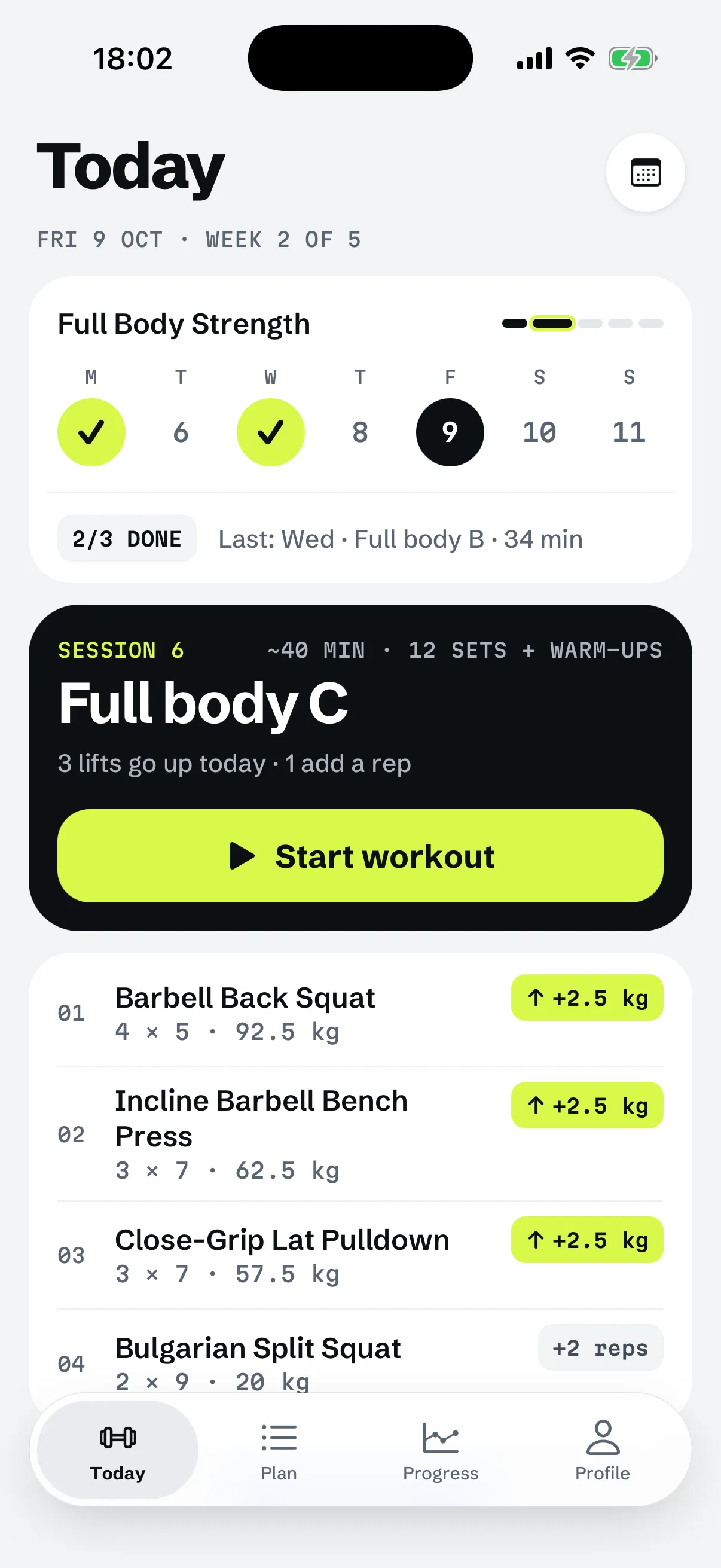
You find a weight by testing it. Pick one you could lift for the middle of the rep range, with the reps left that the plan asks for, and adjust after a trial set. From the second session your log decides. In RIGOR, the app behind this guide, a first guess that was far off is corrected after one session.
How do you know what weight to lift on your first day?
You find it by testing. RIGOR, the app behind this guide, works the same way: for a lift with no history its sheet says "RIGOR won't guess a weight" and asks you to pick one you can lift for the plan's rep range with about the plan's number of reps left.
The rest of the first workout is in first day at the gym. This page covers only the weight, and what happens to it afterwards.
In RIGOR the starting-weight sheet offers two ways to start:
- I know a weight I've used. Enter the weight and the reps. The sheet notes that it is saved as reported, apart from your logged sets, and that "Today starts lighter: 10% less, rounded down to a weight your gym has."
- Do a trial set. Lift a light weight, then say how hard it was.
A trial set goes like this:
- Lift a weight that looks light for the reps the plan shows.
- Log the weight, the reps and the reps you had left: 0, 1, 2, 3 or 4+, or leave it blank.
- Read the line the sheet gives back: right, light or heavy.
- Do another trial, or pick the weight for set 1 from the weights your gym can make. A trial the sheet calls right is the start unless you pick another.
Trial sets are kept as warm-ups and never count. RIGOR adds no warm-up sets after a starting weight is picked during a session: the trial sets served as the warm-up.
What does a trial set tell you?
The reps you did and the reps you said were left decide the line. Take a lift set to 10–15 reps with about 2 left, such as a leg extension.
| Trial set logged | The line says |
|---|---|
| 8 reps | Heavy: under the 10 at the bottom of the range |
| 12 reps, 0 left | Heavy: two fewer left than the target of 2 |
| 12 reps, 2 left | Looks right |
| 12 reps, 4+ left | Light: two more left than the target |
| 18 reps, no entry | Light: more than 2 reps past the 15 at the top |
Your count of reps left is a guess. A 2022 review of 12 studies with 414 participants found that people tended to under-predict the reps they had left, by 0.95 on average, with large differences between studies (Halperin 2022). Treat a trial set as a starting point. Reps in reserve explains the scale.
RIGOR is a strength training app for iPhone that builds your plan and sets every weight by rules you can read.
YOUR IPHONE

What weight do you lift the next time?
The one in your log. From the second session the app looks at the newest earlier session of that exercise and judges it against the targets it had that day. Only completed working sets count. Trial sets and warm-ups do not.
Unless a stall or two misses running has come first, the plain cases for a bench press set to 3 sets of 8–12 reps with 3 left:
| You logged | The next target |
|---|---|
| 60 kg × 10, 10, 9 · 3 left | 60 kg × 11, 11, 10 |
| 60 kg × 12, 12, 12 · 3 left | 62.5 kg × 10, 10, 10 |
- Every set at the top of the range steps the weight up straight away, to the next weight your gym can make, with reps worked out for it. Three conditions hold: every planned set was done, no set was logged two or more reps in reserve below the target, and at the next weight you could still be expected to reach the bottom of the range. Where one fails, other rules decide.
- Every set in the range, but not every set at the top: the same weight, one more rep on each set, up to the top of the range. This is double progression, and an eight-week study of 43 trained lifters found adding reps at a fixed weight and adding weight at fixed reps both workable (Plotkin 2022).
- A set under the bottom of the range: the same weight, with the short sets aiming for the bottom of the range and the others for one rep more.
A miss in two sessions running at one weight takes 10% off that lift, and so do three full sessions at one weight with no more total reps in the newest than in the oldest. Strength plateau has both.
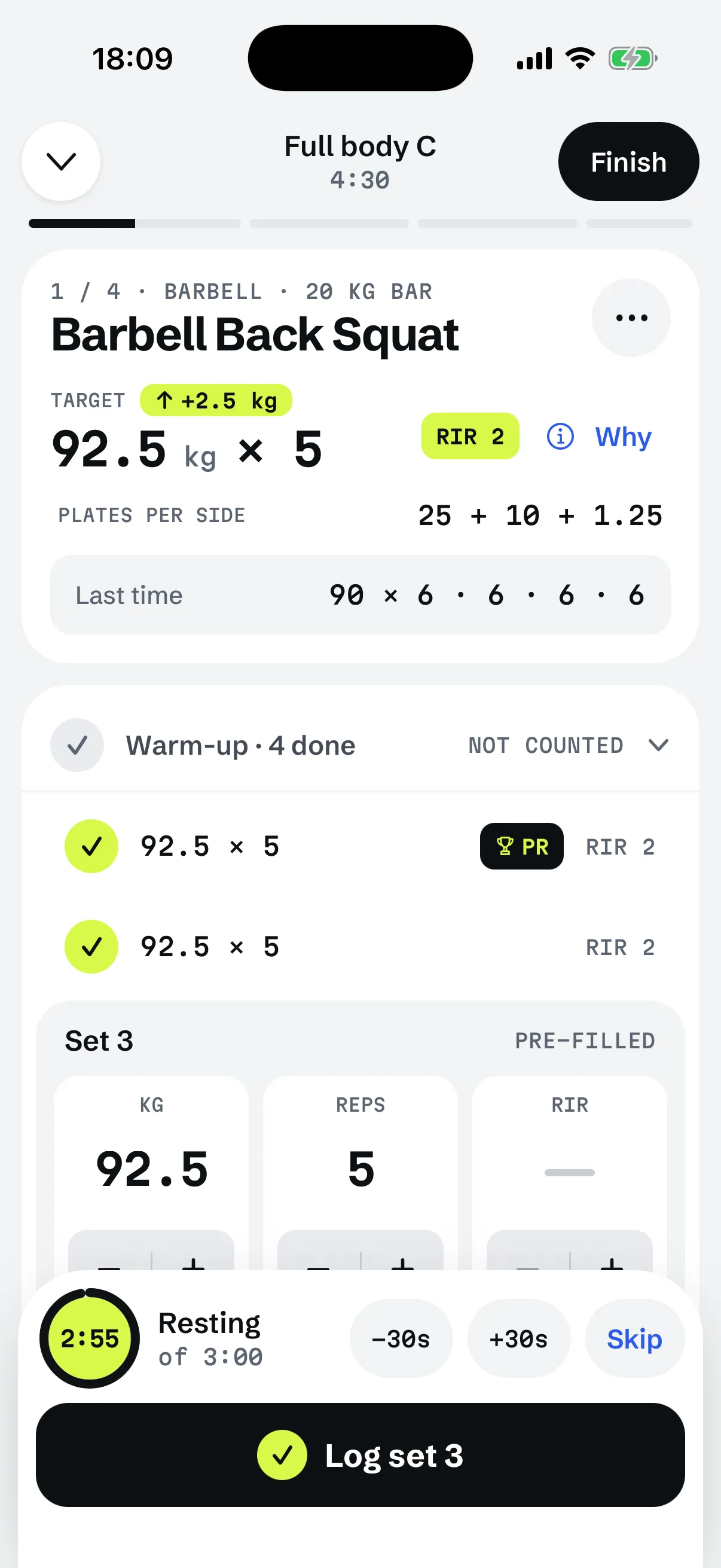
This is a later session, so the weight is filled in from the log.
What if your first guess was far off?
One session is enough to correct it. RIGOR scores a set as its reps plus the reps left, and a set with no reps-left entry is read as the planned number left. Two checks run before the plain rules above.
Too heavy. The best set scores below the bottom of the range plus the target's reps left, minus 2, and a lighter weight is possible. The best set is the one with the highest estimated one-rep max among the planned sets at the weight used. It applies on a lift's first session, when any set was logged at a weight other than the one the app asked for, or when the session before was also too heavy at the same weight. Otherwise one bad day is treated as a plain miss.
Too light. At least half the planned sets score the top of the range plus the target's reps left plus 4 or more, and a heavier weight is possible. The weight rises by at most 20% at once.
In both cases the new weight comes from the best set's estimated one-rep max, and the next target is the middle of the range.
TOP OF THE RANGE8 REPS · BOTTOM
The sums, with 3 left as the target. The best set scores 7 + 0 = 7. The line is 8 + 3 − 2 = 9, so 7 is under it. The estimate is 70 × (1 + 7 ÷ 30) = 86.3 kg, the Epley sum in the 1RM calculator. At 60 kg that estimate gives 30 × (86.3 − 60) ÷ 60 = 13.2, so 13 reps to the limit, minus 3 left is 10, the middle of 8–12. At 62.5 kg it gives 11 minus 3 is 8, short of 10. So 60 kg.
Had the sets been logged with no reps-left entry, the best set would score 7 + 3 = 10, above the line of 9. The too-heavy check would not apply, and the plain rules would ask for 70 kg × 8 on every set. Log the reps you had left.
For too light, take 30 kg with sets of 15, 15 and 14, each logged 4+ left. Two of the three sets score 19, which is 12 + 3 + 4, so the weight is too light. The estimate is 30 × (1 + 19 ÷ 30) = 49 kg, which fits 10 reps with 3 left up to 34.2 kg: in a gym with 2.5 kg steps, 32.5 kg × 10.
What weight do you use for a new or swapped-in exercise?
Each exercise has its own history, and the app never carries one exercise's weight over to another. History means earlier sessions of the same exercise with the same load convention and at least one completed working set.
- An exercise you have never logged has no weight, so you start as on day one: trial sets, or a weight you know.
- A swapped-in exercise you have logged before has that history. Its target comes from its newest earlier session, not from the exercise it replaced.
How do dumbbells and machines change the number?
The number means something different on each kind of equipment, and the app names what it means for the exercise: per dumbbell, the total including the bar, a machine setting, weight added to bodyweight or assistance. A set logged under another convention is not comparable history. See plate math for the bar, and the plate calculator for what to load on each side.
When the app changes a weight it lands on one your gym can make. After a jump up, fewer reps is normal, and the app says so. A plain bodyweight exercise has no weight to find: it asks for reps.
When does this not apply?
- After a break. When your last session with a completed working set is 14 days old or more, Today offers to continue as planned, to make an easier return, or to revisit the plan. See getting back into the gym.
- Easier today. It applies to that session only and is not a baseline unless every planned set was a hit at the usual weight or heavier (at the usual weight, only when your gym can load 90% of it or less).
- A target you edited. It is stored as yours, and the original recommendation is kept beside it.
RIGOR leaves a new lift's weight blank and sets the next from your log
Questions
How much weight should a beginner lift?
No number fits everyone. The American College of Sports Medicine recommends that novices use loads that correspond to an 8 to 12 repetition maximum. RIGOR's version is a weight you could lift for the plan's rep range, with the reps left that the screen shows.
Is there an app that tells you how much weight to lift?
RIGOR does not guess a first weight: its starting-weight sheet says so and asks you to pick one, with trial sets to help. From then on it sets each next weight and rep target from what you logged.
Do trial sets count toward progress?
No. RIGOR keeps trial sets as warm-ups, and they never count. Only completed working sets count.
Do I have to log reps in reserve?
No. A set logged without one is read as the planned effort. Logging it gives the app more to go on, and the example below shows a case where it changes the result.