On your first day at the gym, do one full-body workout and use it to find your starting weights. For each exercise, pick a weight you could lift for the middle of its rep range with about three reps left on the big lifts. RIGOR, the app behind this guide, treats that first session as your baseline.
What should you do on your first day at the gym?
Do one workout that trains the whole body, and use it to find a starting weight for each exercise. A chart cannot tell you what you can lift, so every lift gets one test: a weight you could lift for the middle of its rep range, with a few reps left.
That is the first session in RIGOR, the app behind this guide. A lift you have never logged shows a blank weight, reps in the middle of the range and an effort target. Your first completed sets become the baseline.
What workout should you do on your first day?
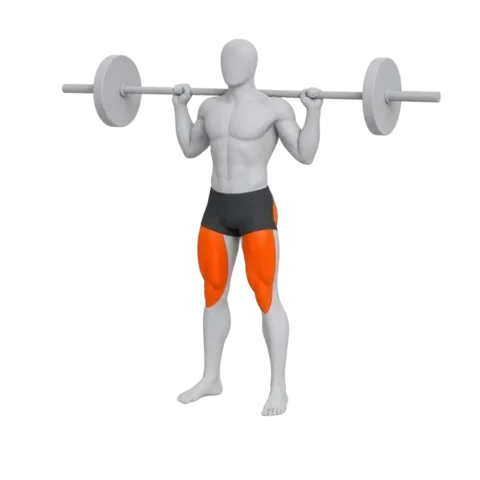
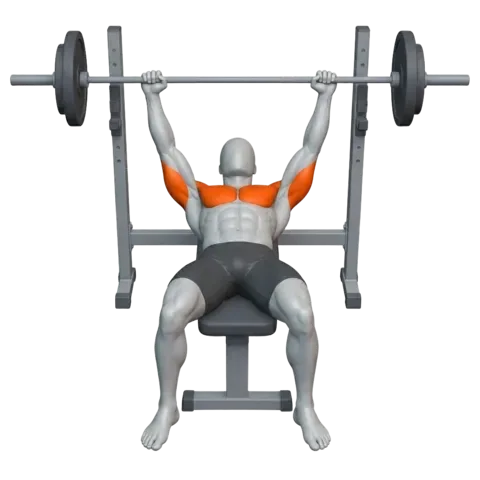
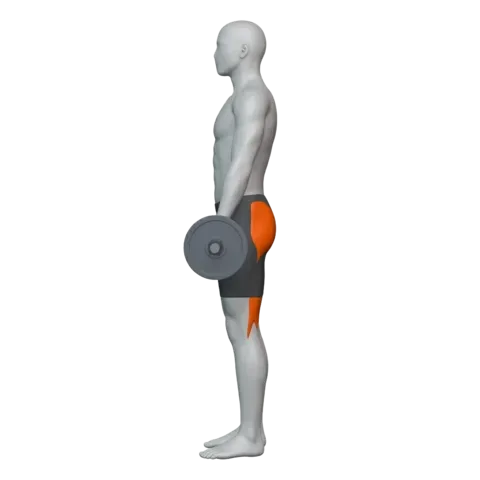
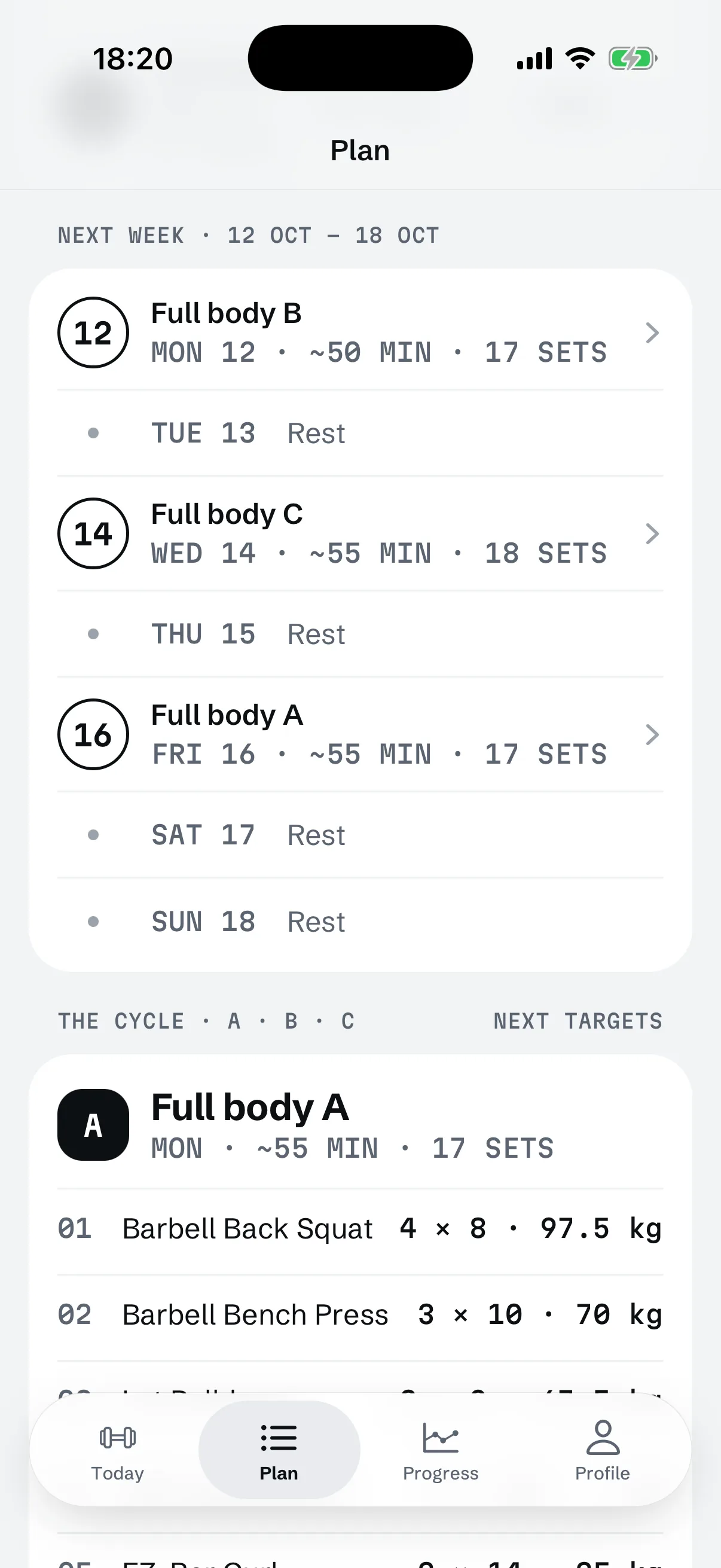
The first workout of a full-body plan. For three days a week RIGOR recommends full body, not a hybrid, and the workout split by days page sets it beside the others. To train full body every other day instead of on set weekdays, the same plan runs as it is. Below is Full body A from RIGOR's plan for a commercial gym, laid out in full in the 3 day full body program. It is written for an intermediate, so a beginner's plan has fewer sets a week; the first-session rules are the same. The plan puts the big lifts first.
The effort target is in reps in reserve (RIR): how many more reps you could have done when you stopped. Reps in reserve explains the scale. In week 1, big lifts ask for 3 and small lifts for 2, for a beginner as well as an intermediate.
| Exercise | Sets × reps | First reps · RIR | A weight you could lift |
|---|---|---|---|
| Barbell Back Squat | 4 × 6–10 | 8 · RIR 3 | 11 times |
| Barbell Bench Press | 3 × 8–12 | 10 · RIR 3 | 13 times |
| Lat Pulldown | 3 × 8–12 | 10 · RIR 3 | 13 times |
| Stiff Leg Deadlift | 2 × 8–12 | 10 · RIR 3 | 13 times |
| EZ-Bar Curl | 3 × 10–15 | 12 · RIR 2 | 14 times |
| Leg Extension | 2 × 10–15 | 12 · RIR 2 | 14 times |
That is six exercises and 17 sets. The reps shown are the middle of each range, rounded down: (6 + 10) ÷ 2 = 8, (8 + 12) ÷ 2 = 10 and (10 + 15) ÷ 2 = 12.5, which becomes 12.
RIGOR is a strength training app for iPhone that builds your plan and sets every weight by rules you can read.
YOUR IPHONE

How do you pick the weight for each exercise?
In RIGOR the weight box starts empty. The screen reads "Pick a weight you can lift for 6–10 reps with about 3 left", with the range and the effort taken from the exercise and the week.
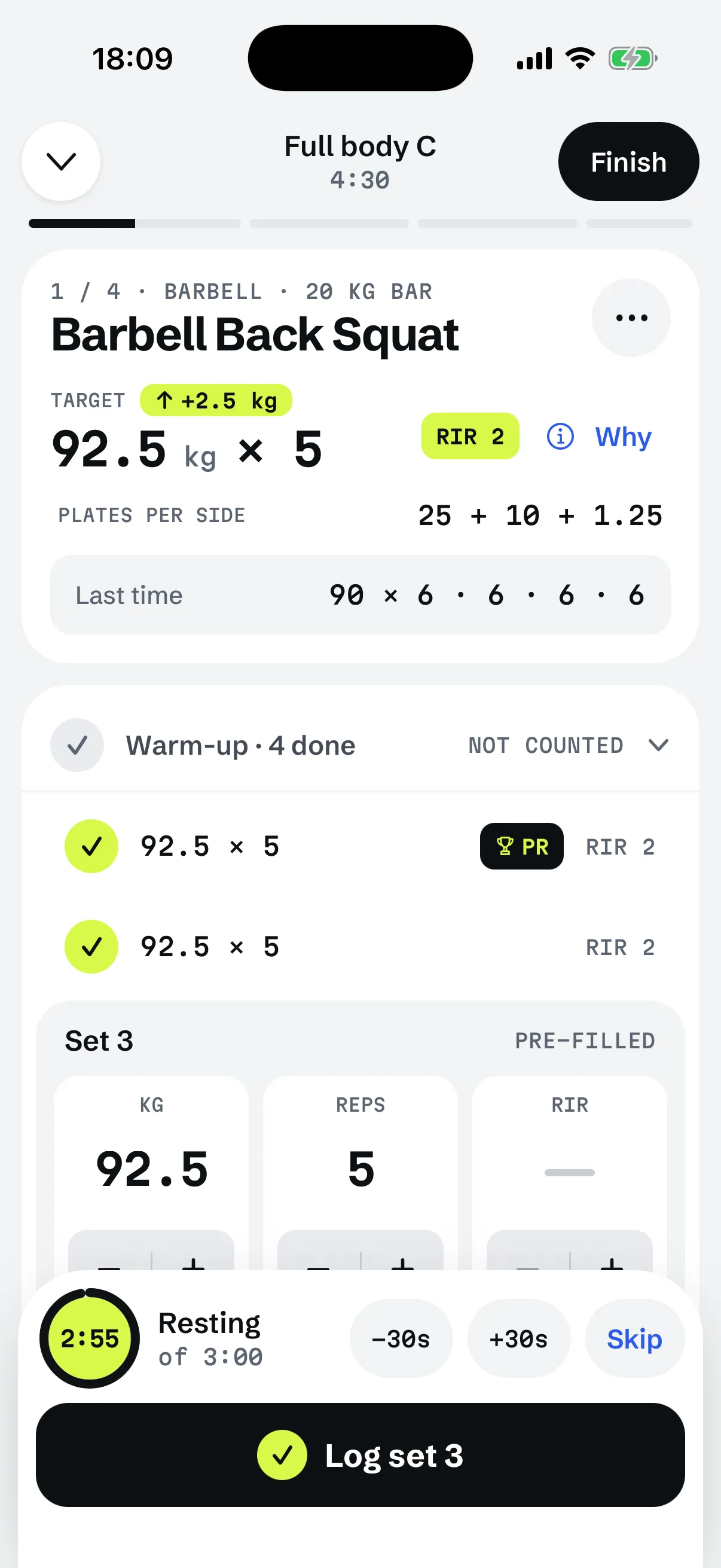
This screen is from a later session, so its weight is filled in. On a lift you have never logged, the weight is blank, the reps start in the middle of the range and the same RIR target is shown.
The app always names what the number means for the exercise: per dumbbell, the total including the bar, a machine setting, weight added to bodyweight or assistance. A bodyweight exercise asks for reps only.
To find the weight:
- Start with a weight that looks too light and lift the middle number of reps: 8 on the squat.
- Ask how many more you could have done. The squat's target is 3.
- More left: add weight and go again. Fewer: take weight off. Stop when the count matches.
Your count will be a little off. A 2022 review of 12 studies and 414 people found they guessed about one rep fewer than they really had left, 0.95 on average, with no significant difference by training status (Halperin 2022). In a 2016 study of 29 squatters, 14 of them novices, the novices rated a one-rep max lower than the 15 experienced squatters did (Zourdos 2016). So treat the first weight as a guess. A little off, and you add reps, then weight; far off, and the app recalculates it, as below.
A weight your gym's list does not have, such as a borrowed plate, is accepted and flagged. Your first session of an exercise has the same rule in short.
What do you log, and what does the app set next?
Log the weight and reps of every set, and the reps you had left if you can say. RIR is optional, and a set without one is read as the planned effort. Logging a set and RIR shows the screen.
After your first completed sets, that session is the baseline. The next target comes from double progression: reps go up first, then weight. A first guess that was far off is corrected sooner. Take the squat, 4 sets of 6 to 10 reps, 3 in reserve.
| Day one | Next target | Why |
|---|---|---|
| 60 kg × 8, 8, 8, 8 · RIR 3 | 60 kg × 9, 9, 9, 9 | Every set was in the range and none at 10: same weight, a rep more |
| 60 kg × 10, 10, 10, 10 · RIR 3 | The next weight up, fewer reps | Every set reached 10 at the planned effort: the weight goes up |
| 80 kg × 6, 5, 4, 4 · RIR 0 | 70 kg × 8, 8, 8, 8 | The guess was too heavy: recalculated from the strongest set |
For the third row, RIGOR scores a set as its reps plus the reps left: 6 + 0 = 6. The squat's line for too heavy in week 1 is the bottom of the range plus the effort target, minus 2: 6 + 3 − 2 = 7. A score under 7 counts as too heavy. The estimate is the one in the 1RM calculator: 80 × (1 + 6 ÷ 30) = 96 kg. The new weight is the heaviest your gym can make that should give 8 reps with 3 left. At 70 kg the estimate gives 30 × (96 − 70) ÷ 70 = 11.1, so 11 reps to the limit, minus 3: 8.
TOP OF THE RANGE6 REPS · BOTTOM
Too light works the same way: a score of 10 + 3 + 4 = 17 or more on at least half the sets, and the weight rises at most 20% at once. Anything between uses the plain rule.
Log the RIR on day one. Had the sets above been logged with none, each would be read as the planned 3 left. The strongest set would score 6 + 3 = 9, above the line of 7, and the app would keep 80 kg and ask for 7, 6, 6, 6. Tracking progressive overload covers the log itself.
What about warm-up sets on day one?
RIGOR builds warm-up sets from your first working weight. On day one that weight is blank, so there is no list yet; the light sets you use to find it serve as the warm-up.
From the next session, a loaded lift gets warm-up sets, unless an earlier lift in the workout already warmed that movement or muscle: the leg extension after the squat gets none. A barbell compound starts with the empty bar × 10, then about 40%, 60% and 80% of the working weight. If your second squat session is at 60 kg, that is 20 kg × 10, 25 × 5, 35 × 5 and 47.5 × 3. The warm-up calculator works out any weight. Warm-up sets never count toward progress.
How long do you rest between sets?
Rest starts when you log a set. In Full body A the plan gives 3:00 after the squat and the stiff leg deadlift, 2:00 after the bench press and the pulldown, and 1:30 after the curl and the leg extension. From the timer you can pause, add or take off 30 seconds, or skip. The studies behind the times are in rest between sets, and the rest timer covers the Lock Screen.
What does a first week at the gym look like?
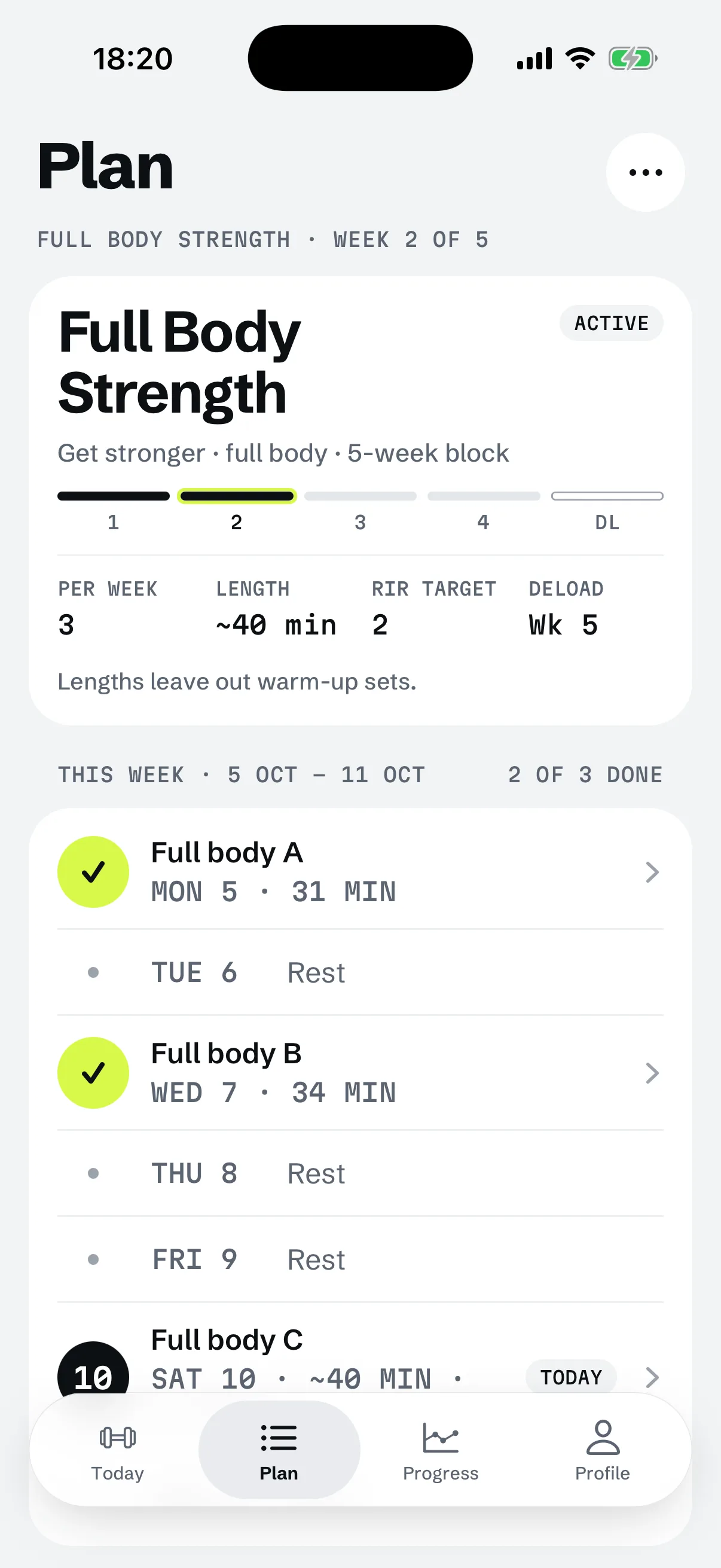
Three workouts, A, B and C, with a rest day between them: three days a week, the top of the two to three the American College of Sports Medicine advises for novices.
In this plan, week 1 has 19 exercise rows across the three workouts. If you are new to the app, eighteen are lifts you have not logged, because each exercise has its own history and none borrows another's weight. Only the squat in workout C has history: it carries on from the squat in workout A. Most of the week is first sessions.
A beginner's effort target is 3 on compounds in weeks 1 and 2, then 2 in weeks 3 and 4; for isolations it is 2, 2, 1 and 1. After a lift's first session, its next target comes from what you logged.
When is the first day different?
When the lift is not new to the app.
- A lift you have logged before. Its target comes from the last comparable session.
- A swapped exercise. It has its own history, so its first session asks you to pick a weight. See swapping an exercise.
- A bodyweight exercise. There is no weight to find; it asks for reps only.
RIGOR builds the first workout and sets the next
Questions
How should a beginner start at the gym?
The American College of Sports Medicine advises novices to train two to three days a week with loads in the 8 to 12 repetition maximum range. RIGOR's three-day plan is full body, and it starts each lift a few reps short of your limit.
What do you do on your first day at the gym as a beginner?
Do one workout of a handful of exercises. Stop each set with about three reps left on a big lift and two on a small one, and log it. That session becomes your baseline.
Do I need warm-up sets on my first day?
RIGOR builds warm-up sets from your first working weight. On day one that weight is not known yet, so the light sets you use to find it serve as the warm-up.
What do I log on my first day?
The weight and reps of every set, and the reps you had left if you can say. RIGOR saves each set as you log it.
What if my first weight is wrong?
A weight far too heavy or too light is recalculated after one session, from your strongest set. One only a little off stays, and you add reps, then weight.