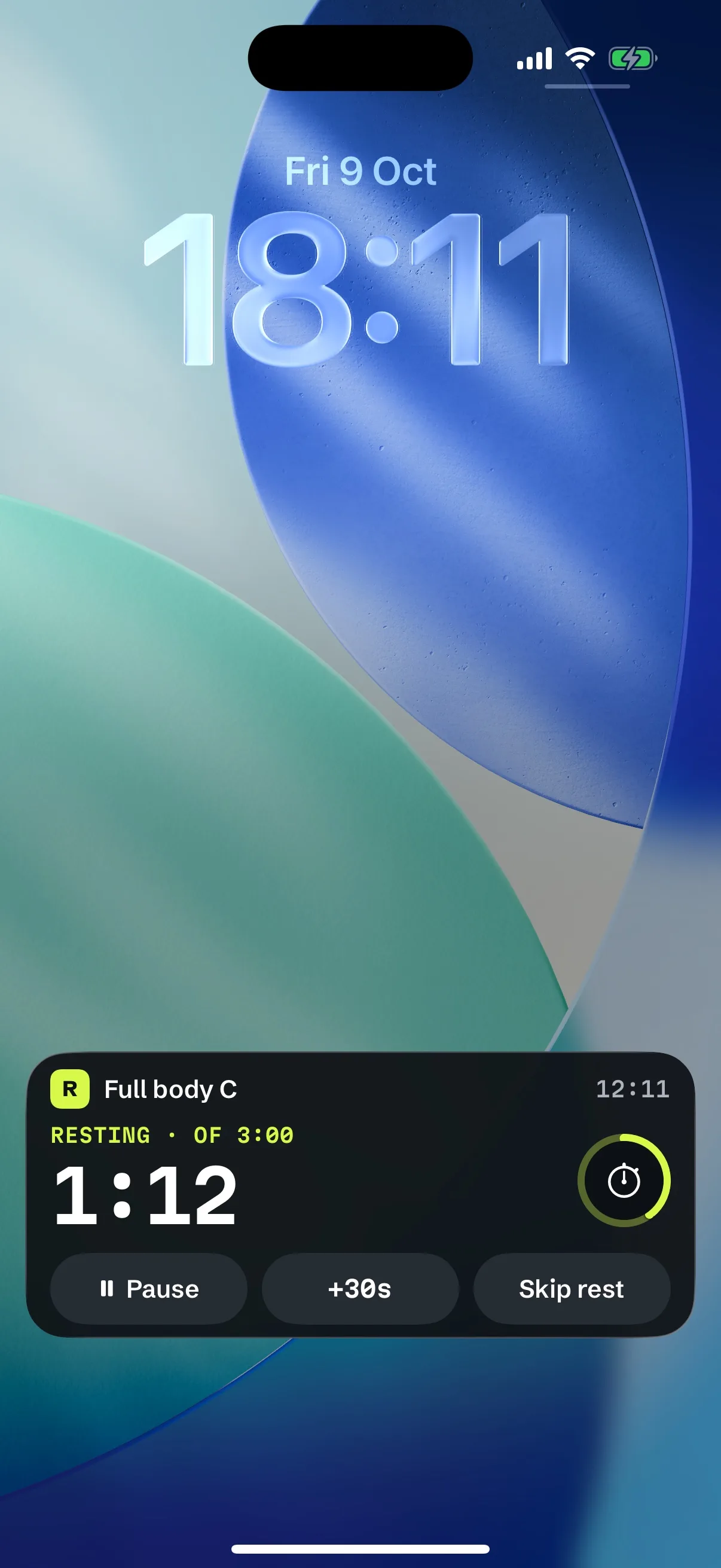
For a barbell lift, start with the empty bar for 10 reps, then do 5 reps at 40% of your working weight, 5 at 60% and 3 at 80%. This warm up sets calculator rounds each step to a weight the bar and plates can make, in kg or lb.
How much weight for warm-up sets?
The empty bar, then about 40%, 60% and 80% of the weight of your first working set. The table shows the ramp for a lighter and a heavier lift, in a higher and a lower rep range. Every row is worked out by the calculator above.
| Weight | Top of range | Warm-up sets |
|---|---|---|
| 60 kg | 8 reps | 20 × 10 · 25 × 5 · 35 × 5 · 47.5 × 3 |
| 100 kg | 8 reps | 20 × 10 · 40 × 5 · 60 × 5 · 80 × 3 |
| 100 kg | 5 reps | 20 × 10 · 40 × 5 · 60 × 5 · 80 × 3 · 90 × 1 |
| 140 kg | 5 reps | 20 × 10 · 55 × 5 · 85 × 5 · 112.5 × 3 · 125 × 1 |
| Weight | Top of range | Warm-up sets |
|---|---|---|
| 135 lb | 8 reps | 45 × 10 · 55 × 5 · 80 × 5 · 110 × 3 |
| 225 lb | 8 reps | 45 × 10 · 90 × 5 · 135 × 5 · 180 × 3 |
| 225 lb | 5 reps | 45 × 10 · 90 × 5 · 135 × 5 · 180 × 3 · 200 × 1 |
| 315 lb | 5 reps | 45 × 10 · 125 × 5 · 190 × 5 · 250 × 3 · 285 × 1 |
Two things show in the table. The steps are not exact shares: 40% of 60 kg is 24 kg, which no bar makes, so the set is 25 kg. And a heavy lift in a low rep range ends with one more set, a single at about 90%.
How many warm-up sets should you do?
Up to four before a barbell lift, and five before a heavy one in a low rep range. The empty bar counts as the first. A light weight gets fewer, because a step that rounds to the bar or to the step before it is dropped.
| Lift | Warm-up sets |
|---|---|
| Barbell lift, first of its movement | The empty bar × 10, then 40% × 5, 60% × 5, 80% × 3 |
| The same, heavy (top of rep range 6 or fewer, 100 kg or 225 lb and up) | The same four, then 90% × 1 |
| Dumbbell or machine lift, first of its movement | 40% × 5, 60% × 5, 80% × 3 |
| Small isolation lift | One set: 60% × 8 |
| A lift whose movement (for an isolation lift, whose muscle) is already warm from earlier that day | None for a dumbbell, machine or isolation lift. A barbell compound keeps only its 80% × 3 |
For a bench press at 60 kg the sets are 20 × 10, 25 × 5, 35 × 5 and 47.5 × 3. At 100 kg for 5 reps there is one more, 90 × 1. A 30 kg lift gets two, 20 × 10 and 25 × 3. All of them come before your first working set, in this order, and none of them counts as one.
How it is calculated
The calculator runs the rule the app uses for a barbell lift that comes first in a session:
- The empty bar × 10
20 kg or 45 lb. It is left out when your working weight is the bar itself.
- 40% × 5, 60% × 5, 80% × 3
Each share of the working weight is moved to the nearest weight the bar and plates can make, in steps of 2.5 kg or 5 lb.
- 90% × 1 for heavy, low-rep sets
Added when the top of your rep range is 6 or fewer and the working weight is at least 100 kg or 225 lb.
A step is dropped when it comes out at or under the bar, or the same as the step before it. That is why a 40 kg lift gets three warm-up sets and not four: 20 × 10, 25 × 5 and 32.5 × 3.
"Working weight" means the weight of your first working set, the one that counts. "Top of your rep range" is the higher number of a range such as 4 to 6.
How accurate it is
Every weight it gives can be loaded: each one is a 20 kg or 45 lb bar plus standard plates, with the plates for one side beside it. The barbell plate calculator does the same sum for any weight and any bar.
The shares themselves are a rule, not a measurement. 40, 60 and 80% are a common ramp, and RIGOR uses it because it is short and climbs evenly. Nothing breaks if you do 50% in place of 40%, or add a set on a cold day. Keep two things: the weight climbs, and the reps fall as it does, so you reach the working set practised and not tired.
It also assumes a standard bar. On a lighter bar, or with dumbbells or a machine, use the shares and round to what the equipment has.
What to use it for
The first heavy barbell lift of a session: squat, bench press, deadlift, overhead press or row.
When to use fewer. A second exercise for the same movement needs no ramp. After squats, a leg press can start at its working weight. A small isolation lift needs one lighter set at most; RIGOR gives it a single set at 60% for 8 reps.
When to skip it. Bodyweight and timed exercises have no weight to ramp.
What it does not replace. A few minutes of easy movement before you touch the bar, if that is part of your routine. The calculator covers the sets with weight on them.
With a written plan. The programs on this site list working sets only. In the 6 day push pull legs routine, the warm-up sets come on top.
Warm-up sets are not working sets. Do not log them toward your reps for the day, and do not take them near failure. They also need less rest: the times in the guide to rest between sets are for working sets. If you do not yet know your working weight for a new rep range, the 1RM calculator gives a starting point. How RIGOR handles them is in Warm-up sets.
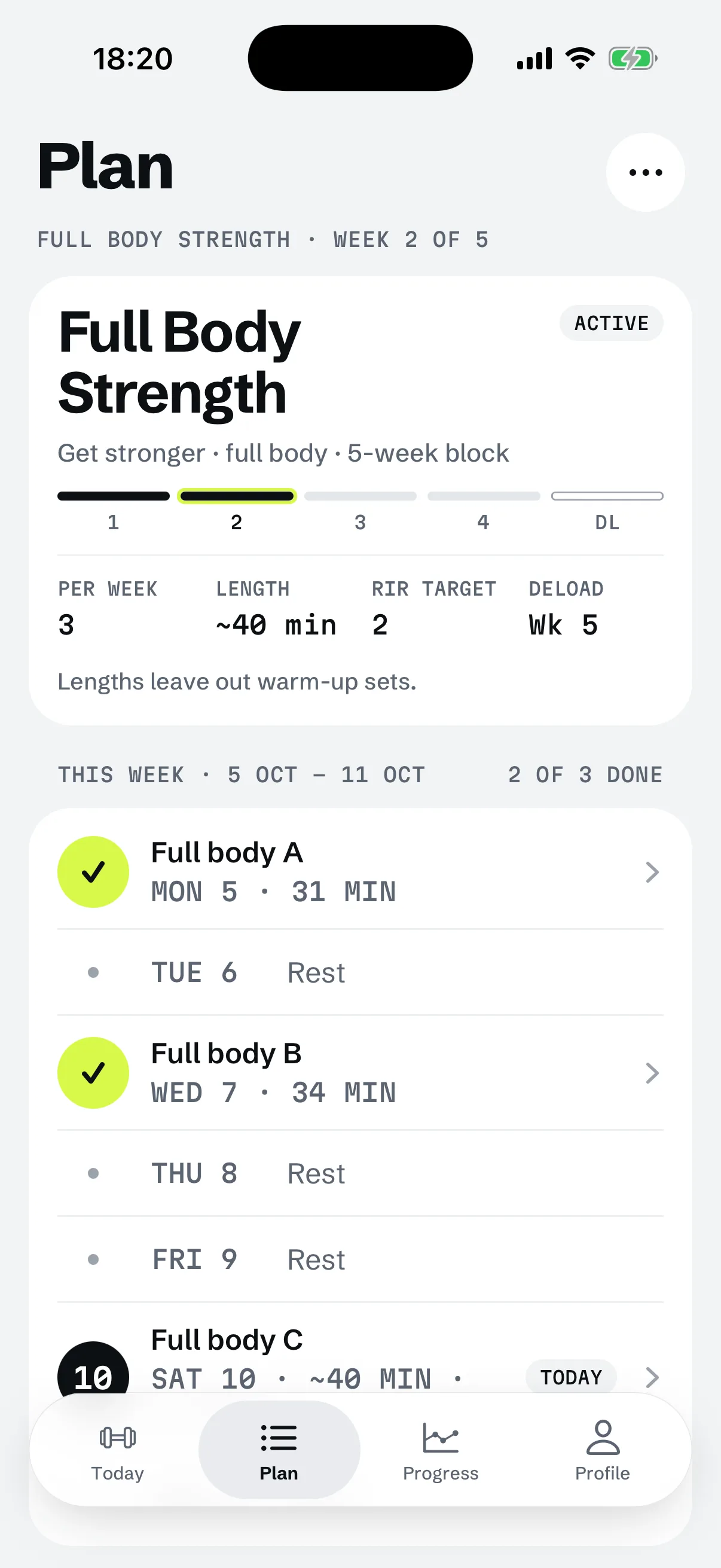
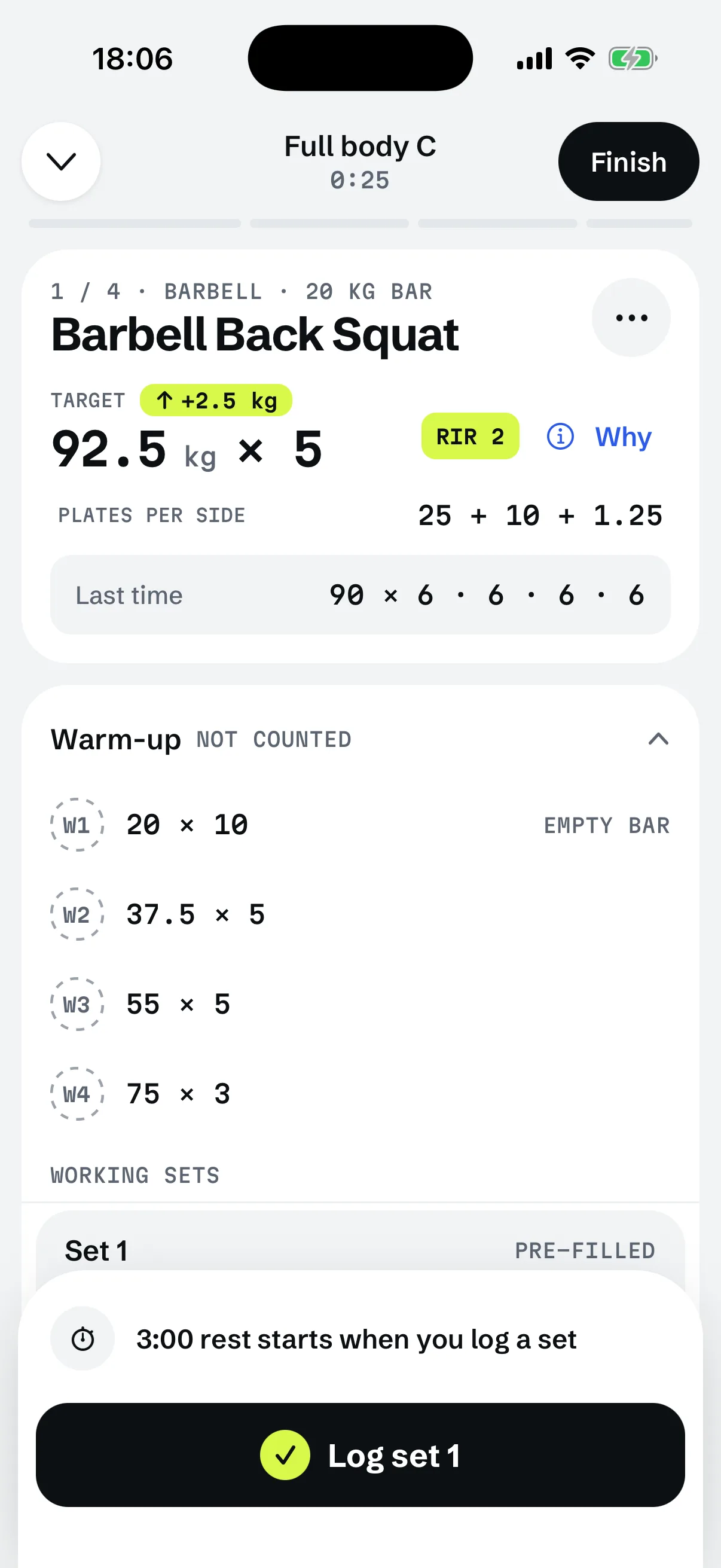
RIGOR builds the warm-up for you

Questions
How many warm-up sets for bench press?
Bench press is a barbell lift, so it gets the full ramp when it is the first press of the session. At a working weight of 60 kg that is three warm-up sets after the empty bar: 25, 35 and 47.5 kg. At 100 kg for 5 reps it is four: 40, 60 and 80 kg, then a single at 90 kg.
How much weight should warm-up sets be?
The empty bar, then about 40%, 60% and 80% of your first working set. For 100 kg that is 20, 40, 60 and 80 kg.
How many reps in a warm-up set?
Fewer as the weight climbs: 10 with the empty bar, then 5, 5 and 3. The sets are there to rehearse the lift, not to tire you.
Do you need warm-up sets for every exercise?
No. Warm up the first lift that uses a movement. A later dumbbell or machine lift for the same movement can start at its working weight; a barbell one keeps a single set at 80% × 3. A small isolation lift needs one lighter set at most.
How do you warm up for a 1 rep max or a heavy low-rep set?
Add one single at about 90% after the 80% set. The calculator adds it when your rep range tops out at 6 or fewer and the weight is 100 kg or 225 lb and up.
Do warm-up sets count as sets?
No. They are not working sets, so they do not count toward your progress, your records or your weekly sets. RIGOR shows them apart and never counts them.