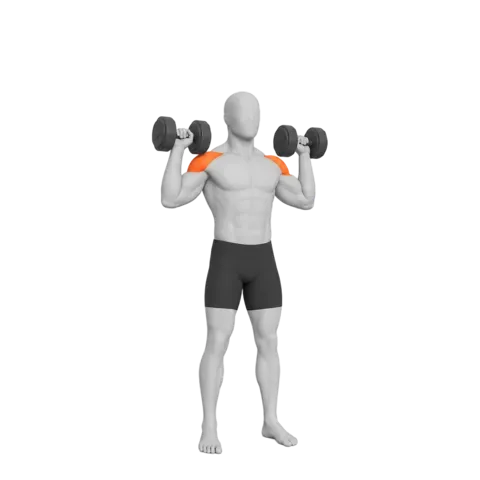
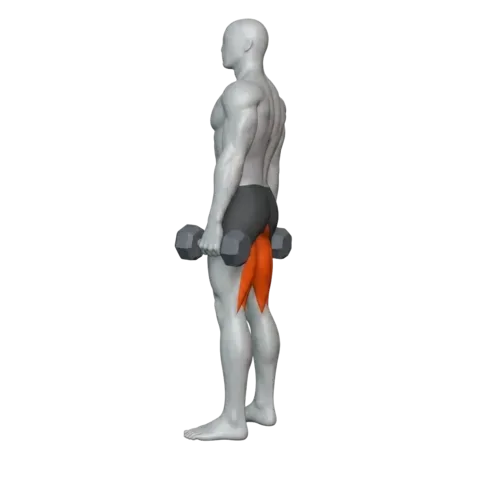
Full body every other day means 3 or 4 workouts in a 7-day week, alternating: 3.5 on average. In RIGOR, the app behind this guide, days passing never move your plan, so a three-day full-body plan runs as it is, and its weekly sets rise from 52 to about 61.
Can you train your whole body every other day?
Yes. A full-body workout every other day leaves one rest day between sessions, as Monday, Wednesday and Friday do, but the rhythm carries on through the weekend. A 7-day week then holds 3 or 4 sessions, alternating, which is 3.5 on average.
The American College of Sports Medicine's position stand recommends 3 to 4 training days a week for intermediate lifters, whom it defines as people with about six months of consistent training, and 2 to 3 for novices (ACSM 2009). Every other day sits inside the first range. Its 4-session weeks sit a day above the second, so by that guidance a new lifter trains 2 to 3 days. Your first day at the gym walks through the first workout.
How does RIGOR run an every-other-day schedule?
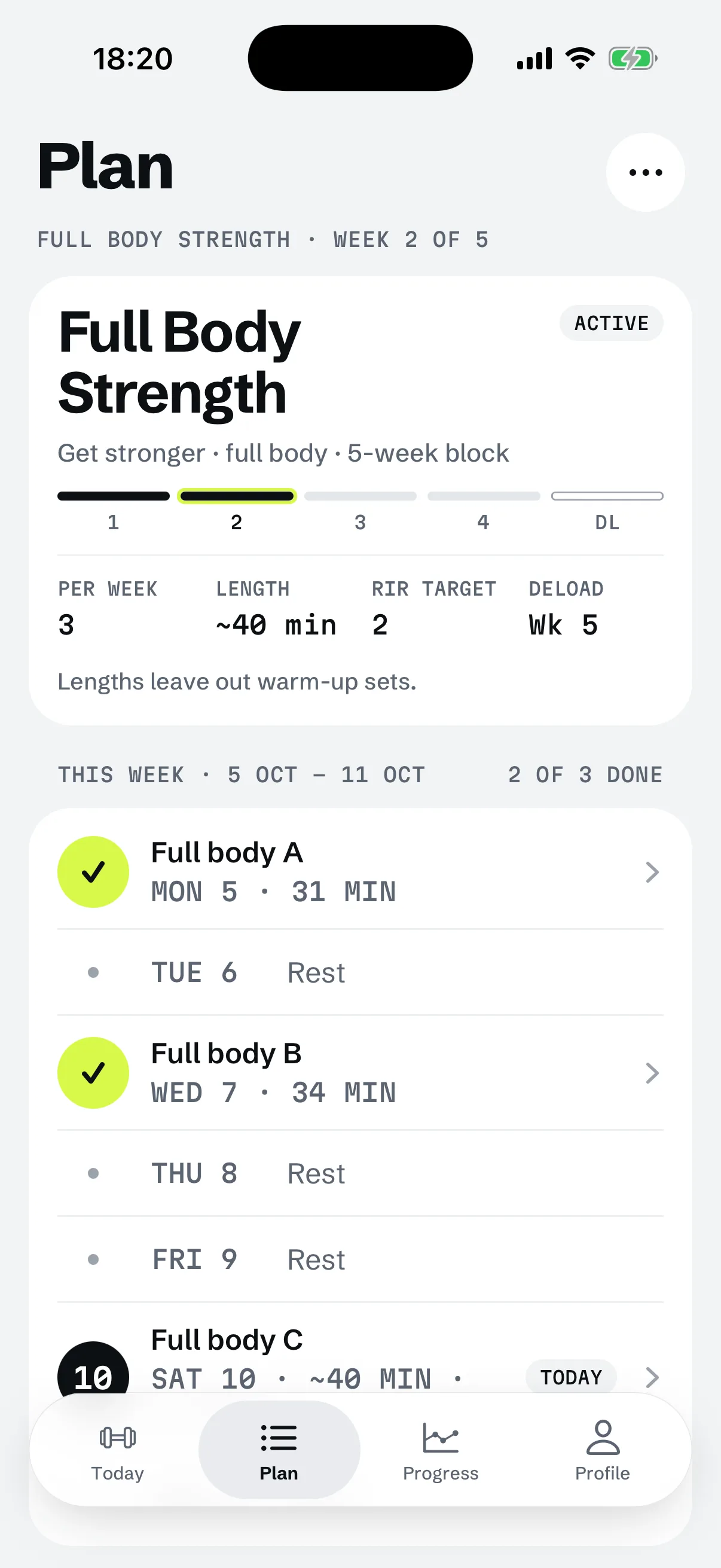
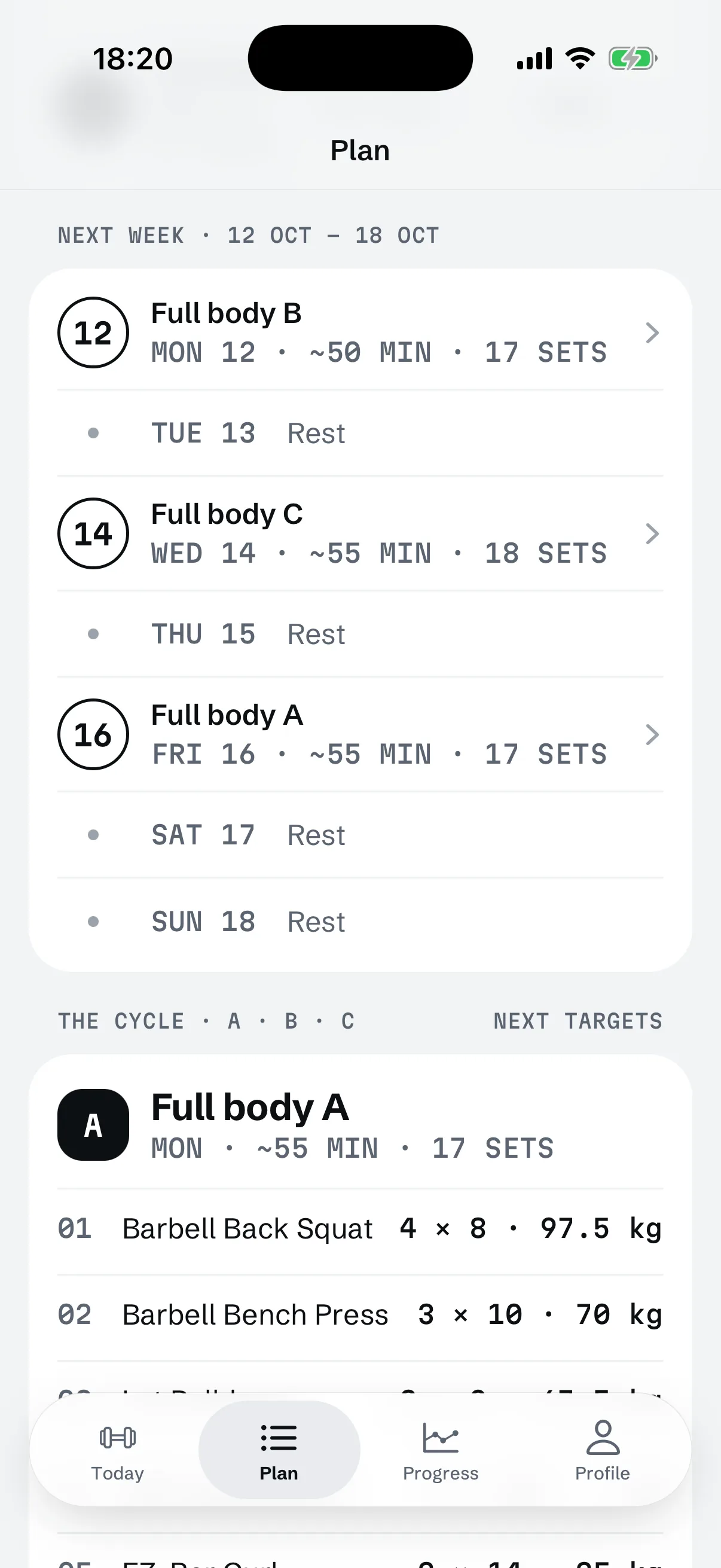
It needs no setting. In RIGOR, days passing never move your plan: a workout you did not do waits for you, and nothing is marked as failed (missed days and time off). The plan is a sequence of workouts, not a set of weekdays, so the three-day plan runs A, B, C, A, B, C for as long as you train, on whatever day each one falls.
The weights follow the same logic. The rules that set your next weights and reps look at your last sessions of each lift, not at the date. None of them counts days. The only training rule that does is the return after a break: from 14 days without a logged set, Today offers an easier return.
The plan's weeks follow the sequence too. A plan week ends when all of its workouts are done or skipped, not when the calendar turns over, and the effort target is set by plan week. For an intermediate's compound lifts it is 3 reps in reserve in week 1, then 2, 2 and 1. Every other day, a pass through the plan repeats every 6 days, not 7.
RIGOR is a strength training app for iPhone that builds your plan and sets every weight by rules you can read.
YOUR IPHONE

How do 3 and 4 sessions fit into calendar weeks?
Train on days 1, 3, 5, 7, 9 and on. Day 7 is the fourth session, so the first 7-day week holds four. Days 9, 11 and 13 fill the second, which holds three. Seven is odd, so the weeks flip between 4 and 3 while the rhythm holds, and any 14 days in a row hold exactly 7 sessions.
The plan has three workouts, so the letters do not line up with the weeks either.
| Week | Days trained | Workouts | Sessions | Working sets |
|---|---|---|---|---|
| 1 | 1, 3, 5, 7 | A · B · C · A | 4 | 69 |
| 2 | 9, 11, 13 | B · C · A | 3 | 52 |
| 3 | 15, 17, 19, 21 | B · C · A · B | 4 | 69 |
| 4 | 23, 25, 27 | C · A · B | 3 | 52 |
| 5 | 29, 31, 33, 35 | C · A · B · C | 4 | 70 |
| 6 | 37, 39, 41 | A · B · C | 3 | 52 |
| All six | 1 to 41 | Seven of each | 21 | 364 |
Which full-body program do you run every other day?
Use the full-body workout plan on the 3-day full body workout page, unchanged, as a routine of A, B and C. Its workouts were built for an intermediate who wants muscle size, in a commercial gym, with 60 to 75 minutes a session. Only the calendar changes.
| Workout | Opens with | Working sets |
|---|---|---|
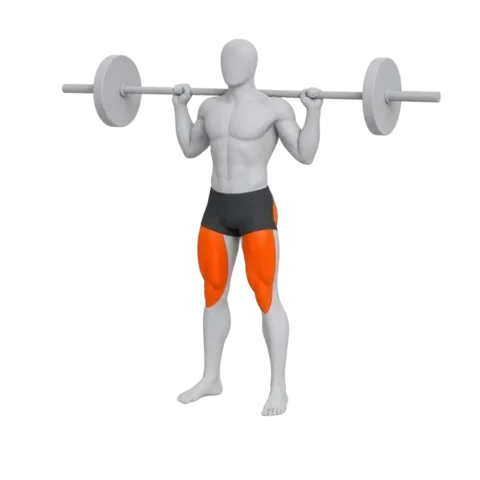
| A | Barbell Back Squat, 4 × 6–10 | 17 |
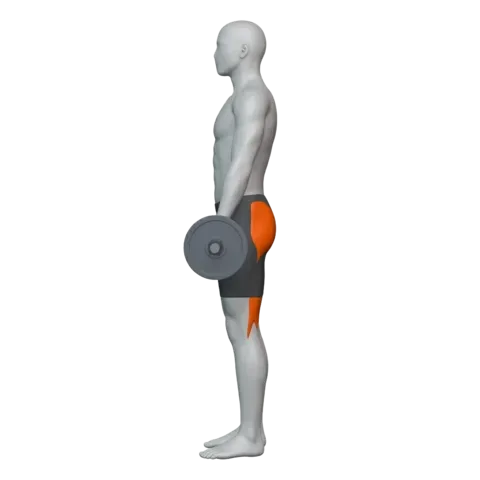
| B | Romanian Deadlift, 3 × 6–10 | 17 |
| C | Barbell Back Squat, 4 × 6–10 | 18 |
| A, B and C | One pass through the plan | 52 |
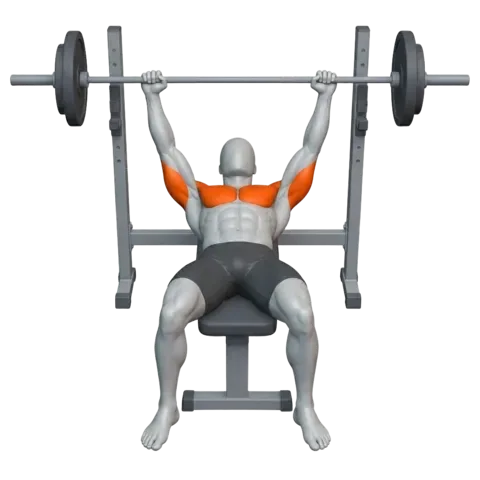
Each workout has a leg lift, a press and a pull, so the legs, chest and back are trained 3 or 4 times in a 7-day week.
How many sets a week does it give?
| Schedule | Sessions a week | Working sets a week |
|---|---|---|
| Monday, Wednesday, Friday | 3 | 52 |
| Every other day | 3 or 4 (3.5 on average) | 52, 69 or 70 (about 61 on average) |
A 3-session week is always 52 sets, because any three workouts in a row make one pass through the plan. A 4-session week is 52 plus the fourth workout: 69 when it is A or B, 70 when it is C. A pass takes 6 days instead of 7, so the average week holds 7/6 of the sets: a sixth more.
The Barbell Back Squat is in A and C. Every other day it comes round after 4 days, then after 2, then 4 again: days 1, 5, 7, 11, 13. On Monday, Wednesday and Friday the gaps are 4 and 3 days. Warm-up sets come on top; the warm-up calculator works them out from your first working weight.
How long does a block take every other day?
The plan's block is five weeks: four training weeks and a deload week, 15 sessions. Every other day, the 15th session falls on day 29. On Monday, Wednesday and Friday it falls on the Friday of week 5, day 33. The block ends four days sooner.
The deload week is the last pass, sessions 13 to 15, on days 25, 27 and 29. It spans two calendar weeks. In it you do half the sets, rounded up, with about 10% less weight, and the week is never used to judge progress.
What do the studies say about training this often?
The sources here count how many times a week a muscle is trained, and their summaries mention no rolling rhythm. A 2016 review of ten studies found that training a muscle group twice a week promoted superior hypertrophic outcomes to once a week. It left open whether three times beats twice (Schoenfeld 2016).
A 2019 review of 25 studies found no significant difference between higher and lower frequencies when the weekly work was equal. Where it was not equal, higher frequencies did better, but the difference between 1 and 3 or more days a week was modest (Schoenfeld 2019). Its authors' advice: for a given volume, choose the frequency you prefer.
Every other day changes both at once. Each muscle is trained 3 or 4 times a week, and the weekly sets rise from 52 to about 61. So the equal-work finding does not describe it directly. Nothing in these summaries shows 3.5 sessions a week beating 3, or the reverse, and none says how far apart sessions should be. The research is thin here.
Full body every other day vs upper lower: which split?
Neither is better when the weekly sets are equal. A 2024 review of 14 studies and 392 people compared split and full-body routines. Bench press strength, leg strength and muscle growth changed by similar amounts when the volume was equated, and its authors conclude that people can choose by preference (Ramos-Campo 2024).
The weeks here are not equal. RIGOR's four-day upper/lower plan has 53 working sets a week, against 52 on three fixed days and about 61 every other day. The two plans are also written for different levels, upper/lower for a beginner and full body for an intermediate, so this compares shapes, not matched programs.
Upper/lower asks for four days a week and gives each half of the body two days of its own. See the 4-day upper lower split. Over three days, some lifters run an upper, a lower and a full-body day instead. Full body every other day asks for a workout every second day, whichever weekday it falls on. The best workout split sets each split against the days you can train.
When does a rolling schedule not fit?
- You skip a day. Do the next workout when you train, or move or skip one from Today. The rhythm shifts by a day and the weeks in the table fall differently.
- You are new. The position stand's range for novices is 2 to 3 days a week. Three fixed days gives the same plan with 52 sets every week.
- You want the same weekdays. Monday, Wednesday and Friday runs the same A, B, C.
RIGOR runs the plan in order, not by date
Questions
Is full body every other day 3 or 4 days a week?
Both, alternating. Training on days 1, 3, 5, 7 and on gives 4 sessions in the first 7-day week, then 3, then 4 again: 3.5 a week on average.
Does RIGOR need a special plan to train every other day?
No. A workout you did not do waits for you and days passing never move the plan, so the three-day full-body plan runs as it is: you do the next workout whenever you train.
What is a 3 day full-body workout routine for building muscle?
RIGOR's three-day plan has workouts A, B and C of 17, 17 and 18 working sets, built for muscle size in a commercial gym. Each workout opens with a squat or a Romanian deadlift.
How many sets a week is full body every other day?
With RIGOR's three-day plan, 52 working sets in a 3-session week and 69 or 70 in a 4-session week: about 61 on average, a sixth more than three fixed days.
What if I skip a day on a rolling schedule?
Do the next workout when you train. You can also move or skip one from Today. Only a gap of 14 days or more changes anything: Today then offers an easier return.
Which is better, a split or full body every other day?
Neither, when the weekly sets are equal: a 2024 review of 14 studies found similar strength and muscle growth from split and full-body routines. The weeks compared on this page do not have equal sets.