Rest about 3 minutes between heavy sets and big leg lifts, 2 minutes on presses, rows and pulldowns, 90 seconds on isolation lifts and a minute on ab exercises. For strength, long rests matter most. For muscle growth, the studies favour more than a minute and find little difference past 90 seconds.
How long should you rest between sets?
About 3 minutes after a heavy set or a big leg lift, 2 minutes after a press, a row or a pulldown, 90 seconds after an isolation lift and a minute after an ab exercise. The right rest time between sets depends on the lift and on how heavy the set is.
These are the times RIGOR, the app behind this guide, sets its rest timer to. Each row names lifts from its plans.
| Type of lift | Rest | Such as |
|---|---|---|
| Heavy sets, any lift | 3:00 | A strength plan's main lifts, at 4 to 6 reps |
| Lower-body compound | 3:00 | Barbell Back Squat, Leg Press, Romanian Deadlift |
| Upper-body compound | 2:00 | Barbell Bench Press, Lat Pulldown, Seated Cable Row |
| Isolation | 1:30 | EZ-Bar Curl, Leg Extension, Standing Calf Raise |
| Core | 1:00 | Crunch, Cable Crunch |
The heavy-set row is checked first. A bench press at 4 to 6 reps rests 3:00; the same lift at 8 to 12 rests 2:00. The Barbell Deadlift rests 3:00 in either case.
How long to rest between sets for strength?
Three minutes or more on the heavy lifts. A 2018 systematic review of 23 studies and 491 people concluded that trained lifters seem to need more than 2 minutes between sets to gain the most strength. For untrained people, 1 to 2 minutes seemed to be enough.
The American College of Sports Medicine's 2009 guidance goes further for heavy loading, weights you can lift 1 to 6 times: 3 to 5 minutes between sets.
RIGOR follows the rep range. The main lifts of a strength plan are sets of 4 to 6 reps, so each rests 3:00, upper body or lower.
RIGOR is a strength training app for iPhone that builds your plan and sets every weight by rules you can read.
YOUR IPHONE

How long to rest between sets for muscle growth?
More than a minute, and past 90 seconds the studies find little difference. The fullest look at rest between sets for hypertrophy is a 2024 meta-analysis of 9 studies. It found a small benefit for rests longer than 60 seconds and no appreciable difference beyond 90. Its estimates overlap widely and the studies disagree with each other, so read it as a lean, not a law.
The same analysis asked whether it changes anything if sets go to failure or stop short, with reps in reserve. It did not meaningfully change the effect of rest.
The older guidance is close: the American College of Sports Medicine gave 1 to 2 minutes for muscle growth. RIGOR's times for a muscle-growth plan are the table's: 3:00 on leg lifts, 2:00 on upper-body compounds, 1:30 on isolation lifts.
Do shorter rest periods build more muscle?
No. In an 8-week study, 21 trained men did the same full-body workouts three times a week: 3 sets of 8 to 12 reps on 7 exercises. One group rested 1 minute between sets, the other 3 minutes. The 3-minute group gained more strength in the squat and the bench press, and more muscle thickness in the front of the thigh.
What does a short rest cost?
Reps on the sets that follow. In a 2005 study, 15 men did 4 sets of squats and 4 of bench presses with a weight they could lift 8 times, resting 1, 2 or 5 minutes. They completed the most reps with 5 minutes, fewer with 2 and the fewest with 1.
Those reps matter to any plan that progresses on reps. RIGOR uses double progression: the weight goes up when every set reaches the top of the rep range. Take a Barbell Bench Press at 60 kg, or 135 lb where the plates are in pounds, 3 sets of 8 to 12. Say you cut the rests short and the reps fall away.
The weight moves only when all three sets reach 12. The rest is what gives the second and third sets their chance.
Is 1 minute enough rest between sets?
For ab exercises, yes; for heavy compound lifts it is less than they need. RIGOR sets 1:00 for core work such as a crunch and 1:30 for isolation lifts. A minute still trains you: the 2018 review found robust strength gains even with rests under 60 seconds. What you give up is reps on the later sets of the big lifts.
What you get back is time. Here is Upper A of the 4 day upper lower split, with the rest after each set.
| Exercise | Sets × reps | Rest |
|---|---|---|
| Dumbbell Bench Press | 4 × 5–8 | 2:00 |
| Lat Pulldown | 3 × 8–12 | 2:00 |
| EZ-Bar Curl | 2 × 10–15 | 1:30 |
| Dumbbell Lateral Raise | 2 × 12–20 | 1:30 |
| Machine Chest Fly | 2 × 10–15 | 1:30 |
| Crunch | 2 × 12–20 | 1:00 |
At one minute each, the 14 rests would take 14 minutes, not 24. That is ten minutes saved, most of it taken from the bench press and the pulldown.
How long to rest between sets of bench press?
Two to three minutes. RIGOR gives a bench press 2:00 as an upper-body compound, and 3:00 when its rep range tops out at 6 reps or fewer.
In a 2006 study, 16 trained men did 5 sets of bench press with 1, 2 or 3 minutes of rest, once with a heavy weight (80% of their one rep max) and once with a light one (50%). With both, 3 minutes gave more total reps than 2 minutes or 1.
How RIGOR's rest timer works
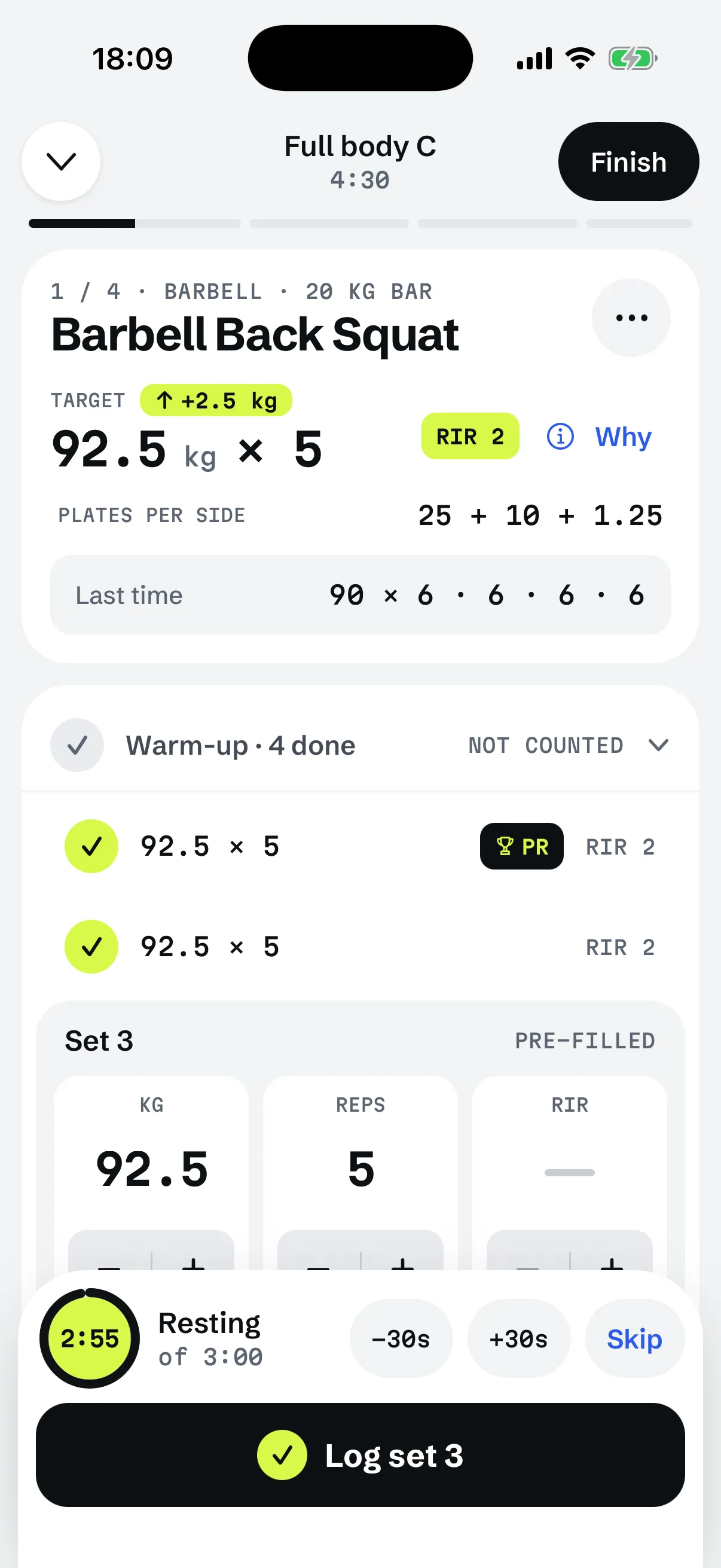
Rest starts when you log a set. The lift shown is a Barbell Back Squat, a lower-body compound, so by default 3:00 follows each set.
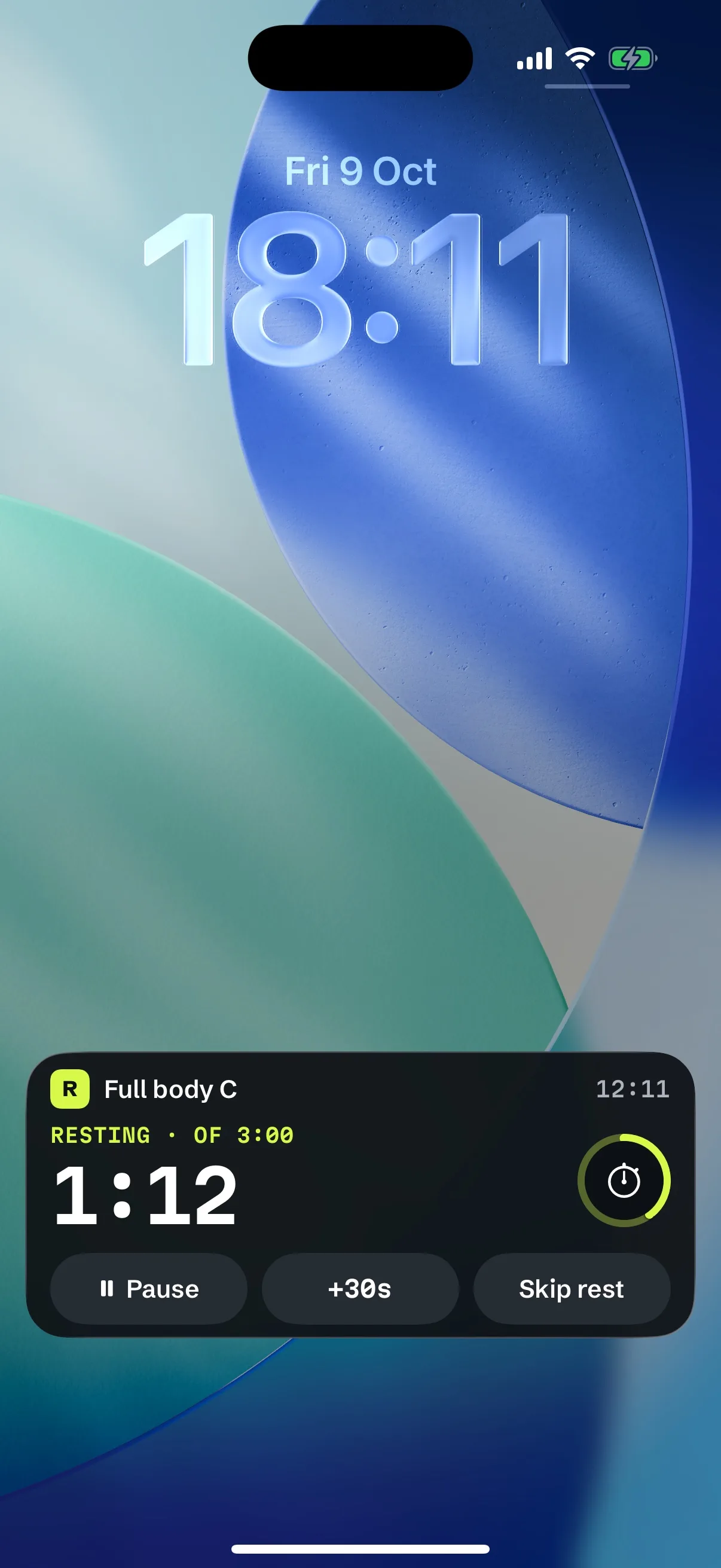
From the timer you can pause it, add or take off 30 seconds, or skip it. It also shows on the Lock Screen and in the Dynamic Island, and RIGOR can alert you when rest ends, with the iPhone locked too.
The times are defaults. Change them, or give one exercise its own rest, in Profile › Workout settings › Rest times. The help page is Rest timer and Lock Screen.
When do these rest times not apply?
On warm-up sets and timed holds, and whenever you need longer. The cases:
- Warm-up sets. They are light and stop far from failure, so they need less rest than a working set. The times in this guide are for working sets.
- Timed holds. A hold has no rep range, so it rests by what it trains. In RIGOR a plank rests 1:00 and a farmer's walk 3:00.
- A beginner's plan. In the 2018 review, 1 to 2 minutes seemed enough for untrained people to gain the most strength. RIGOR's beginner plans keep the times in the table.
- A set you are not ready for. The timer is a default. Add 30 seconds and go when you can repeat the lift well.
Rest between sets is recovery inside one workout. Recovery across weeks is a different tool: a deload week, a planned lighter week at the end of a block.
RIGOR times every rest for you
Questions
How long should you rest between sets?
About 3 minutes after heavy sets and big leg lifts, 2 minutes after presses, rows and pulldowns, 90 seconds after isolation lifts and a minute after ab exercises. Those are the times RIGOR's rest timer sets.
How long to rest between sets for strength?
Three minutes or more on the heavy lifts. A 2018 review of 23 studies concluded that trained lifters seem to need more than 2 minutes to gain the most strength, while 1 to 2 minutes seemed enough for untrained people.
How long to rest between sets for muscle growth?
More than a minute. A 2024 analysis of 9 studies found a small benefit for rests over 60 seconds and no appreciable difference past 90 seconds.
Is 1 minute enough rest between sets?
For ab exercises, yes. For heavy compound lifts it is less than they need: with a minute you complete fewer reps on the later sets than with two minutes or more.
Do shorter rest periods build more muscle?
No. In an 8-week study of 21 trained men, the group that rested 3 minutes gained more strength, and more muscle thickness in the thigh, than the group that rested 1 minute.
How long to rest between sets of bench press?
Two to three minutes. RIGOR sets 2:00 for a bench press, and 3:00 when its rep range tops out at 6 reps or fewer. In a 2006 study, 3 minutes of rest gave more total reps over five sets than 2 minutes or 1.
Can you change the rest times in RIGOR?
Yes. Change the defaults, or give one exercise its own rest, in Profile › Workout settings › Rest times. During a rest you can pause the timer, add or take off 30 seconds, or skip it.