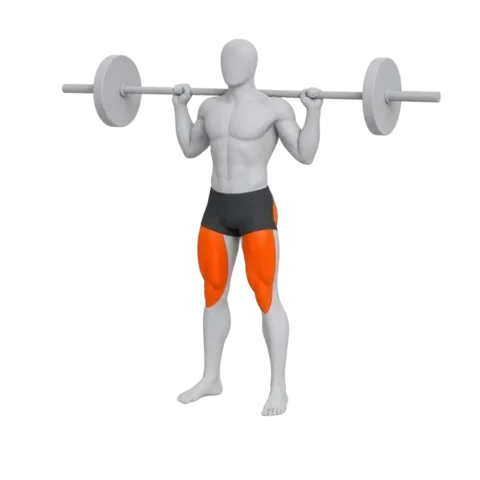
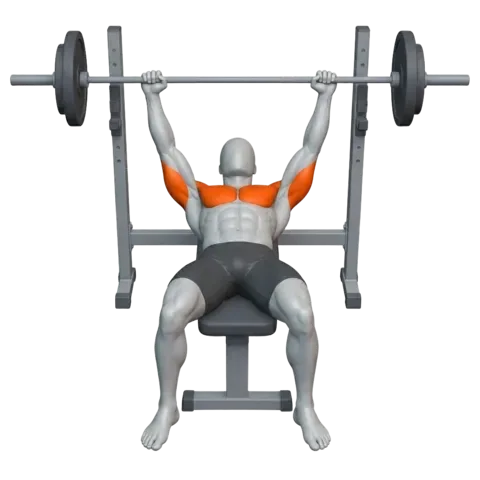
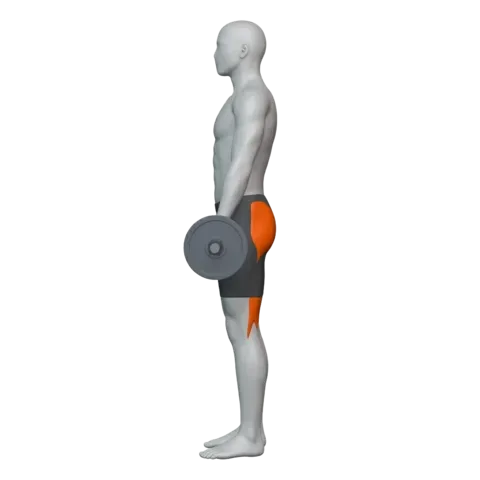
The best workout split is the one that fits the days you can train. Use full body for three days a week, upper/lower for four and push/pull/legs for six; each trains the legs, chest and back two or three times a week. In reviews of the research, split and full-body routines built similar muscle and strength when the weekly sets were equal.
Which workout split is best?
None is best on its own: the best workout split is the one that fits the days you can train. Three days a week suits full body, four suits upper/lower and six suits push/pull/legs (PPL).
A workout split is how a week's training is divided between days. The three here:
- Full body: every workout trains the legs, the chest and the back.
- Upper/lower: upper-body days (chest, back, shoulders, arms) alternate with lower-body days (legs, glutes, calves).
- Push/pull/legs: push days train the chest, shoulders and triceps, pull days the back and biceps, legs days the lower body.
RIGOR, the app behind this guide, builds a plan from your days, your session length and your equipment. Its rules pair each number of days with a split.
| Days a week | Recommended | Also allowed |
|---|---|---|
| 2 | Full body | Upper/lower |
| 3 | Full body | Push/pull/legs, each muscle once a week |
| 4 | Upper/lower | Full body |
| 5 | Upper/lower plus push/pull/legs | Full body |
| 6 | Push/pull/legs, twice | Upper/lower, three times |
Best workout split for 3 days a week
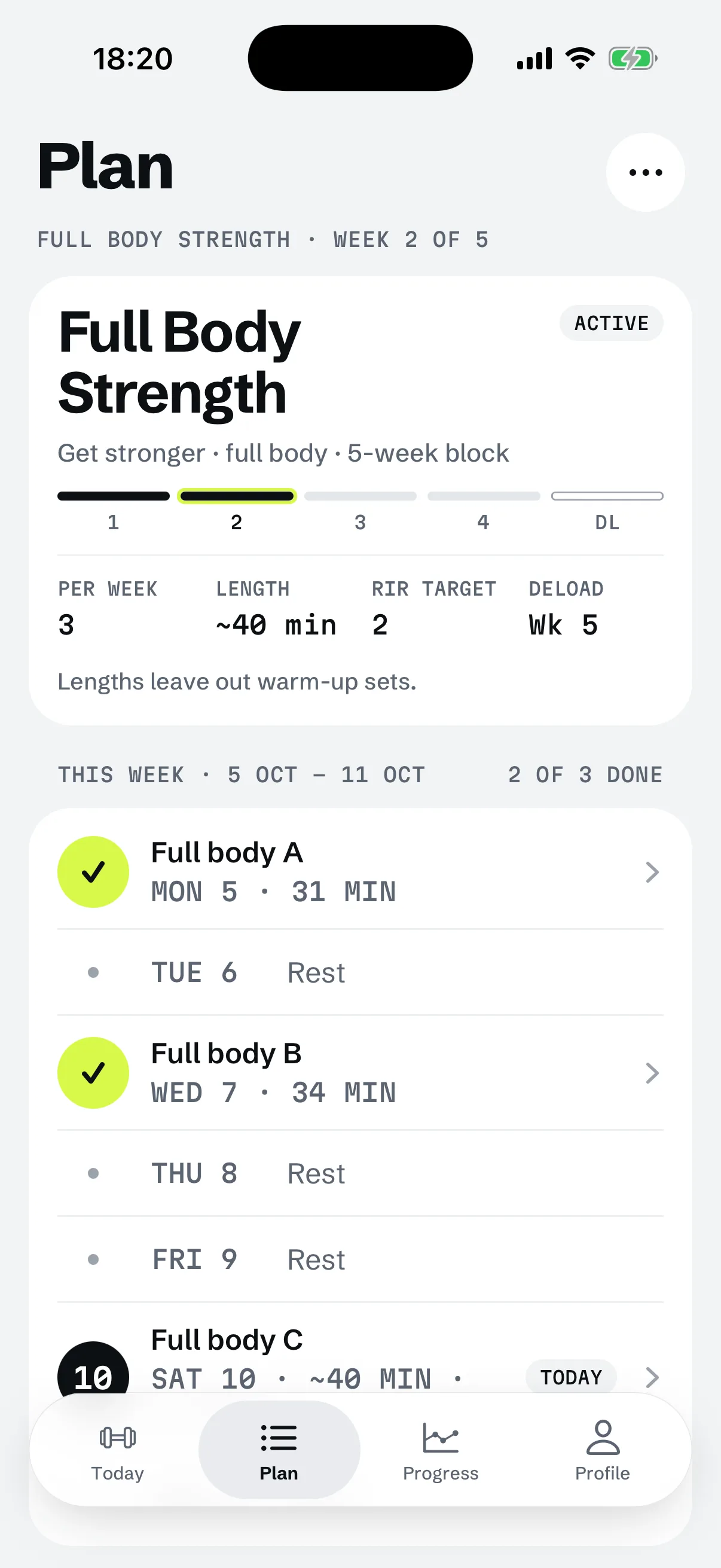
Full body. With three days, each workout trains the whole body, so the legs, chest and back are worked three times a week and one missed day leaves none of them untrained.
- MONFull body A
- TUERest
- WEDFull body B
- THURest
- FRIFull body C
- SATRest
- SUNRest
The 3-day full body workout is the plan for a commercial gym: 17 or 18 working sets a session, 60 to 75 minutes, written for an intermediate. With dumbbells only, the 3-day dumbbell workout keeps the same week in 30 to 45 minutes, with 9 to 11 sets a session, written for a beginner.
Push/pull/legs on three days trains each muscle once a week. RIGOR allows it and flags it. Its rules cap a muscle group at 10 sets in one session, with half a set counted for a muscle that only helps, and an intermediate's weekly target for a big muscle group is 13, which once a week cannot reach.
RIGOR is a strength training app for iPhone that builds your plan and sets every weight by rules you can read.
YOUR IPHONE

Best workout split for 4 days a week
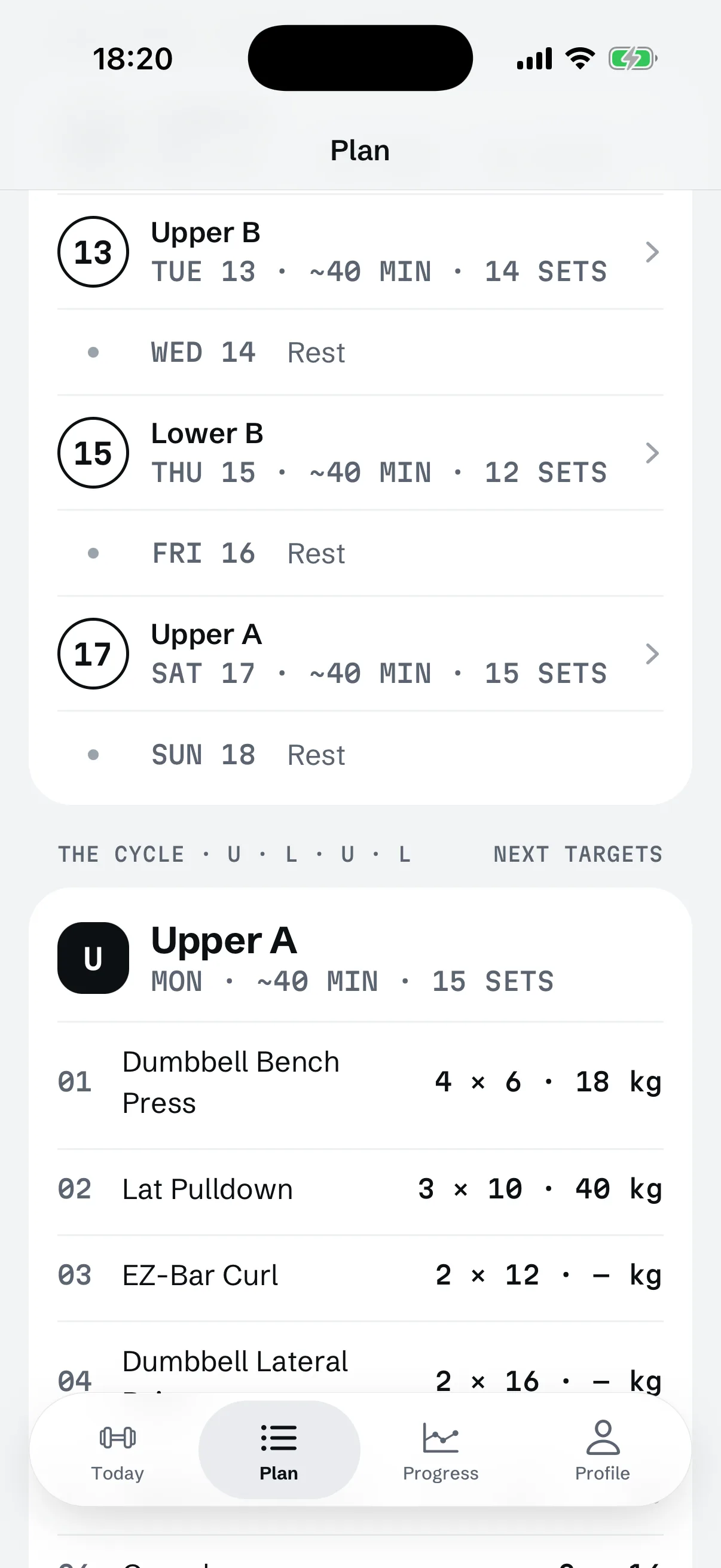
Upper/lower. Four days make two upper-body and two lower-body workouts, so each half of the body is trained twice a week on days of its own.
- MONUpper A
- TUELower A
- WEDRest
- THUUpper B
- FRILower B
- SATRest
- SUNRest
The 4-day upper lower split is written for a beginner: four workouts of 12 to 15 sets, 45 to 60 minutes each.
Best workout split for 6 days a week
Push/pull/legs, run twice. Six days make push, pull and legs, then push, pull and legs again, with one rest day.
- MONPush A
- TUEPull A
- WEDLegs A
- THUPush B
- FRIPull B
- SATLegs B
- SUNRest
The 6-day push pull legs routine is written for an advanced lifter: 84 working sets a week in sessions of 12 to 16. It is not a split to start on. If you cannot keep six days most weeks, train four.
What about 5 days a week?
For five days, RIGOR's rules recommend a mix: upper/lower plus push/pull/legs. The chest and back are trained on the upper day and again on the push and pull days, the legs on the lower day and the legs day.
This site has no five-day program written out: the four plans below are for three, four and six days.
The four plans side by side
Each of the four is a plan RIGOR's engine built, and the numbers are its own.
| Plan | Days | Written for | Session | Block |
|---|---|---|---|---|
| Full body | 3 | Intermediate | 60–75 min | 5 weeks, the last a deload |
| Upper/lower | 4 | Beginner | 45–60 min | 4 weeks, no deload |
| Push/pull/legs | 6 | Advanced | 60–75 min | 5 weeks, the last a deload |
| Dumbbell full body | 3 | Beginner | 30–45 min | 4 weeks, no deload |
| Plan | Sets a session | Sets a week | Legs, chest and back |
|---|---|---|---|
| Full body | 17–18 | 52 | 3 times a week each |
| Upper/lower | 12–15 | 53 | 2 times a week each |
| Push/pull/legs | 12–16 | 84 | 2 times a week each |
| Dumbbell full body | 9–11 | 30 | 3 times a week each |
The targets follow the level, not the split: RIGOR aims a beginner at 10 sets a week for each big muscle group, an intermediate at 13 and an advanced lifter at 16. When the session is too short for that, RIGOR cuts sets to fit the time: the dumbbell plan most of all, and the full-body plan a little.
The big lifts start with warm-up sets. Before a 60 kg squat they are 20, 25, 35 and 47.5 kg; before 135 lb, 45, 55, 80 and 110 lb.
RELATED TOOLWarm-up calculatorWarm-up sets from your first working weight.Full body vs upper lower vs PPL: what the studies say
No split is best in the studies. Three reviews compare how often a muscle is trained, or full-body routines with split ones.
- A 2016 review of ten studies found that training a muscle twice a week grew more muscle than once a week. It could not say whether three times beats two.
- A 2019 review of 25 studies found no significant difference in muscle growth between higher and lower frequencies when the weekly work was equal. Where it was not equal, training more often did better, by a modest margin.
- A 2024 review of 14 studies and 392 people compared split routines with full-body ones. Bench press strength, leg strength and muscle growth were similar when the weekly work was equal.
The 2019 and 2024 authors end in the same place: for a given amount of weekly work, choose by preference. None of the three ranks upper/lower against push/pull/legs; the 2024 review takes split routines as one group.
Full body vs upper lower
Neither is better when the weekly sets are equal. Full body fits three days and trains the legs, chest and back three times. Upper/lower needs four days and trains each twice. A three-day hybrid mixes the two.
Upper lower vs PPL
Neither is better. Both train each big muscle at least twice a week: an upper lower split in four days, a push pull legs routine in six. What six days give is room. The six-day plan's 84 sets average 14 a session; on four days they would need 21.
Which workout split is best for beginners?
Full body on three days, or upper/lower if you can keep four. The American College of Sports Medicine recommends two to three days a week for novices.
The four-day upper/lower and the three-day dumbbell plan are written for a beginner. The three-day full-body plan is written for an intermediate. For a beginner RIGOR plans the same week with fewer sets, leaves the deload week off by default, and keeps one more rep in reserve in weeks 2 and 4. New to lifting? Start with how to start lifting weights and gym terms. Your first day at the gym is a plan's first workout.
How many days a week should I work out?
Train the most days you will keep, from two to six, the range RIGOR's rules build plans for. To build muscle, the 2016 review's authors advise training each big muscle at least twice a week. The American College of Sports Medicine's guidance is two to three days for novices, rising to four to five for advanced lifters.
- Two or three days: full body; on three, it can run full body every other day.
- Four days: upper/lower, each half of the body twice a week.
- Five days: a mix, as above.
- Six days: push/pull/legs twice, with one rest day.
RIGOR's rules stop at six days, so lifting every day is not a plan they build. A 2019 review of 25 studies found no significant difference in muscle growth between higher and lower training frequencies when the weekly work was equal. When it was not equal, more frequent training did better by a modest margin.
When should you change your split?
When the days you can train change, not because a block ended. A block is four training weeks, with a lighter fifth, the deload week, when the plan has one. At its end, repeat the plan with your new weights for as long as your reps or weights keep going up on most lifts.
The rule that moves the weights is the same in every split. It is double progression: add reps until every set reaches the top of the rep range, then add the smallest weight your gym can make, usually 2.5 kg or 5 lb on a barbell.
In RIGOR, building a new plan asks the training questions again and shows every workout before you activate anything. The plan it replaces is kept, and your next weights carry over. See changing your plan.
Choosing an app to plan your split? RIGOR vs Fitbod puts the two apps side by side.
Get a split built for your days
Questions
What is the best workout split for 3 days a week?
Full body. Three workouts train the legs, chest and back three times a week, with a rest day between sessions.
What is the best workout split for 4 days a week?
Upper/lower. Two upper-body and two lower-body workouts train each half of the body twice a week.
What is the best workout split for 5 days a week?
RIGOR's rules recommend a mix for five days: upper/lower plus push/pull/legs. Full body on five days is also allowed.
Full body vs upper lower: which is better?
Neither, when the weekly sets are equal. A 2024 review of 14 studies found similar strength and muscle growth from split and full-body routines.
Upper lower vs PPL: which is better?
Neither. Both train each big muscle at least twice a week, in four days or in six. Pick the one whose days you can keep.
Which workout split is best for beginners?
Full body on three days, or upper/lower if you can keep four. The American College of Sports Medicine recommends two to three days a week for novices.
Is working out 3 days a week enough?
It can be. Three full-body days train the legs, chest and back three times a week each, above the twice-a-week advice of the 2016 review. RIGOR's rules recommend full body for three days.
Is working out 5 days a week too much?
RIGOR's rules allow it and recommend upper/lower plus push/pull/legs for five days. The reviews cited here compare how often a muscle is trained and set no limit on days.