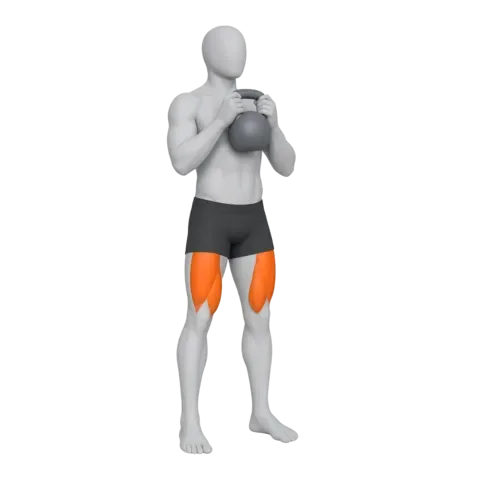
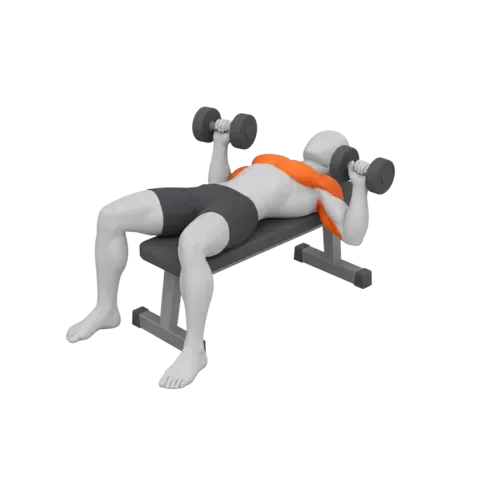
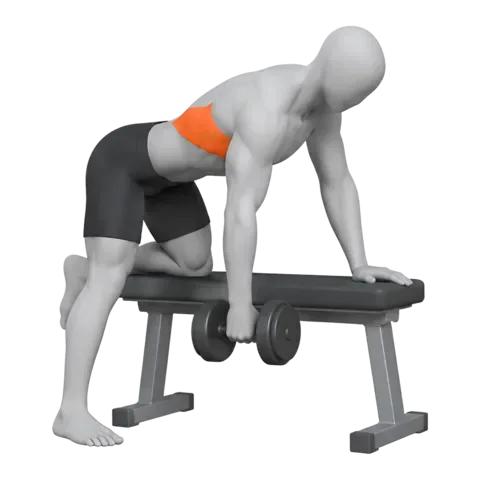
An upper lower full body week has three workouts, one upper, one lower and one full body. Each half of the body is trained twice a week. RIGOR does not build this hybrid. At three days it recommends full body and also allows push/pull/legs; upper/lower is not offered at three.
What is upper lower full body training?
It is a three-day week made of three different workouts: an upper-body day, a lower-body day and a full-body day. The upper day trains the chest, back, shoulders and arms. The lower day trains the legs and glutes. The full-body day trains both halves.
Add it up and each half of the body is trained twice a week: the upper muscles on the upper day and the full-body day, the legs on the lower day and the full-body day. That is the appeal of the hybrid. It is a way to get a twice-a-week week out of three days.
RIGOR, the app behind this guide, does not build it. The rest of this page shows why, and what the app builds on three days.
Does RIGOR build an upper, lower and full-body week?
No. The generator holds a short list of structures for each number of days a week, and a mixed week is not on it. Any other pairing of days and structure is refused with a constraint code (unsupported_structure) rather than quietly replaced.
| Days a week | Recommended | Also allowed |
|---|---|---|
| 2 | Full body | Upper/lower |
| 3 | Full body | Push/pull/legs, flagged: each muscle once a week |
| 4 | Upper/lower | Full body |
| 5 | Upper/lower plus push/pull/legs | Full body |
| 6 | Push/pull/legs, twice | Upper/lower, three times |
Two things stand out. Upper/lower is not offered at three days. And the only week that puts different kinds of day together is the five-day one, with an upper, a lower, a push, a pull and a legs day. Nothing pairs a full-body day with an upper and a lower day.
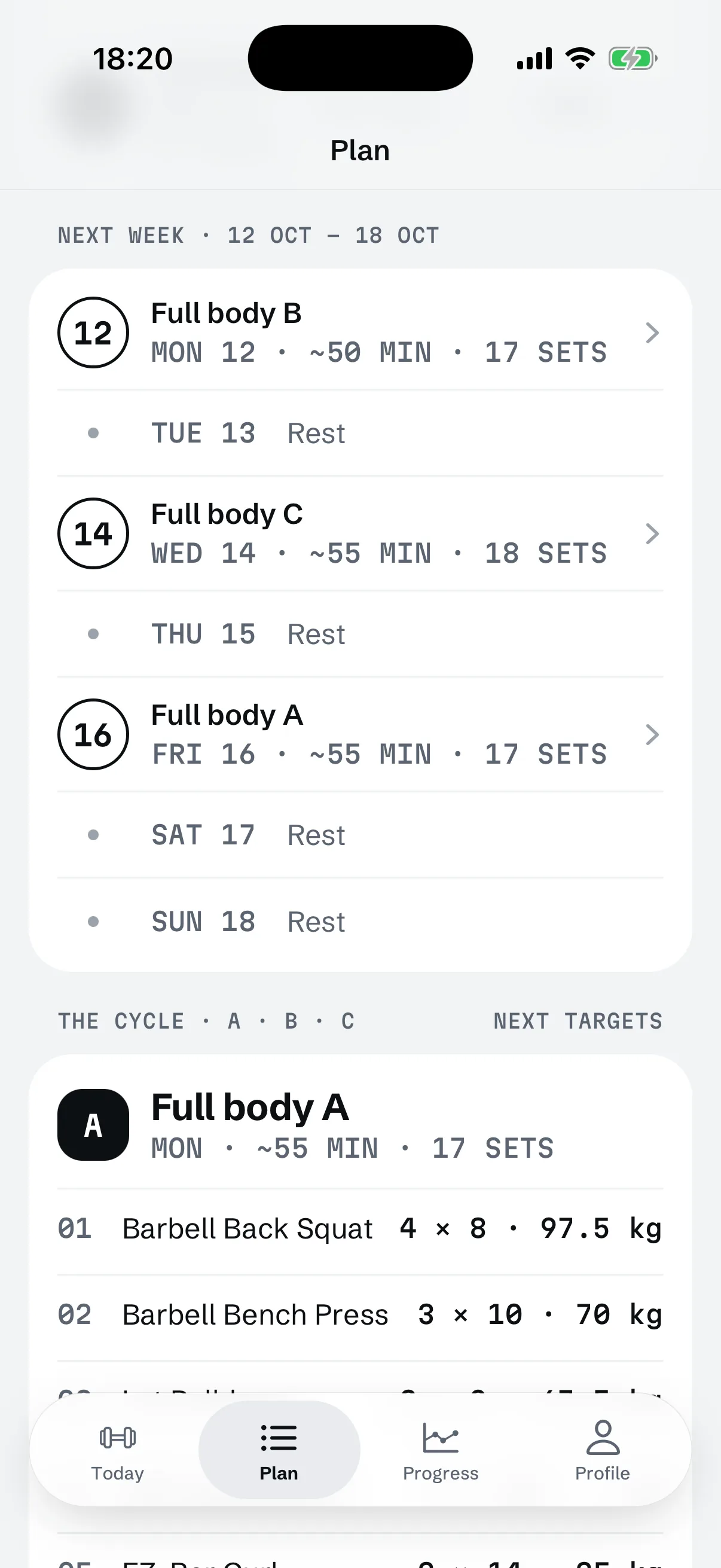
RIGOR is a strength training app for iPhone that builds your plan and sets every weight by rules you can read.
YOUR IPHONE

What does RIGOR give at three days?
Full body is the recommended structure, and push/pull/legs is allowed with a flag, because it trains each muscle once a week. The 3 day full body workout is the plan RIGOR's rules build for it, with a rest day between sessions.
- MONFull body A
- TUERest
- WEDFull body B
- THURest
- FRIFull body C
- SATRest
- SUNRest
Each workout trains the legs, chest and back, so each is trained three times a week. The rules cite research for the twice-a-week target: "train each muscle about twice a week". A three-day full-body week is above that line, and the hybrid sits on it.
How often does each week train the legs, chest and back?
Here is the arithmetic for the weeks in play. The first two rows are RIGOR plans. The last two are not: they are counted from the shape of the week.
| Week | Days | Legs, chest and back |
|---|---|---|
| Full body, RIGOR plan | 3 | 3 times each |
| Upper/lower, RIGOR plan | 4 | 2 times each |
| Upper, lower, full body | 3 | 2 times each |
| Upper/lower alternating | 3 | Twice one week and once the next, for 1.5 on average |
The last row is why a "3 day upper lower split" is awkward. Alternating upper and lower across three days gives upper, lower, upper in one week and lower, upper, lower in the next. Each half then gets two sessions one week and one the next. The hybrid fixes that by making the third day a full-body day.
How do the weekly sets compare, full body at 3 days against upper/lower at 4?
The two plans below are not matched. The full-body plan is for an intermediate on a muscle-size goal with 60 to 75 minutes a session. The upper/lower plan is for a beginner on a strength-and-size goal ("both") with 45 to 60 minutes. They have different day counts, levels and goals, so this compares the shape of a week, not the same program cut two ways.
The counts follow section 6 of the training rules: a working set counts 1 for a muscle group when one of the exercise's primary muscles is in it, and 0.5 when only a secondary muscle is, at most once per group. Warm-up sets are left out.
| Muscle group | Full body, 3 days | Upper/lower, 4 days |
|---|---|---|
| Chest | 12 | 10 |
| Back | 13.5 | 10 |
| Quads | 13 | 10 |
| Hamstrings | 12.5 | 10 |
| Glutes | 16 | 15 |
| Shoulders | 11.5 | 12 |
| Biceps | 7 | 6.5 |
| Triceps | 9.5 | 7 |
| Calves | 4.5 | 6 |
| Abs | 2 | 6.5 |
The totals are close: 52 working sets against 53. The difference is how they are cut. The full-body week spends them in three sessions of 17, 17 and 18 sets, and the upper/lower week in four sessions of 15, 12, 14 and 12.
The rules set a weekly target for each major group: 10 for a beginner and 13 for an intermediate. The upper/lower plan meets 10 on chest, back, quads and hamstrings. The full-body plan is fitted to its time, and its record notes that volume was capped by time. Chest at 12, shoulders at 11.5 and hamstrings at 12.5 sit under the intermediate's 13.
Which is better, full body or upper lower full body?
The research does not pick one. A 2024 review of 14 studies and 392 people compared split and full-body routines and found similar bench press strength, leg strength and muscle growth when volume was equated. Its authors say individuals are free to choose by preference (Ramos-Campo 2024). That review treats split routines as one group, so it says nothing separate about a hybrid.
On frequency, a 2016 review of ten studies found that training a muscle twice a week grew more than once a week. It could not say whether three times beats two (Schoenfeld 2016). A 2019 review of 25 studies found no significant difference between higher and lower frequencies when volume was equated, and a modest edge for higher frequencies when it was not (Schoenfeld 2019).
So the choice between three times a week and two is not settled by these studies, and both weeks clear the once-a-week mark. What differs is practical. Full body gives every workout the same shape and one missed day leaves nothing untrained. The hybrid gives each day a different job.
Who might choose the hybrid, and what do you do in RIGOR?
Someone who wants each half of the body on its own day as well as a full-body day, and can train three days. That is a reason of taste, not of results, and RIGOR does not make that week.
In RIGOR you have three routes. Choose full body at three days, the recommended structure. Choose push/pull/legs at three days, with its flag that each muscle is trained once a week. Or move to four days and take upper/lower, the 4 day upper lower split, which trains each half twice. The best workout split sets all three against the days you can train.
If you train three days but not on a fixed pattern, full body every other day shows how full body fits a week that does not stay the same.
When does this not apply?
The weekly sets above are two plans RIGOR built for particular answers. A different level, goal, session length or gym changes the counts.
Get a three-day week built for your gym
Questions
What is an upper lower full body split?
A three-day week of one upper-body workout, one lower-body workout and one full-body workout. Because the full-body day trains both halves, the legs, chest and back each get two sessions a week.
Can I do a 3 day upper lower split?
Not as a RIGOR plan. The app offers upper/lower at two, four and six days, and inside the five-day mix, but not at three. On three days a week you would alternate upper and lower, so one half is trained twice one week and once the next.
Does RIGOR build an upper, lower and full-body week?
No. Its structures are full body, upper/lower, push/pull/legs, and upper/lower plus push/pull/legs for five days. A week that mixes a full-body day with upper and lower days is not one of them.
What does RIGOR give at three days?
Full body is recommended. Push/pull/legs is allowed and flagged, because it trains each muscle once a week.
Is training a muscle twice a week enough?
A 2016 review of ten studies found twice a week built more muscle than once a week. It could not say whether three times beats two.
Does the split matter if the weekly sets are equal?
Not in the 2024 review of 14 studies: split and full-body routines gave similar strength and muscle growth when volume was equated, and the authors say to choose by preference.