Start lighter than where you stopped, and the longer you were away, the lighter. RIGOR, the app behind this guide, takes 5% off the weight after two to four weeks away, 15% after four to eight, 25% after eight weeks to six months and 40% after six months, and drops a set from four weeks on.
How should you start getting back into the gym after a long break?
Start lighter than where you stopped, and let the length of the break set how much lighter. A few weeks away costs a small cut. Months away cost a bigger one, and a year or more away calls for a fresh look at the plan.
RIGOR, the app behind this guide, writes that down as a rule. When your last logged workout is 14 days old or more, Today offers three choices: continue as planned, start with an easier return, or revisit the plan. The easier return changes the first workout back and nothing else. New to lifting rather than coming back? Start with your first day at the gym.
How much to cut: RIGOR's return table
The cut depends on the days since your last workout with a completed working set. The weight is a share of what the app would have asked for that day, and from four weeks on each exercise loses one set.
| Days since last workout | Weight | Sets |
|---|---|---|
| 14–27 | 95% (5% off) | Unchanged |
| 28–55 | 85% (15% off) | One fewer per exercise |
| 56–179 | 75% (25% off) | One fewer per exercise |
| 180 or more | 60% (40% off) | One fewer per exercise, and the app suggests a new plan |
The numbers are RIGOR's own choice. The research below says only which way to lean. The rule changes weight and sets, and nothing else about the workout.
Every new weight is rounded down to one that your gym can make, the heaviest one at or below the result, so a 5% cut can land a little lower. See the weights your gym can make. A set is dropped from the end, and an exercise never goes below one set.
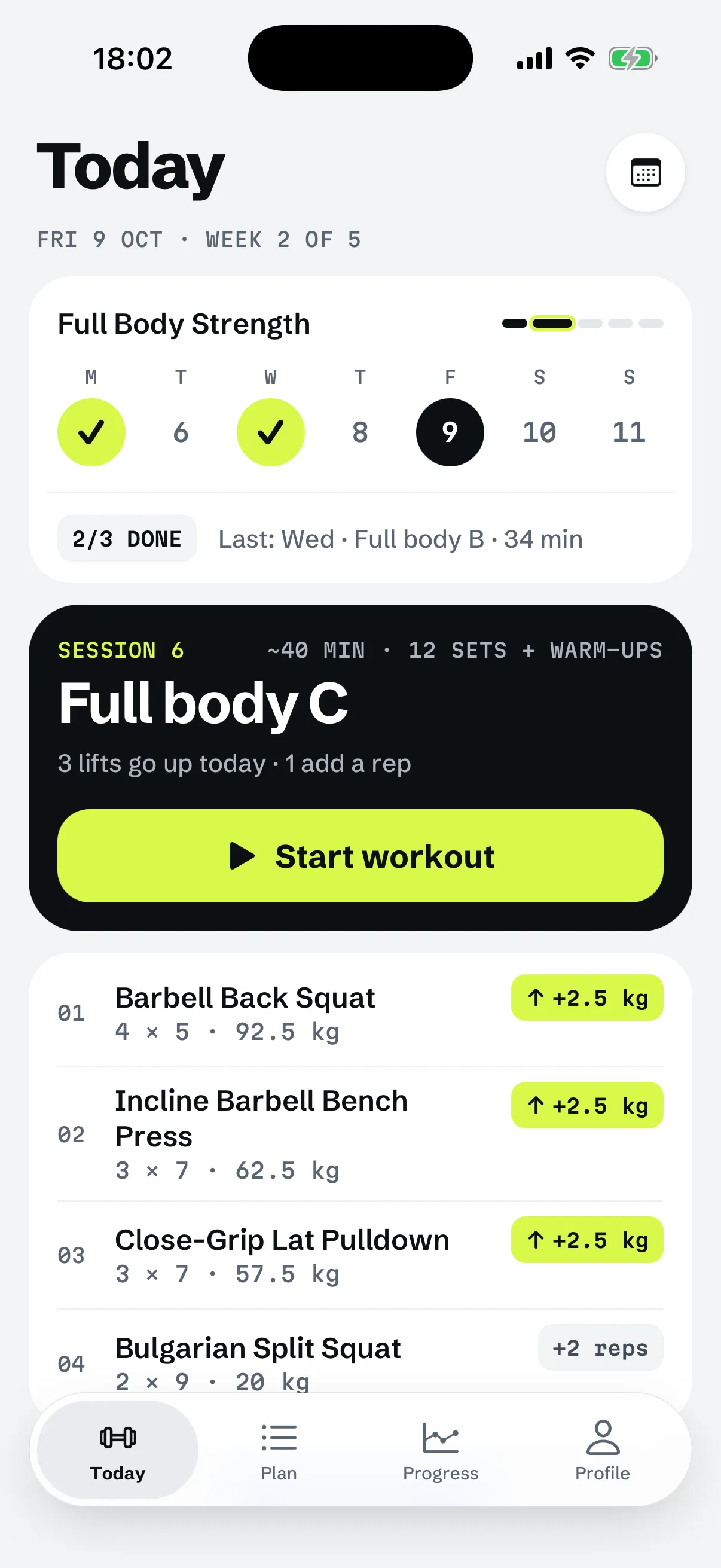
RIGOR is a strength training app for iPhone that builds your plan and sets every weight by rules you can read.
YOUR IPHONE

A worked example: two lifts, four breaks
Say the app would have asked for 102.5 kg on a Barbell Back Squat, 4 sets, and 80 kg on a Barbell Bench Press, 3 sets. The bar loads in 2.5 kg steps. Each weight below is the cut weight rounded down to a 2.5 kg step.
| Days away | Back Squat, 4 sets | Bench Press, 3 sets |
|---|---|---|
| 14–27 | 97.375 → 95 kg × 4 sets | 76 → 75 kg × 3 sets |
| 28–55 | 87.125 → 85 kg × 3 sets | 68 → 67.5 kg × 2 sets |
| 56–179 | 76.875 → 75 kg × 3 sets | 60 kg × 2 sets |
| 180 or more | 61.5 → 60 kg × 3 sets | 48 → 47.5 kg × 2 sets |
In pounds, on a bar that loads in 5 lb steps, a 225 lb squat becomes 210 lb after 14 to 27 days (213.75 rounded down), 190 lb after 28 to 55 (191.25), 165 lb after 56 to 179 (168.75) and 135 lb after 180 days or more (exactly 135).
The 1RM and plate tools do the arithmetic if you train outside the app: the plate calculator shows which plates make a rounded weight, and the 1RM calculator turns an old best set into a number to start from.
RELATED TOOLWarm-up calculatorWarm-up sets from your first working weight.What if the cut turns out too cautious?
The easier return is the new baseline, and RIGOR does not stay there if it was too much. The first workout back is judged against its own targets. When your best set shows you had far more in hand, the app recalculates the weight from that set and raises it, instead of climbing in the smallest steps.
The test is on reps done plus reps left in reserve. For a 4 to 6 rep range with 2 reps left targeted, a set shows the weight was too light at 12 or more, on at least half the planned sets. The rise is capped at 20% in one session, so 75 kg goes up to 90 kg at most. Reps in reserve explains the count.
Once the weight is right, the usual rule takes over. Double progression adds reps until every set reaches the top of the range, then adds weight, which is the plainest case of progressive overload.
How long does it take to regain strength after a break?
Nobody can give a number for one lifter, and the research that exists points one way: strength falls with time away, and it comes back.
- Falling. A 2013 meta-analysis pooled 103 studies of people who stopped resistance training. Submaximal strength, maximal force and maximal power all fell, and the drop grew with the length of the break. The averaged effect was largest for submaximal strength and smallest for power.
- Falling slowly. A review of detraining beyond four weeks reports that force production declines more slowly than endurance does.
- Coming back. In a trial of 14 young men, one group trained bench press for 24 weeks straight. The other trained in three 6-week blocks with a 3-week break between each. Muscle size and strength gains ended up similar. The first cycle after a break gained as much as the continuous group did over the same weeks, and the second gained more.
The evidence is thin where it matters to you. The trial was small, covered one lift and used breaks of three weeks. That is why the table is a rule and not a finding.
Going back after 3 months, a year or 2 years
Three months is about 90 days: 75% of the weight and one set fewer. A year or two years is past 180 days, and the table has one row for all of it: 60% and one set fewer, plus a suggestion to build a new plan, because the plan you left may no longer fit your week.
A returning lifter does well on a short, simple plan. Three full-body days a week, such as the 3 day full body workout, let you train each lift often at modest volume. Choose "revisit the plan" when you are offered the return to open your plan. Build a new plan, in the plan's settings, asks the training questions again and builds one from your answers.
When the return table does not apply
- Under 14 days away. Nothing is offered. Days passing never move the plan, and a missed workout waits for you: see missed a week of gym.
- A planned lighter week. That is a deload week, which is part of the plan and does not become your baseline. The return cut does.
- You choose to continue as planned. The app keeps the plan's own targets. Pick this when you were away from the barbell but still training.
RIGOR shows every new weight first
Questions
How much weight should you cut after a break from the gym?
RIGOR cuts 5% after 14 to 27 days away, 15% after 28 to 55 days, 25% after 56 to 179 days and 40% after 180 days or more. No study sets these numbers; they are RIGOR's rule.
Should you do fewer sets when you come back?
After four weeks or more, yes: RIGOR drops one set from every exercise, never below one set. For a break of 14 to 27 days it keeps every set.
Going back to the gym after 3 months: where do you start?
Three months is about 90 days, so RIGOR starts at 75% of the weight it would have asked for, with one set fewer per exercise.
How to get back into the gym after a year off?
A year is past 180 days: start at 60% of the weight you would have lifted, one set fewer per exercise, and rebuild the plan if it no longer suits you.
Going back to the gym after 2 years: does the same table apply?
Yes. RIGOR's table stops at 180 days, so two years is cut the same as six months: 60% of the weight and one set fewer.
How long does it take to regain strength after a break?
There is no tested timetable for one lifter. A 2013 meta-analysis found strength falls further the longer training stops, and a small trial found lifters regained strength and muscle size as fast as people who never stopped.
Is a deload the same as an easier return?
No. A deload is a planned lighter week inside a block. An easier return is a one-off cut after a long gap, and it becomes the new starting point.