Missing a week of the gym costs you little. Strength is largely kept for up to four weeks without lifting. In RIGOR, the app behind this guide, days passing never move your plan, and under 14 days nothing is reduced: you pick up at the weights you left.
Is missing a week of gym bad?
No. A week without lifting costs little, and the research on training breaks is reassuring. A 2001 review of what happens to muscle when training stops concludes that strength in general is readily maintained for up to four weeks of inactivity. Your plan does not need to change for one missed week.
The longer the break, the more you lose. A 2013 meta-analysis of 103 studies on stopping resistance training found a loss in every measure of muscular performance, larger the longer the break. Its summary does not give a figure for a single week, so this page does not either. What it shows is the direction: a week is a small part of the story, and a month or more is a bigger one.
What RIGOR changes after a missed week: nothing
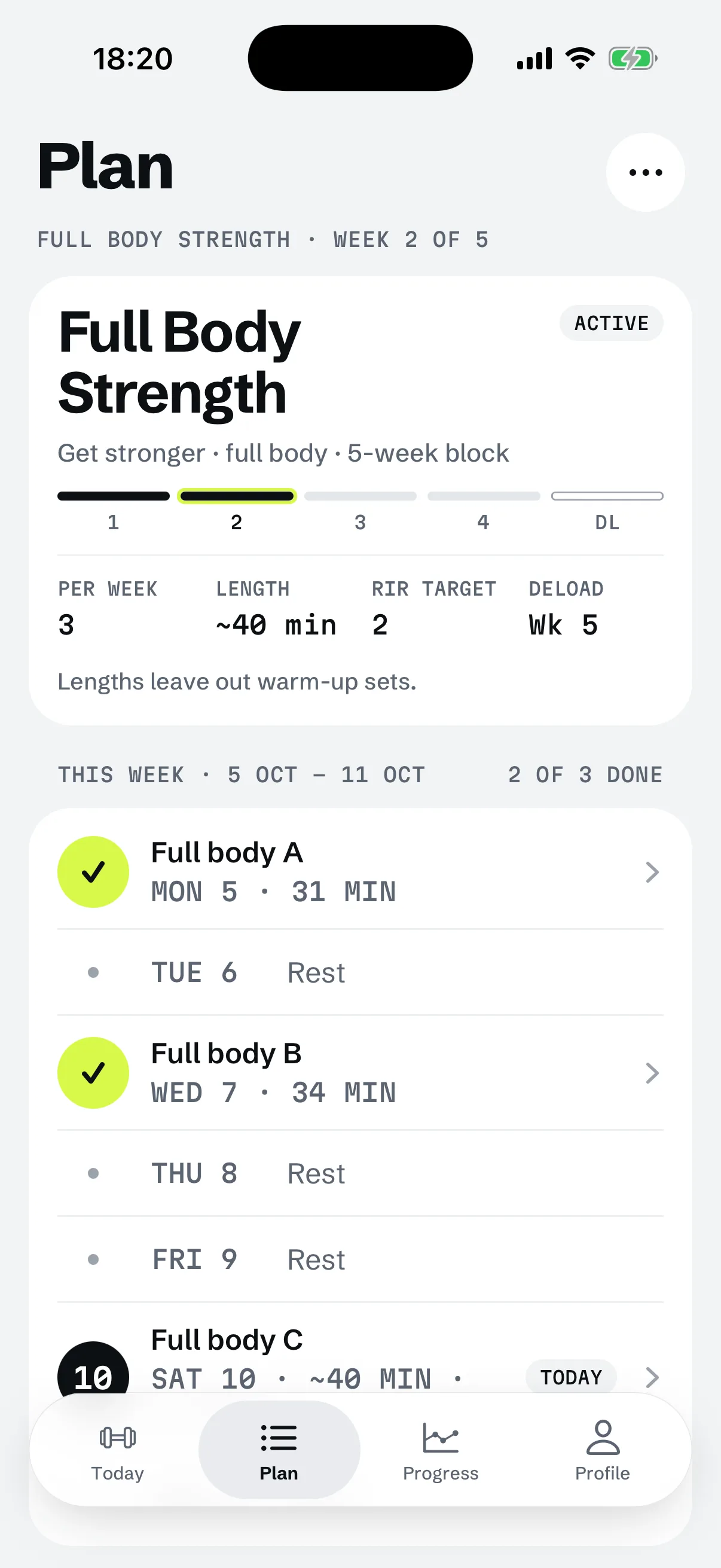
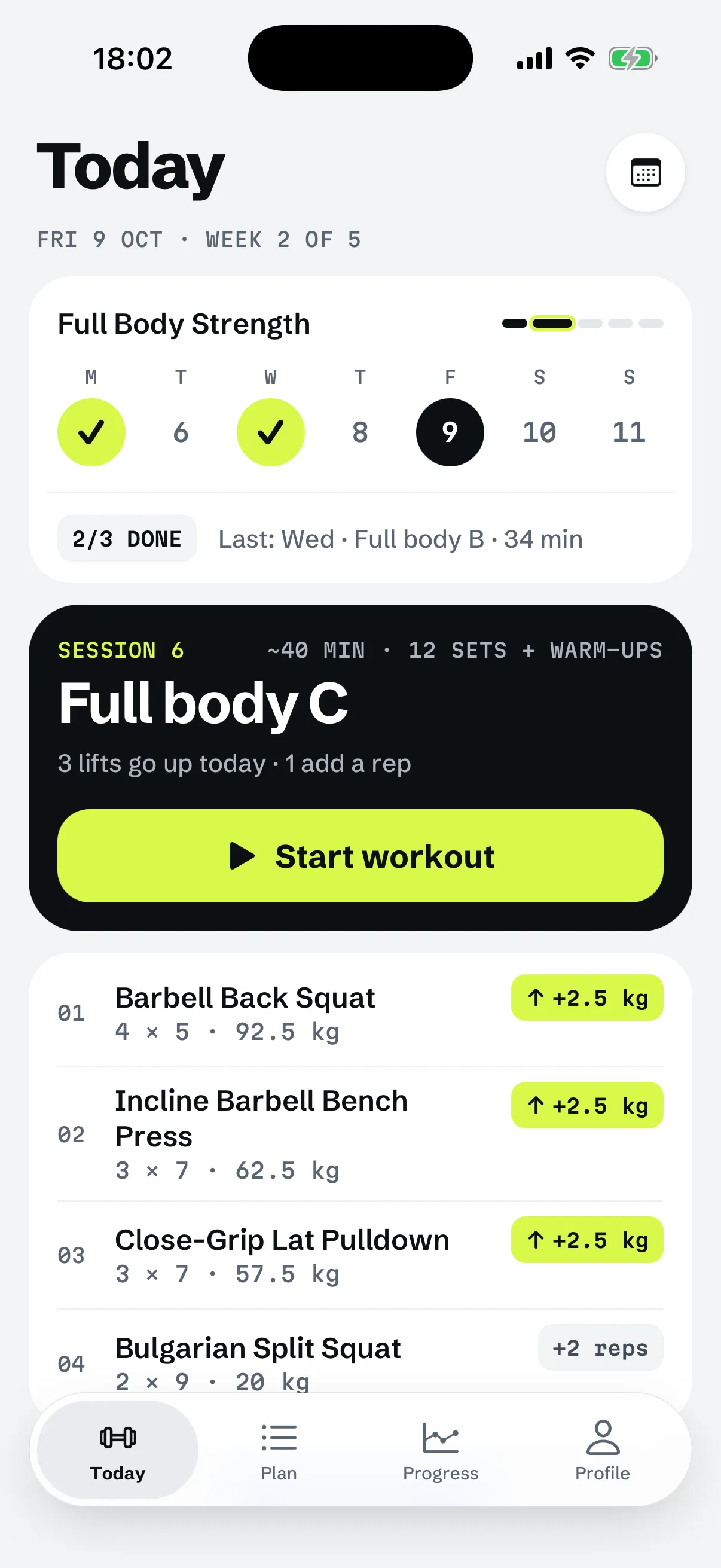
In RIGOR, the app behind this guide, days passing never move your plan. A workout you did not do waits for you, and nothing is marked as failed. The next target for each exercise is worked out from your last comparable session, not from the calendar.
Under 14 days since your last logged set, the app reduces nothing. From 14 days it speaks up.
| Days since your last session | What RIGOR does |
|---|---|
| 1 to 13 | Nothing. Your next target is the same as if you had not missed a day |
| 14 to 27 | Offers three choices: continue as planned, an easier return, or revisit the plan. The easier return is 5% less weight, with the same sets |
| 28 or more | The same three choices, with bigger cuts to the weight and one set fewer per exercise |
Weights are rounded down to ones your gym can make. The easier return applies to the first session back and becomes your new starting point, so if the cut was too cautious the app lifts the weights again quickly. The app's help article on missed days and time off has the same rule in short.
RIGOR is a strength training app for iPhone that builds your plan and sets every weight by rules you can read.
YOUR IPHONE

A worked example: a week missed, then back
Take a Dumbbell Bench Press, 3 sets of 8 to 12 reps. Your last session was 40 kg × 10, 9, 9, hitting every rep at the planned effort. Then a week goes by.
TOP OF THE RANGE8 REPS · BOTTOM
This is double progression: every set hit its target but not all are at the top of the range, so the weight stays and each set aims for one more rep, up to 12. The week away does not appear anywhere in the calculation. When every set reaches 12, the weight goes up by the smallest step you can load. The same idea, applied to all your lifts, is progressive overload.
Why one week does not undo your training
The 2001 review found that force production declines slowly, in step with a fall in muscle electrical activity. It also named what can decline significantly within that month: highly trained athletes' eccentric force and sport-specific power, and recently gained isokinetic strength. Most lifters returning after seven days are not in those groups.
There is even a case that breaks help. In a 2013 trial, 14 young men trained the bench press three days a week for 24 weeks. One group trained straight through. The other trained in three 6-week blocks with a 3-week break between each, and ended with similar gains in muscle size and strength to the continuous group. The sample was small and it was one exercise in young men, so it does not prove breaks are good. It does suggest that time off does not erase what you built.
Should you go lighter after a week off?
Not by default. RIGOR resumes where you left off, and you do not need to repeat a week or restart a cycle.
If a first session back feels heavy, you can choose easier today for that workout alone: about 10% less weight, one set fewer per exercise and one more rep left in reserve, shown to you before it applies. The plan does not change and that session is not used to judge your progress.
Warm up as usual: the warm-up calculator works out the sets from your first working weight.
What if you missed a workout, not a week?
Move it to another day or skip it. From Today you can do either. A skipped workout is not marked as failed, and the plan does not shift to catch up: the next session carries on from your last logged sets. A plan with fewer days, such as the 3 day full body workout, has fewer sessions to miss.
When the rule is different: two weeks or more
At 14 days without a logged set, Today offers the choices in the table above. A longer break gets a bigger easier return: it takes 5% off the weight after two to three weeks, more after four, and one set fewer per exercise from four weeks on. Past that, a deload is not the tool: a deload week is a planned lighter week inside a plan, and a break is days off the plan.
The research is thinner here. The 2013 meta-analysis found larger losses for older people and for people who were inactive to begin with.
RIGOR leaves your plan where it was
Questions
Is missing a week of gym bad?
No. A review of the detraining research finds strength is generally maintained for up to four weeks without training, so one missed week is not a setback.
What if I miss a week of gym?
Go back to the plan where you left off. RIGOR never moves your plan for days that passed, and nothing is marked as failed.
Can I miss a week of gym and still progress?
Yes. In a 2013 trial, men who took a 3-week break between 6-week blocks gained as much muscle and strength over 24 weeks as men who never stopped.
What should I do on my first day back at the gym?
Do the workout that is next in your plan at the weights you left. After 14 days or more away, RIGOR also offers an easier return for that first session.
I missed a workout day, not a week. What now?
Move the workout to another day or skip it. The missed one waits for you, and nothing is marked as failed.
Should I lower the weights after a week off?
Not by default. RIGOR reduces nothing before 14 days. You can still choose easier today for one workout: about 10% less weight and one set fewer per exercise.