What to write in a workout log book: the date, each lift with how its weight is counted, and for every working set the weight, the reps and the reps in reserve. Leave warm-ups out. Those are the numbers RIGOR's next-target rules start from.
What should you write in a workout log book?
For each working set, the weight, the reps and the reps in reserve, under the lift's name and the date. That is what a set holds in RIGOR, and the progression rules start from those numbers.
The case for the three numbers is in how to track workouts. This page is about the page itself.
| Field | What it holds | Read for the next target? |
|---|---|---|
| Working or warm-up | Each set is one or the other; values typed before a set is marked done are a draft | Only completed working sets count. Warm-ups never count toward progress, volume or records |
| Weight and unit | The load, in kg or lb; blank means not entered, 0 means zero load | Yes. The weight used on the most completed working sets is the session's weight; on a tie, the heavier. A loaded set with a blank weight is ignored |
| Reps | A whole number | Yes. A completed set with no reps is ignored, so the session counts as partial. A completed set of 0 reps is a miss |
| Reps in reserve | Optional: 0, 1, 2, 3 or 4+, or not sure | Yes, when written. A set without it is read at its target reps in reserve, and at 0 if that is blank too |
| Duration | Seconds, for timed exercises | Yes, for timed exercises, in place of reps |
| Bodyweight on the day | Held once per workout, for lifts that add load to bodyweight | Yes: the estimate uses the logged load plus bodyweight |
| Date | When the workout was performed | Yes: history is ordered by the performed time, and when the last session with a completed working set is 14 days or more old, Today offers an easier return |
| Note | One per exercise, one per workout | No rule in the next-target table reads a note |
Reps in reserve is optional in RIGOR. A review of 12 studies and 414 people found lifters tended to underpredict the reps they had left by 0.95, and that predictions made closer to set failure were slightly more accurate (Halperin 2022).
What does a log book layout look like?
One page per workout, with a header, one block per lift and a row for each set. The header holds the date and the workout's name. Each block opens with the lift and how its weight is counted, then lists the working sets in the order you did them.
| Line | What goes on it | Why |
|---|---|---|
| Header | The date, the workout's name, and your bodyweight if a lift adds load to it | History is ordered by the date performed. Bodyweight is part of the total load for added-weight lifts |
| Lift line | The exercise's name and how its weight is counted, such as per dumbbell or total with the bar | History compares only the same exercise with the same load convention. The ways to count are in how to track workouts and in does the bar count as weight |
| Set rows | Weight, reps and reps in reserve, one row per working set, in order | The rule is applied per set position: reps go up by one on each set |
| Extra sets | Any set beyond the plan, marked as extra | Extra sets count for volume and records only; hit, top and miss are judged on the planned sets |
| Day flag | "Easier" or "deload" beside the date, if it was one | So that when you read the page later you know the weights were lowered on purpose. |
| Next time | The next target, written from the rule below, before the session | Gives the workout a number to beat |
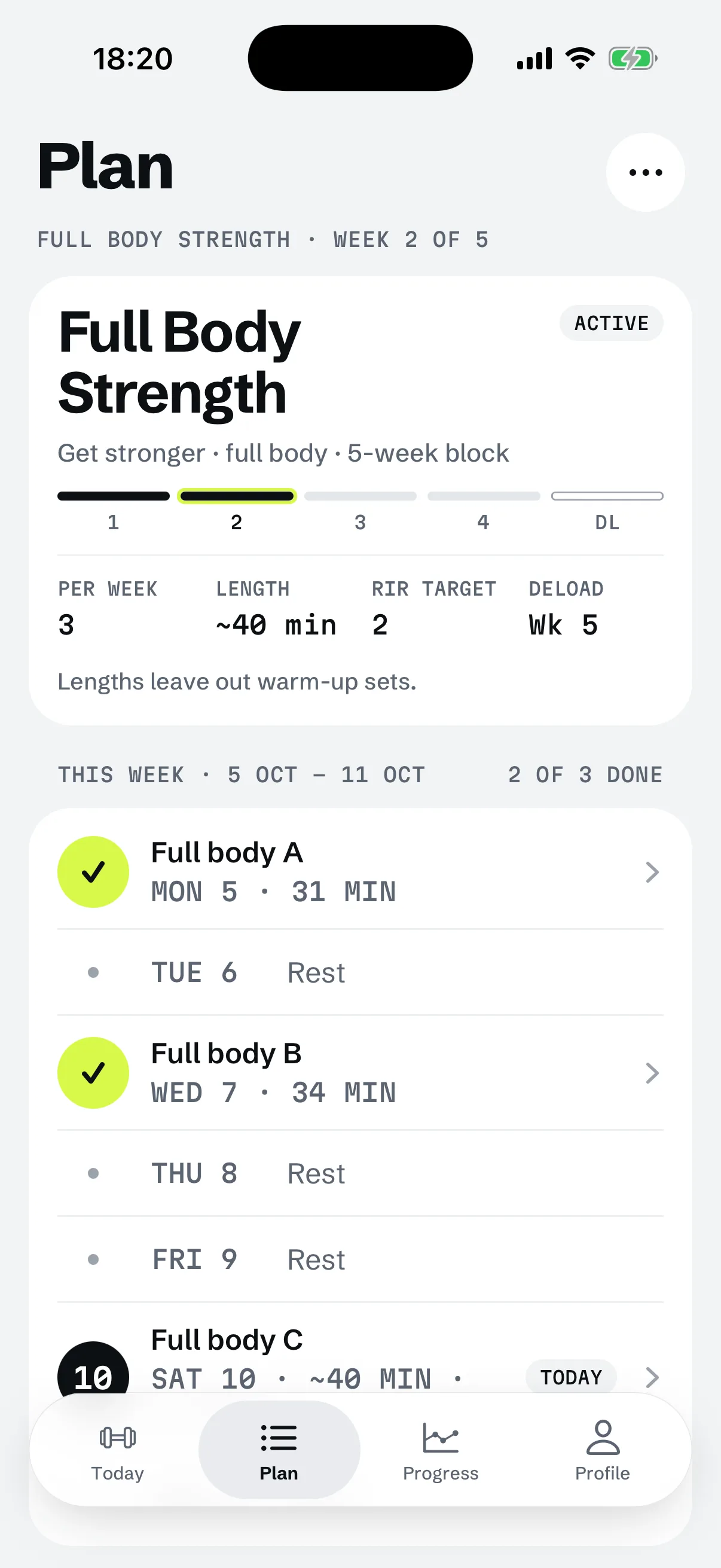
RIGOR is a strength training app for iPhone that builds your plan and sets every weight by rules you can read.
YOUR IPHONE

What does a filled-in gym log book example look like?
One day of three stack lifts, each with 3 planned sets, a rep range of 8 to 12 and 2 in reserve planned.
| Lift | Weight | Reps | Reps in reserve |
|---|---|---|---|
| Seated Cable Row | 50 kg | 10, 9, 8 | 2, 2, 1 |
| Machine Chest Press | 45 kg | 12, 12, 12 | 2, 2, 2 |
| Leg Extension | 35 kg | 9, 8, 6 | 2, 1, 0 |
Warm-up sets are not on it, and nothing is an average: each set has its own reps.
What should the next entry say?
Whatever the first matching rule says, and here it is double progression: add reps until every set reaches the top of the range, then add weight, with reps in reserve as a guard. Take the three lifts on the page.
The Machine Chest Press had every set at 12 with 2 left, but the next stack setting is 50 kg. The estimated one-rep max is 45 × (1 + 14 ÷ 30) = 66 kg, which at 50 kg predicts floor(30 × (66 − 50) ÷ 50) − 2 = 9 − 2 = 7 reps, under the bottom of the range. So the weight stays and each set adds a rep. The Leg Extension had a set under 8, a miss: same weight, 8 on the missed set, a rep more on the others.
| What you logged | Rule that applies | Next entry |
|---|---|---|
| Cable Row, 50 kg: 10, 9, 8 · RIR 2, 2, 1 | All hit, not all at the top: reps up by 1 per set, capped at 12 | 50 kg × 11, 10, 9 |
| Chest Press, 45 kg: 12, 12, 12 · RIR 2, 2, 2 | All at the top, but the next load predicts under 8: same weight, reps up by 1 per set | 45 kg × 13, 13, 13 |
| Leg Extension, 35 kg: 9, 8, 6 · RIR 2, 1, 0 | A miss in the session: same weight, 8 on the missed set, reps up by 1 on the rest | 35 kg × 10, 9, 8 |
| Cable Row, 50 kg: 12, 12, 12 · RIR 2, 2, 2 | All at the top and the next load predicts at least 8: next weight | 55 kg × 8, 8, 8 |
| Cable Row, 50 kg: 12, 12, 12 · RIR 0, 0, 0 | All at the top, but reps in reserve below the plan by more than 1: same weight, top reps | 50 kg × 12, 12, 12 |
| Cable Row, 50 kg: 10, 9 (two sets) · RIR 2, 2 | Fewer sets than planned, no miss: reps up by 1, an unlogged set gets 8 | 50 kg × 11, 10, 8 |
The fourth row is the only one where the weight goes up. Its estimate is 50 × (1 + 14 ÷ 30) = 220 ÷ 3, about 73.33 kg: at 55 kg that is floor(30 × (220 ÷ 3 − 55) ÷ 55) − 2 = 10 − 2 = 8 reps. The calculation is the one behind the 1RM calculator. A session far outside the range is recalculated instead; double progression has those cases.
To read a log across sessions, see how to track gym progress; the strength plateau guide covers a lift that stops moving.
What can you leave out of a workout log?
Everything the rule does not read, unless you want it for yourself.
- Warm-up sets. They never count toward progress, volume or records, and RIGOR shows them apart. The warm-up calculator works out their weights; warm-up sets explains them.
- Rest times. A logged set has no field for rest, and no rule in the next-target table reads it.
- Notes. RIGOR keeps one per exercise and one per workout, and no rule in the table reads a note. Use them for anything you want to remember.
- Totals and averages. The rule works on each set, in its position, and the app works out volume from completed working sets. A total hides the set that stopped at 7.
- Paper or phone. The gym notebook weighs the two; RIGOR's log works with no signal.
In a study of 43 trained lifters over eight weeks, adding reps at a fixed weight and adding weight at fixed reps both appeared to be viable ways to progress (Plotkin 2022), so both the weight and the reps of each set are worth keeping. A meta-analysis of 138 randomised studies and 19,951 people found that monitoring progress toward a goal promoted goal attainment, more so when the information was physically recorded (Harkin 2016). None of the studies cited here tested a particular log layout.
When does this layout not apply?
Bodyweight, assisted and timed exercises follow their own rows of the rules. For a barbell lift, the plate calculator shows which totals your bar and plates can make.
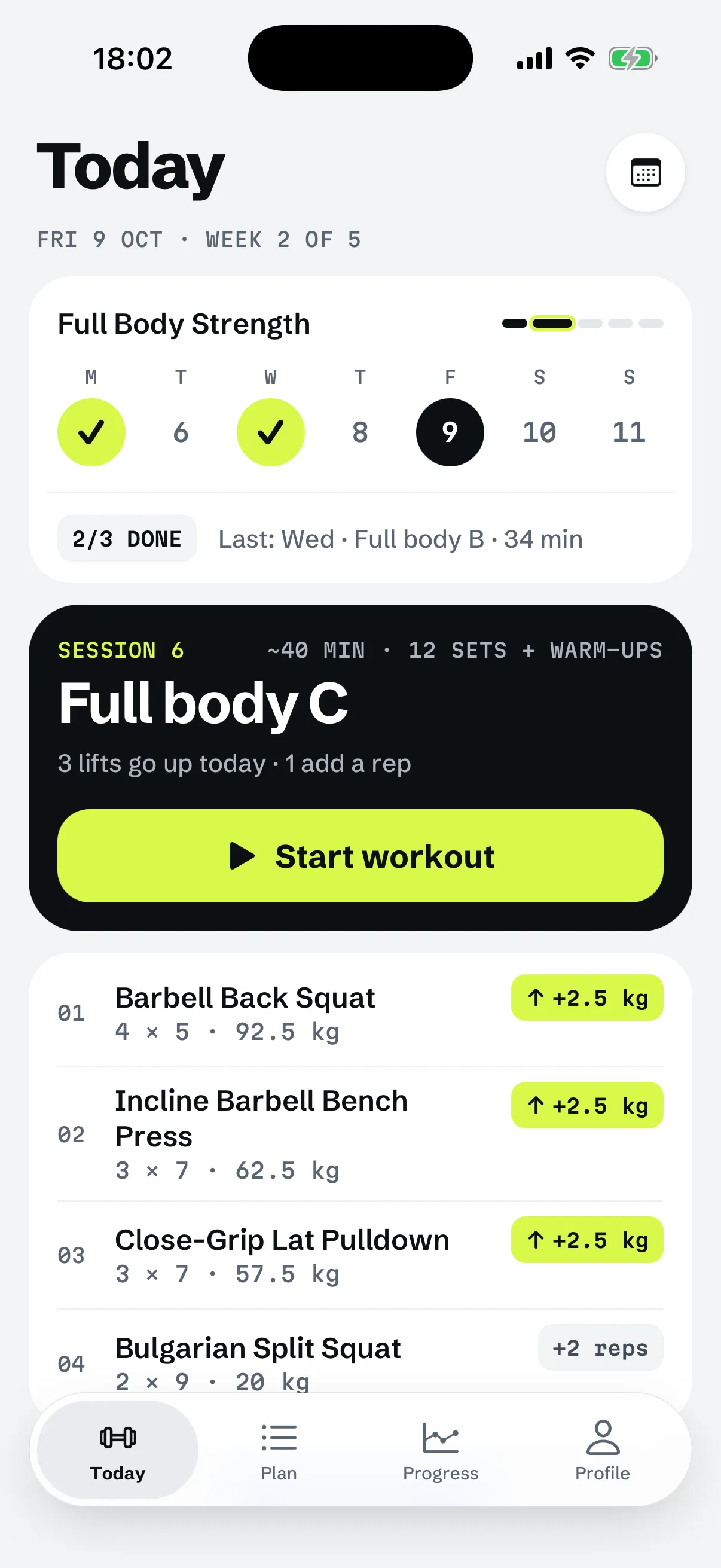
RIGOR keeps the log and writes the next line
Questions
What to write in a workout log sheet?
A header with the date and the workout's name, then one block per lift: its name, how the weight is counted, and a row for each working set with weight, reps and reps in reserve. The layout section below sets it out line by line.
What to write in workout logs, in short?
For every completed working set, the weight, the reps and, if you can judge it, the reps in reserve. RIGOR also keeps the unit, the bodyweight on the day for lifts that add load, and a note; no rule in the next-target table reads a note.
What is a good workout journal?
One that lets you read last time's line before you pick up the first weight. For that it needs the same lift names, the same way of counting each weight and one row per working set. Nothing cited here tested one layout against another.
Should the next target be written in the log?
It helps to write it before the session, from the rule. RIGOR freezes a session's targets when the first set is logged, so a later change to a rule never rewrites what was planned for that day.