A gym notebook beats an app on speed, cost and focus, and an app beats it when the next weight has to be worked out. Paper needs four columns: exercise, weight, reps per set and reps in reserve. The next-weight sum is short, but you do it yourself, every lift, every session.
Is a gym notebook better than an app?
Neither, for everything. Paper wins on speed, cost and focus: it opens at once, it costs a notebook and a pen, and nothing on the page pings you between sets. An app wins the moment the next weight has to be worked out, because that is a sum, and a notebook leaves the sum to you.
No study opened for this page compared paper with apps, so what follows is reasoning from how the log is used, not a finding. The sections below give the layout, an example, the hand sum and what an app does with it.
| Notebook | App | |
|---|---|---|
| Getting started | Open at the last page | Open, unlock, find the workout |
| Cost | A notebook and a pen | A phone, and the app's own price |
| Between sets | Nothing else on the page | A phone with everything else on it |
| Last time's numbers | You turn back to the page | Shown beside today's target |
| Next weight | You work it out | Worked out for you |
| Rounding to weights your gym has | You check the plates yourself | Done by the rule |
| If you lose it | A lost notebook is gone | The log is on the phone |
What should a gym notebook layout look like?
Four columns, one line per lift, one page per day. The date goes at the top of the page, and the lines stay in the same order every session so last time is always in the same place.
| Exercise | Weight | Reps per set | Reps in reserve |
|---|---|---|---|
| Barbell Overhead Press | Total, bar included | One number per set | One number per set |
| Lat Pulldown | Stack setting | One number per set | One number per set |
Reps in reserve is how many more reps you could have done when the set ended. The lifting version of the scale was set out by Zourdos and colleagues in 2016 and applied to training by Helms and colleagues; reps in reserve and the RPE scale explain the numbers. A lifter's count of reps left runs a little short on average: a review of 12 studies and 414 people found lifters underpredicted the reps they had left by 0.95 (Halperin 2022). Count the same way every time and the column stays comparable.
Only working sets go in. What each kind of lift counts as its weight, and why, is in how to track workouts; how to read the page afterwards is in how to track gym progress. This page is about the choice, and the one sum that the layout leaves open.
RIGOR is a strength training app for iPhone that builds your plan and sets every weight by rules you can read.
YOUR IPHONE

What does a gym notebook example look like?
Two sessions of the same page. The overhead press is a 3-set lift with a rep range of 6 to 10 and 2 reps in reserve planned. Weights are totals with a 20 kg bar; the plates go down to 1.25 kg, so the smallest jump is 2.5 kg.
| Session | Exercise | Weight | Reps per set | Reps in reserve |
|---|---|---|---|---|
| 1 | Barbell Overhead Press | 40 kg | 9, 8, 8 | 2, 2, 1 |
| 1 | Lat Pulldown | 50 kg | 10, 10, 9 | 2, 2, 1 |
| 2 | Barbell Overhead Press | 40 kg | 10, 10, 10 | 2, 2, 2 |
| 2 | Lat Pulldown | 50 kg | 11, 11, 10 | 2, 2, 1 |
Session 2 of the press is the interesting one. Every set reached 10, the top of the range, at the planned effort. That means the weight should go up, and by how much is the sum.
How do you work out next session's weight by hand?
With the rule double progression that RIGOR follows: add reps until every set reaches the top of the range, then add weight, with reps in reserve as a guard. On paper, every step is yours. For the press in session 2:
- Is every set at the top? 10, 10, 10 against a top of 10: yes. If not, and no set fell short of 6, the weight stays and each set aims for one more rep, up to the top.
- Was the effort real? The reps in reserve were 2, 2, 2. A set with 0 left, when 2 were planned, would hold the weight and ask for 10 again.
- Take the best set's capacity: reps plus reps in reserve. 10 + 2 = 12.
- Estimate the one-rep max: weight × (1 + capacity ÷ 30). 40 × (1 + 12 ÷ 30) = 40 × 1.4 = 56 kg. It is the Epley formula, the same one behind the 1RM calculator.
- Pick the next weight you can load: the next load above 40 kg that the bar and plates make. With 1.25 kg plates that is 42.5 kg.
- Work out the reps at that weight: 30 × (56 − 42.5) ÷ 42.5, rounded down, minus the reps in reserve planned. 30 × 13.5 = 405, and 405 ÷ 42.5 = 9.53, which rounds down to 9. 9 − 2 = 7.
TOP OF THE RANGE6 REPS · BOTTOM
Check it: 7 reps with 2 left at 42.5 kg is capacity 9, and 42.5 × (1 + 9 ÷ 30) = 42.5 × 1.3 = 55.25 kg, just under the 56. The target is a whole rep, rounded down.
Step 6 can fail, and a notebook does not warn you. A gym with no plates under 2.5 kg jumps from 40 to 45 kg. Then 30 × (56 − 45) ÷ 45 = 330 ÷ 45 = 7.33, rounded down to 7, and 7 − 2 = 5. That is below the bottom of the range, 6, so the jump is too big. RIGOR then keeps 40 kg and asks for one more rep on each set, 11, up to 5 above the top of the range, before it raises the weight. Fractional plates covers how a smaller step changes this, and the plate calculator loads either weight.
Two more cases fill out the page. A set under 6 reps repeats the weight. A miss at the same weight in two sessions running takes 10% off, rounded down to a weight you can make. A stall has its own rule, in strength plateau.
What does a gym notebook app do instead?
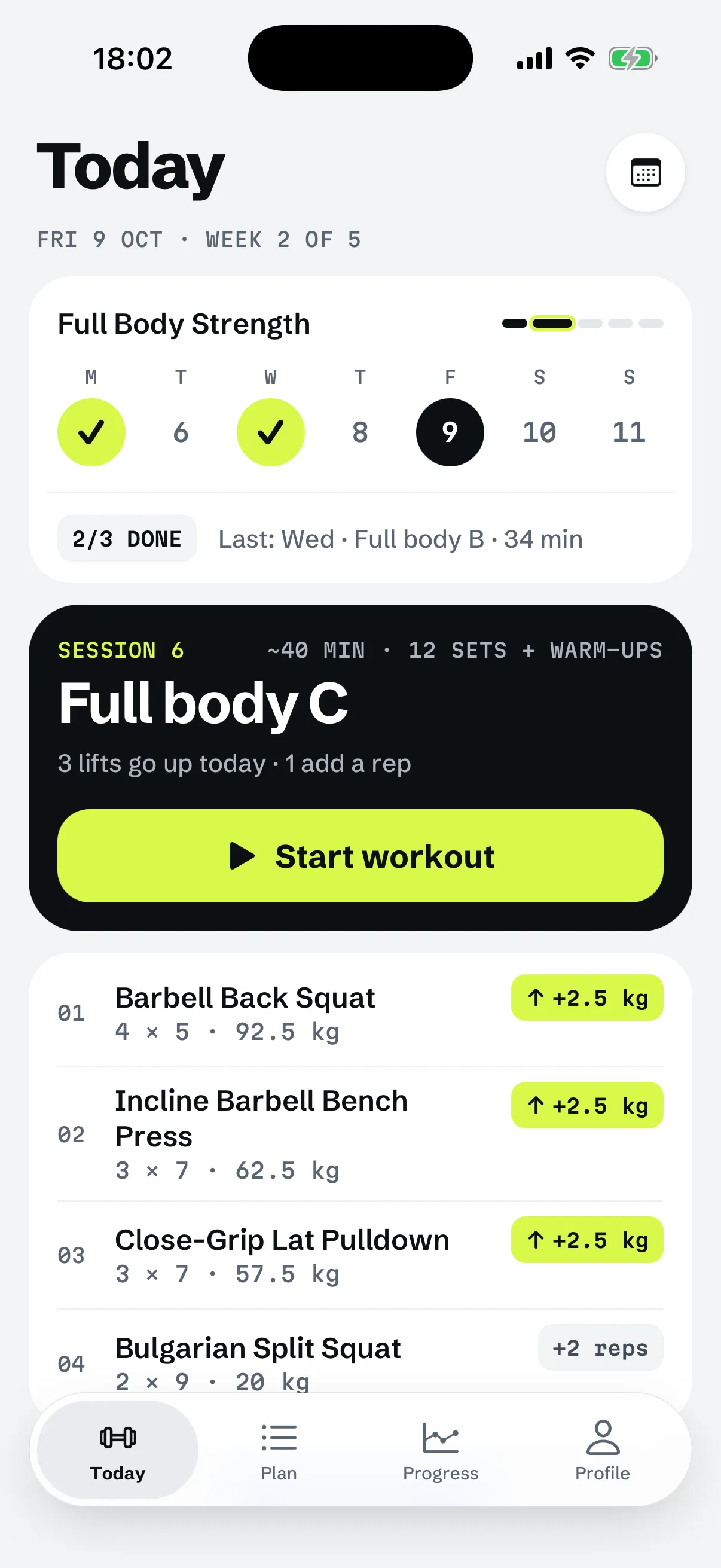
It runs those steps for you. RIGOR is an iPhone app, and it takes your last comparable session of the lift, judges it against the targets it had and sets the next weight and reps by a fixed table. The sum above is the table's row for every set at the top; the cases around it are its other rows. It rounds to a weight your gym can make, and it shows last time beside the target.
The target, the reps in reserve to leave and last time's line sit on one screen, so nothing is looked up. You change the weight or reps if you did something else, and add reps in reserve if you want the extra signal.
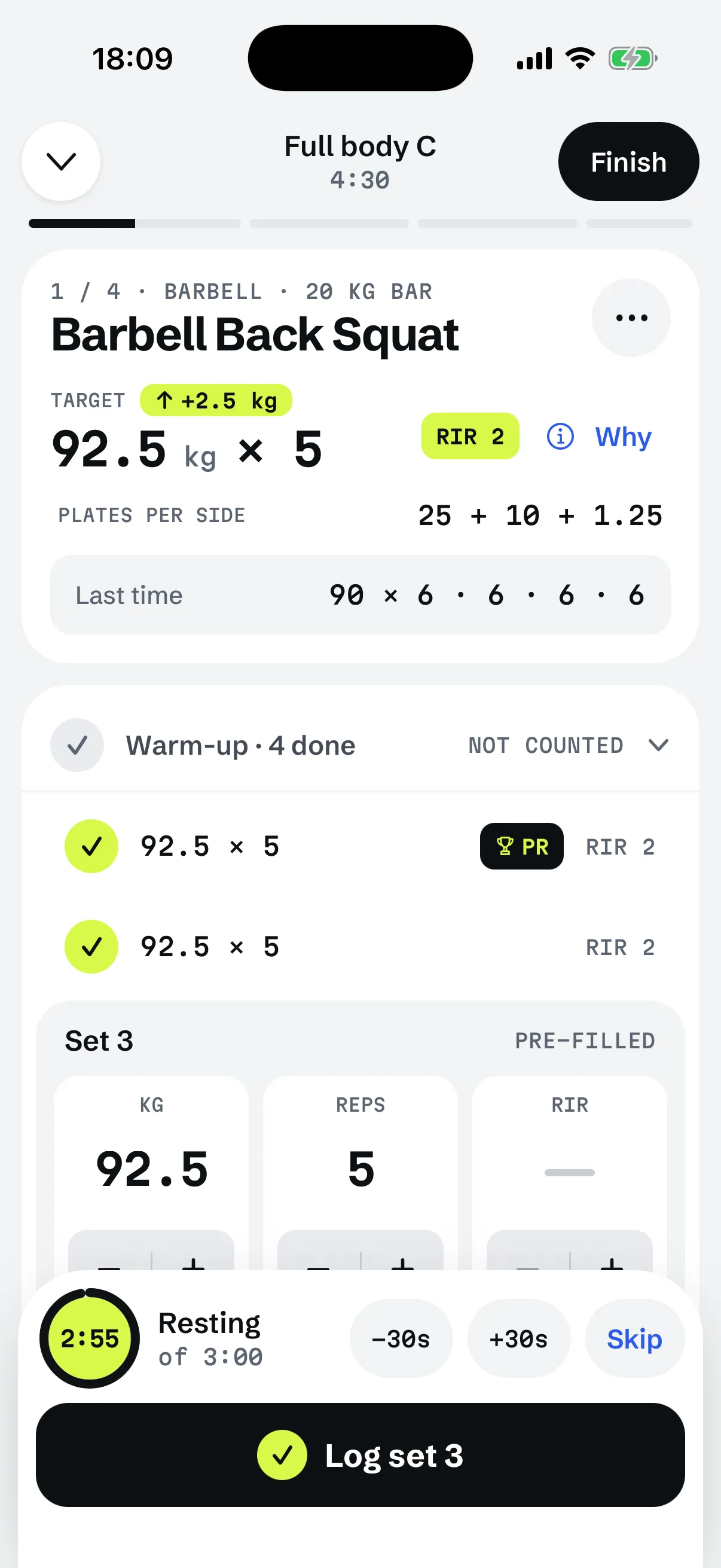
What the app does not do is lift or count for you. You still log each set. What it takes over is the sum, the table of cases and the rounding.
Does paper or an app work better for progress?
Nothing opened for this page says. The nearest evidence is general. A 2016 meta-analysis of 138 randomised studies and 19,951 people looked at monitoring progress toward a goal, any goal, and found it promoted goal attainment (d+ = 0.40, 95% CI 0.32 to 0.48), more when progress was physically recorded (Harkin 2016). The review covered goal monitoring in general, not lifting logs.
On the lifting side, an eight-week study of 43 people with at least a year of lower body training found that adding reps at a fixed weight and adding weight at fixed reps were both viable ways to progress (Plotkin 2022). Either way you need last time's numbers in front of you, which both tools give.
Who should use which?
Use paper if you train the same few lifts, keep your rule simple and can do the sum, or if you simply like a page. Use an app if you want each target worked out and rounded for you, or if your rep ranges and weights change often enough that the sum becomes the part you skip. A person can also do both: a notebook for the day, an app for the targets.
For a week of lifts to put in the notebook, the 4 day upper lower split sets a rep range for every exercise.
RIGOR does the sum and the rounding
Questions
Do I need a gym notebook template?
No. Rule four columns by hand, exercise, weight, reps per set and reps in reserve, and repeat the layout every session. Keeping one format matters more than any printed template.
Should warm-up sets go in the notebook?
Leave them out of the four columns. RIGOR shows warm-up sets apart and never counts them toward progress, volume or records, so a paper log that compares sessions should skip them too.
Is the reps in reserve column needed on paper?
It is worth having. Under the rule on this page, a set logged with 0 reps left, when 2 were planned, blocks the weight increase even if every set reached the top of the range, unless the session before had already put every set at the top at that weight.
What if my gym has no plate small enough for the jump?
Then the next load can predict fewer reps than the bottom of the range. In that case RIGOR keeps the weight and adds one rep per set, up to 5 above the top of the range (2 when the top is 8 or fewer), before it raises the weight.
Does writing a workout down help?
Probably, though no study opened for this page tested lifting logs. A large review of goal monitoring in general found it helped people reach goals, more when progress was physically recorded.