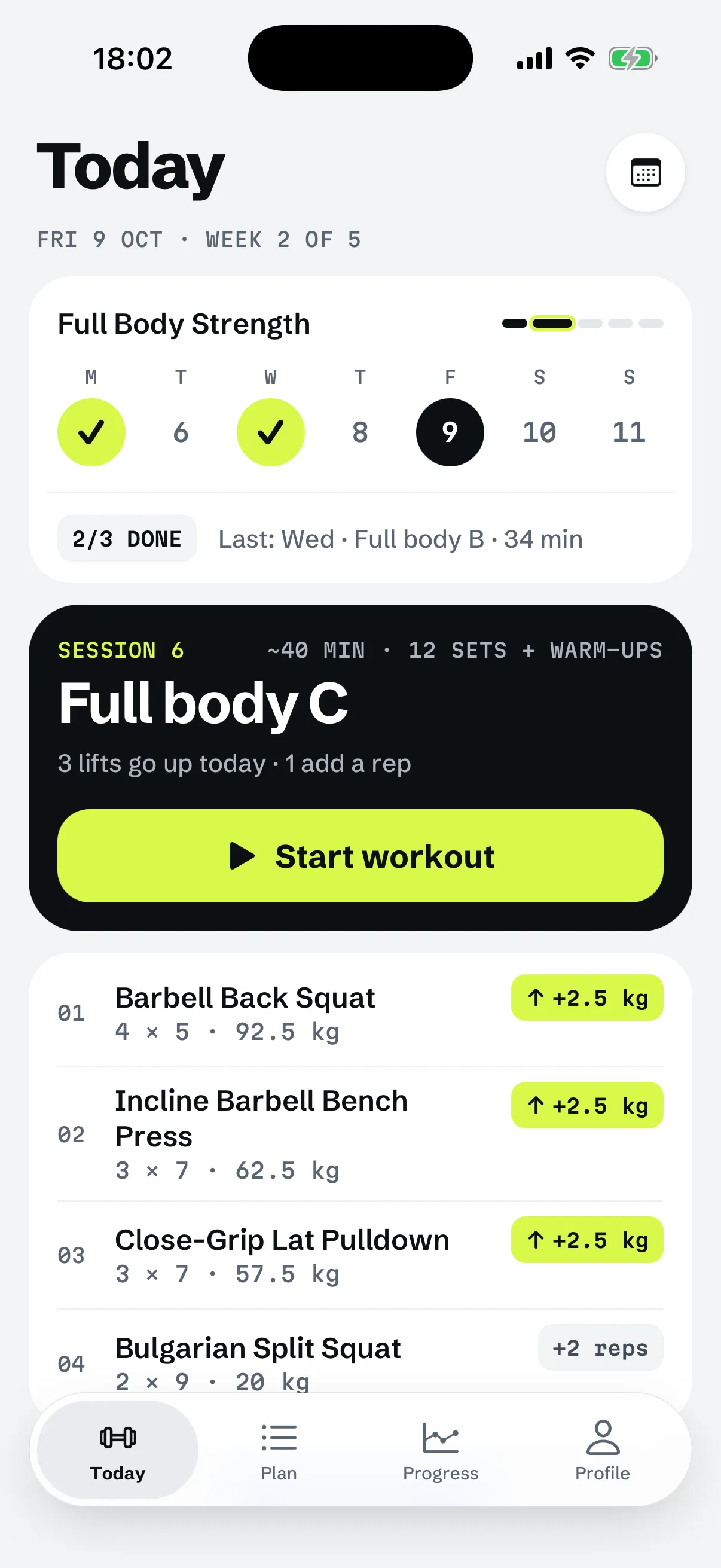
A strength plateau is a lift that has stopped going up for weeks, not one bad session. In RIGOR, the app behind this guide, one miss repeats the weight, two misses in a row take 10% off that lift, and a stall is three sessions at one weight with no more total reps. Then you climb again.
What is a strength plateau?
A strength plateau is a lift that has stopped going up: the same weight, with the same reps or fewer, for several sessions in a row. One flat session is not one. A plateau is a run of them.
Research on plateaus themselves is thin. The studies cited below test nearby questions, such as how to progress or how many sets to do, and each says only what it tested. The firm part of this guide is RIGOR's rules, which define the word in numbers. RIGOR is the app behind this guide.
What counts as stuck?
In RIGOR three things are kept apart, and each has its own answer. A miss is a set that ends below the bottom of the rep range, such as 3 reps on a 4 to 6 range.
| What you logged | What RIGOR does next |
|---|---|
| One session with a miss | Same weight again |
| A miss, and a miss the session before, at one weight | Down 10% on that lift |
| Three full sessions at one weight, newest no more total reps than oldest | Down 10% on that lift |
After a cut, you climb again by double progression: reps first, then the smallest weight step. After a single miss, the sets that fell short aim for the bottom of the range, the others for one rep more.
RIGOR is a strength training app for iPhone that builds your plan and sets every weight by rules you can read.
YOUR IPHONE

A worked example: two misses on a squat
Take a Barbell Back Squat, 4 sets of 4 to 6 reps, at 100 kg. In session 1 the last set stops at 3 reps, a miss. The sets that fell short aim for 4 next time and the rest for one rep more. Session 2 repeats the weight and the last set stops at 3 again.
TOP OF THE RANGE4 REPS · BOTTOM
A stall needs no miss at all. Take the same squat for three sessions with every set at 4 or more reps. The totals are 20, 21 and 20.
| Session | Reps | Total |
|---|---|---|
| Oldest | 5, 5, 5, 5 | 20 |
| Middle | 6, 5, 5, 5 | 21 |
| Newest | 5, 5, 5, 5 | 20 |
Twenty is no more than 20, so the next target is again 90 kg. Had the newest session reached 21, the squat would not be a stall.
The fine print of a stall
The three sessions must share one weight, one rep range, one number of sets and one reps-in-reserve target, and every planned set must be done. Misses come first: two sessions running with a miss are handled by the two-miss rule before a stall is looked at.
What causes strength plateaus?
No single cause is proven, and the research does not rank them. These are the ones a lifter can check, each with the evidence it has.
- A step that is too big. A new rep is a smaller step than a new plate. In an eight-week study of 43 trained lifters, adding reps at a fixed weight and adding weight at fixed reps were both workable ways to progress. Strength gains slightly favoured adding load, and one muscle measure modestly favoured adding reps. If the plates will not go up, add reps first.
- Effort that is not what you think. A 2022 review of 12 studies and 414 people found lifters tended to under-predict the reps they had left, by 0.95 reps on average. If your logged effort runs harder than the truth, targets can hold longer than needed. See reps in reserve.
- Too little work. A 2017 meta-analysis of studies on weekly sets found a graded relationship: each added weekly set went with about 0.37% more muscle growth. That is muscle size, not the one-rep max, and it is an average across many studies.
- Fatigue that builds over a block. This is why plans include a deload week. The evidence for it is limited, as that page sets out.
- Time away. A break changes what you should lift next: see missing a week of gym.
Why am I lifting less than last week?
Some of it is by design. RIGOR lowers the weight in these cases, among others:
- Two misses in a row, or a stall: 10% off that lift.
- Easier today, a choice you make for one session: about 10% less weight and one set fewer on each exercise.
- A deload week: about 10% less weight and half the sets.
Another case lowers reps, not weight: after a jump up in weight the reps drop, which the app says is normal. An easier-today or deload session is not the baseline for your next target. A drop after misses is the rule at work, not proof of lost strength.
How long do strength plateaus last?
There is no tested answer. How long a stall lasts depends on the lift, the person and what changed, and no study gives a number to copy.
In RIGOR a single lift is called stuck after two sessions with a miss or three sessions without more reps, and the cut then gives you a weight you can finish. A plateau of months is more than one rule can explain: look at the list above, and at whether the logged sets and weights match what you did.
How do you break through a squat plateau?
Change one thing at a time, in this order. The same order fits a bench press or a row.
- Add reps before weight. Hold the weight until every set reaches the top of the range, then take the smallest step. The double progression page has the rule, and the ACSM position stand also recommends periodized loading for intermediate and advanced lifters, from 1 to 12 reps.
- Log the effort honestly. If a set felt like 0 reps left when 2 were planned, the weight should stay.
- Take the planned lighter week. RIGOR puts one after four training weeks when deload is on. A week with no lifting is not the same thing: in a 2024 trial of 39 trained lifters, the group that stopped for a week gained less lower-body strength than the group that trained straight through.
- Let the cut work. After a 10% drop, 100 kg becomes 90 kg and the lift climbs again with reps you can finish. To compare sessions at different weights, use the estimate behind the 1RM calculator.
A plan built on these rules, such as the 3 day full body workout, applies them to every lift.
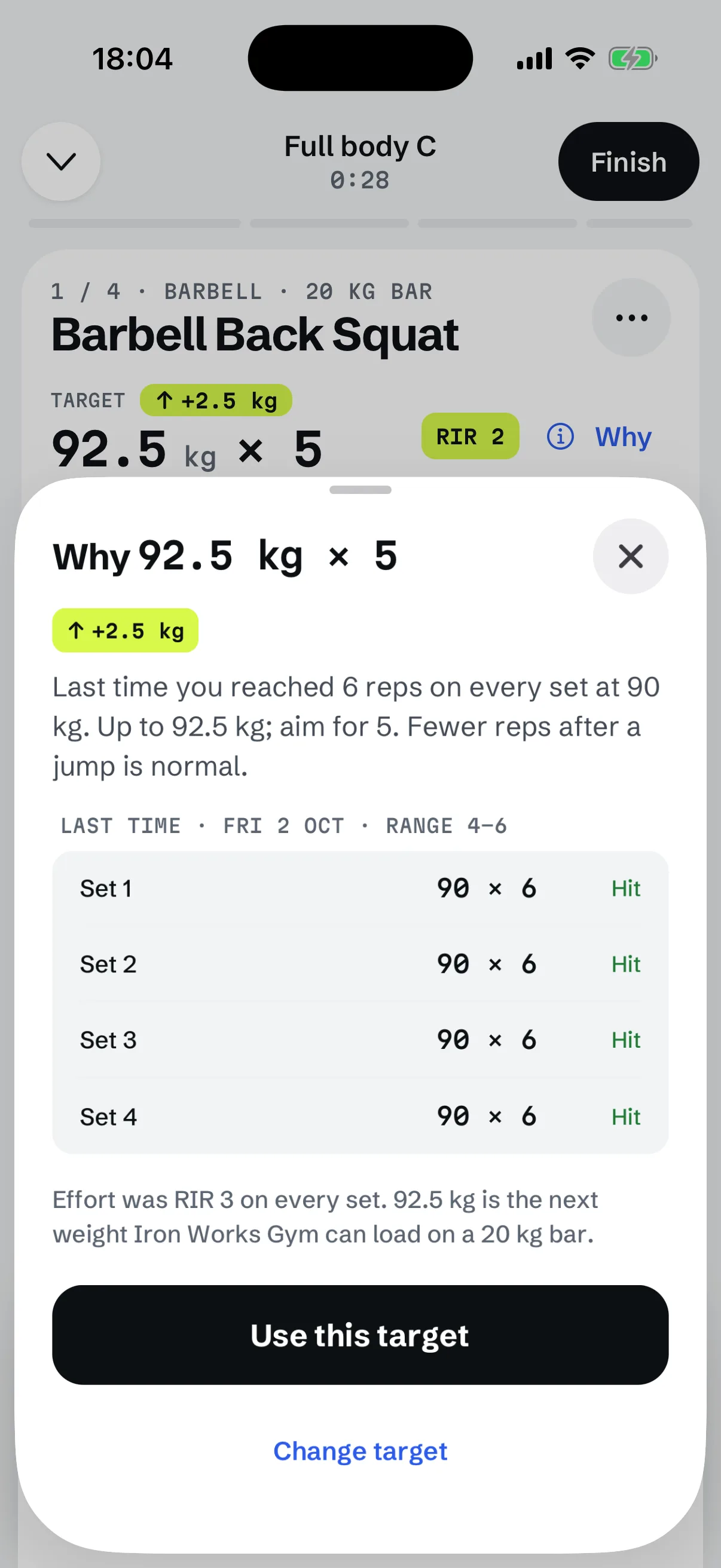
RIGOR reads your log and says why
Questions
How to break through a squat plateau?
Treat it as any stuck lift. Add reps before weight, take the smallest weight step your gym can make, check that your sets were as hard as planned, and take a planned lighter week after a block of hard training.
What kills muscle gains the most?
No study ranks the causes. For training, the evidence points to the amount of hard work: in a 2017 meta-analysis, more weekly sets went with more muscle growth. Food, sleep and illness are outside this guide.
Is one bad session a plateau?
No. In RIGOR one set under the bottom of the rep range repeats the weight. It takes two sessions running, at the same weight, to take 10% off.
Does going down in weight mean I am losing strength?
Not by itself. A 10% cut after two misses or a stall is a way to build back with reps you can finish, and RIGOR starts the climb again from the lower weight.
Should I stop training a stuck lift?
No. RIGOR keeps the lift in your plan, lowers its weight when the rules say so and climbs again. In a 2024 trial, a week with no lifting did not help lower-body strength.