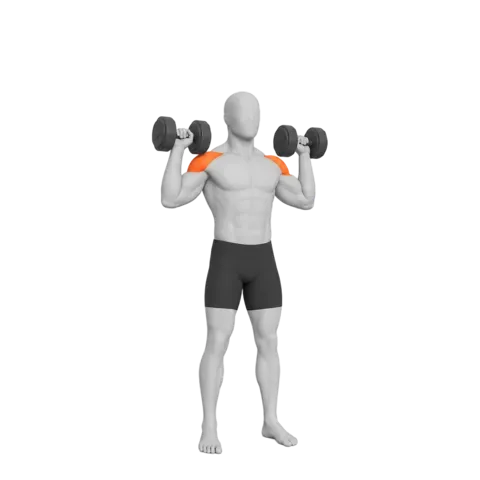
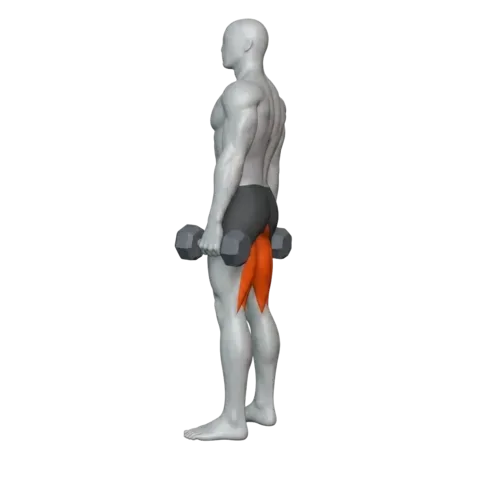
Most exercises need 2 to 4 working sets. Reviews link more weekly sets to more muscle growth and find no clear gap between 2 to 3 and 4 to 6 sets on one exercise. RIGOR gives a day's first lift 3 or 4 sets and every other exercise 2 or 3.
How many sets per exercise should you do?
Two to four working sets for most exercises. A working set counts toward progress; a warm-up does not. The research below names no one best number, so the useful question is how many sets a muscle gets across the week. RIGOR, the app behind this guide, answers per exercise: 3 or 4 sets for a day's first lift, 2 or 3 for the rest.
How many sets does RIGOR give each exercise?
Its rule is that main compounds get 3 to 4 working sets and the other exercises 2 to 3. Four sample plans show what that makes. Between them they hold 81 exercises, and every exercise has 2, 3 or 4 sets.
| Plan | 2 sets | 3 sets | 4 sets | Sets a week |
|---|---|---|---|---|
| 3 day full body, 60–75 min | 7 | 10 | 2 | 52 |
| 4 day upper/lower, 45–60 min | 7 | 9 | 3 | 53 |
| 6 day push/pull/legs, 60–75 min | 10 | 16 | 4 | 84 |
| 3 day dumbbells, 30–45 min | 9 | 4 | 0 | 30 |
| All four | 33 | 39 | 9 | 219 |
The sums: the full body plan has 7 + 10 + 2 = 19 exercises and 7 × 2 + 10 × 3 + 2 × 4 = 14 + 30 + 8 = 52 sets. The other rows come to 19, 30 and 13 exercises. Together that is 81 exercises and 52 + 53 + 84 + 30 = 219 sets, or 66 + 117 + 36 from the last row.
Where the fours sit is the point. All nine four-set exercises open their workout: Barbell Back Squat in the full body and push/pull/legs plans, Dumbbell Bench Press and Leg Press in the upper/lower plan, Barbell Bench Press and Lat Pulldown in push/pull/legs. Nothing later in a session gets more than 3. Compounds go first in a session, so the most sets go to the first lift. Exercise order covers why that lift leads.
Here is the first day of the full body plan, with its sets.
Full body A
- Barbell Back Squat4 × 6–10 · REST 3:00
- Barbell Bench Press3 × 8–12 · REST 2:00
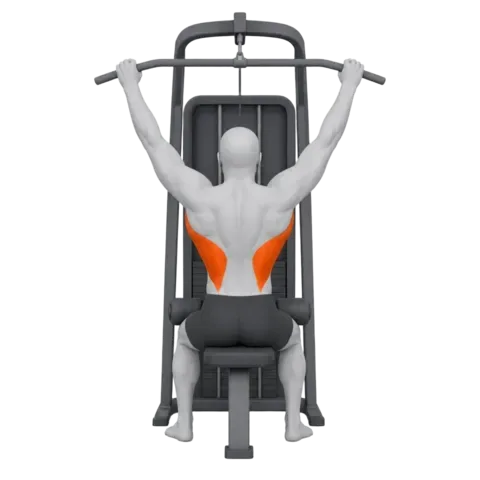
- Lat Pulldown3 × 8–12 · REST 2:00
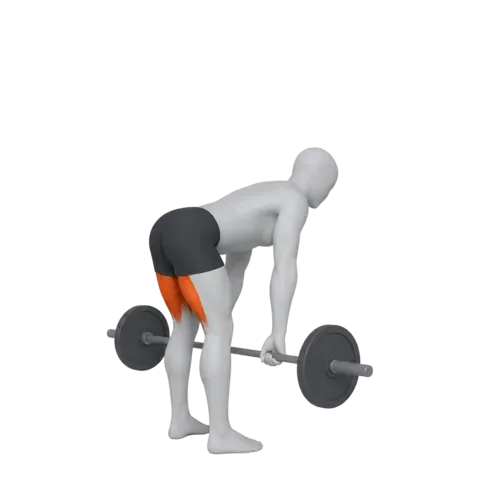
- Stiff Leg Deadlift2 × 8–12 · REST 3:00
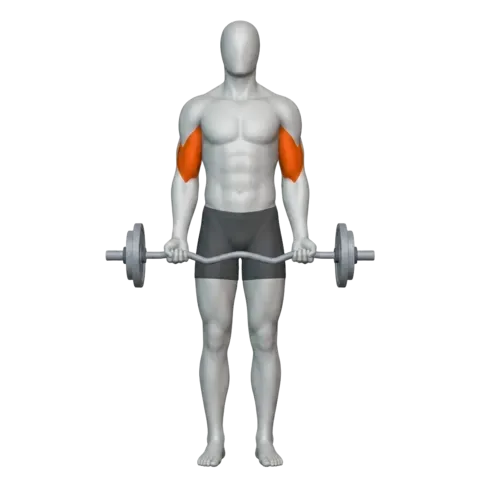
- EZ-Bar Curl3 × 10–15 · REST 1:30
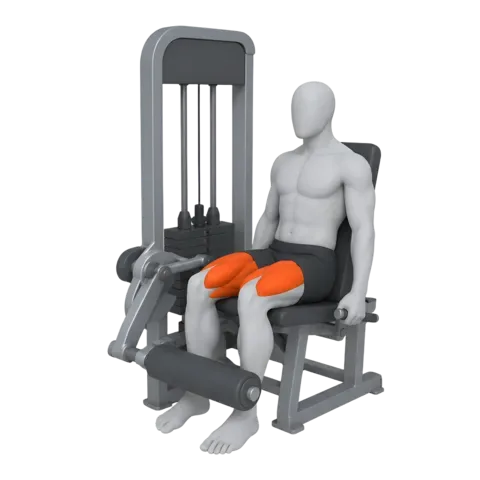
- Leg Extension2 × 10–15 · REST 1:30
RIGOR is a strength training app for iPhone that builds your plan and sets every weight by rules you can read.
YOUR IPHONE

Is 3 sets or 4 sets better for hypertrophy?
The studies opened for this guide do not say. One looked at sets per exercise, and two at sets per muscle per week.
- Krieger 2010. A meta-analysis of 8 studies, 19 treatment groups and 55 effect sizes. Multiple sets were associated with a larger effect on muscle growth than one set. Two to three sets and four to six sets per exercise each showed a trend over one set. Between 2 to 3 and 4 to 6 sets the difference was not significant (p = 0.29). The abstract's average effect sizes rose from 0.24 for 1 set to 0.34 for 2 to 3 and 0.44 for 4 to 6 (Krieger 2010).
- Schoenfeld 2017. A meta-analysis of 15 studies and 34 treatment groups, counting sets per muscle per week. Each extra weekly set was associated with a 0.37% larger gain, and higher-volume groups gained 3.9% more than lower ones in the same study (Schoenfeld 2017).
- Baz-Valle 2022. A systematic review of 7 trials, 6 in the pooled analysis, in lifters with at least a year of training. It compared 12 to 20 weekly sets with more than 20. Quadriceps and biceps growth did not differ between them; triceps growth favoured more than 20. Its conclusion is that 12 to 20 weekly sets per muscle group may be an optimum standard for trained men (Baz-Valle 2022).
Read together: more sets were linked to more growth, yet at the higher counts two of the three muscles in the 2022 review showed no gain from more. The gap between a third and a fourth set on one exercise is small enough that the 2010 data could not separate them.
How many sets per workout for muscle growth?
A workout in RIGOR's four plans holds 9 to 18 working sets. The count is set by the muscles, not by a number per workout. Each muscle has a weekly target, and the plan counts a set as 1 for a muscle that is a primary mover of the exercise and 0.5 for one that helps.
| Beginner | Intermediate | Advanced | |
|---|---|---|---|
| Major (chest, back, quads, hamstrings, glutes, shoulders) | 10 | 13 | 16 |
| Minor (biceps, triceps, calves, abs) | 6 | 8 | 10 |
The sets of one muscle come from several exercises on several days, so the sets of one exercise are a piece of the week. A beginner's 10 for a major muscle sits below the 12 to 20 range in Baz-Valle's review, which studied lifters with at least a year of training. The intermediate 13 and the advanced 16 fall inside it.
One more limit shapes a workout: no muscle gets more than 10 counted sets in a single session, so a bigger weekly target is spread over more days. The best workout split page covers how days divide the week.
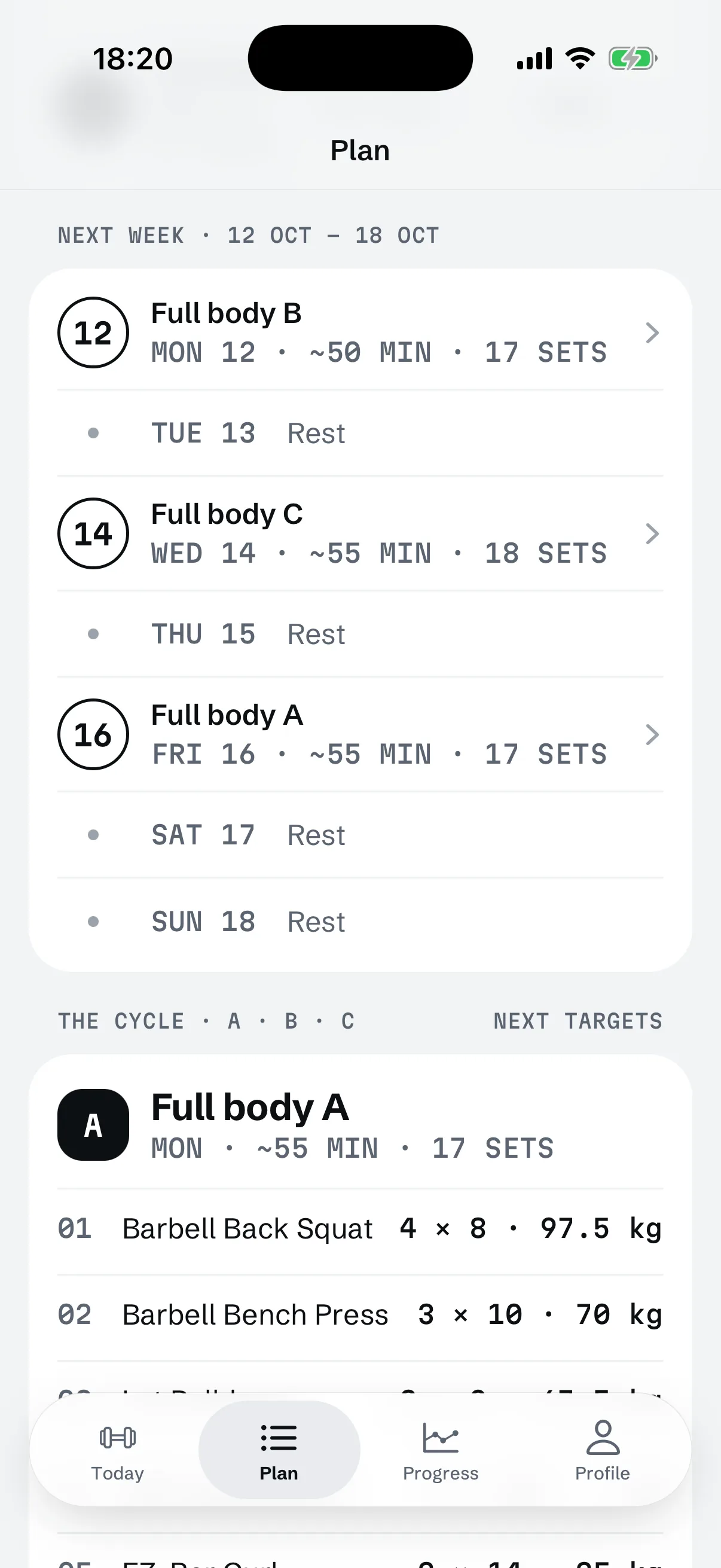
The Plan screen lists each coming workout with its length and its sets. Here Full body B, C and A hold 17 or 18 sets each, and the first lift of Full body A is a squat for 4 sets.
How does RIGOR cut sets when time is short?
It cuts in a fixed order, and never below 2 sets on an exercise. When a day's estimate runs over the session length, the generator takes sets first from muscles you deprioritised, then from minor muscles, then evenly across exercises, then drops the last isolation, unless it gives a minor muscle its 2 direct sets, and after that the last compound that is not a main lift.
The 30 to 45 minute dumbbell plan has nine two-set exercises and no four-set one, and its notes record that sets were cut for time. The 60 to 75 minute full body plan carries the same note. Rest between sets is the other half of fitting a session into the clock.
How does a deload week change the sets?
It halves them, rounded up, so 4 become 2, 3 become 2 and 2 become 1. The reps go to the bottom of each range and the weights drop about 10%. The deload week guide has the rest of the rule. This page takes the sets.
Take Full body A from the plan above. In a training week it has 17 sets. In the deload week, week 5 of the block:
| Exercise | Training week | Deload week |
|---|---|---|
| Barbell Back Squat | 4 × 6–10 | 2 × 6 |
| Barbell Bench Press | 3 × 8–12 | 2 × 8 |
| Lat Pulldown | 3 × 8–12 | 2 × 8 |
| Stiff Leg Deadlift | 2 × 8–12 | 1 × 8 |
| EZ-Bar Curl | 3 × 10–15 | 2 × 10 |
| Leg Extension | 2 × 10–15 | 1 × 10 |
| Total sets | 17 | 10 |
The sums: before, 4 + 3 + 3 + 2 + 3 + 2 = 17. After, 2 + 2 + 2 + 1 + 2 + 1 = 10. Rounding up keeps a little more than half of 17, so the day lands on 10 and not 8 or 9. The whole week works the same way. Full body B goes from 17 sets to 10 and Full body C from 18 to 11, so the week falls from 17 + 17 + 18 = 52 sets to 10 + 10 + 11 = 31.
Only some plans have the week. A block is four training weeks, with a fifth deload week when deload is on, which it is by default for intermediate and advanced lifters and not for beginners. The beginner upper/lower plan above has four weeks and no deload.
- WEEK1
- WEEK2
- WEEK3
- WEEK4
- DELOAD5
What does "easier today" do to the sets?
It takes one set from each exercise, the last one, and never goes below 1. It applies to that session only: the plan stays as it was. The same day, Full body A, would run 3, 2, 2, 1, 2 and 1 sets, 11 in all. Check: 17 − 6 = 11, one off each of the six exercises, and none was down to its last set. The loads drop 10% as well. The deload keeps 10 sets and the easier day 11. One is planned, the other is your call on the day.
When does this not apply?
A set below the bottom of the rep range is a miss under double progression, and the weight does not go up. The 4 day upper lower program keeps its count at 2 to 4. Rep ranges covers the reps, and what 3x10 means how to read a row of sets and reps.
RIGOR sets the sets for you
Questions
Is 3 sets or 4 sets better for hypertrophy?
The research here does not pick one. In a 2010 meta-analysis, 2 to 3 sets and 4 to 6 sets per exercise did not differ significantly. Weekly sets for the muscle is what later reviews counted.
How many sets per exercise for muscle growth?
Two to four working sets is the range RIGOR uses. Its first lift of the day gets 3 or 4 and the rest get 2 or 3. In its four sample plans no exercise has 1 set or 5.
How many sets per workout for muscle growth?
In RIGOR's four sample plans a workout holds 9 to 18 working sets. The rule behind them is a cap of 10 counted sets for any one muscle in a session, and a weekly target for each muscle.
What do 3 sets of 15 reps mean?
Three sets of fifteen reps: 15 lifts, a rest, 15 more, a rest and 15 more. That is 3 × 15 = 45 reps. The first number is the sets and the second the reps.
What is the 3-3-3 rule for working out?
Read it from the plan that uses it, which should say what its three threes are. RIGOR's plans use no such rule: they set 2 to 4 sets per exercise.