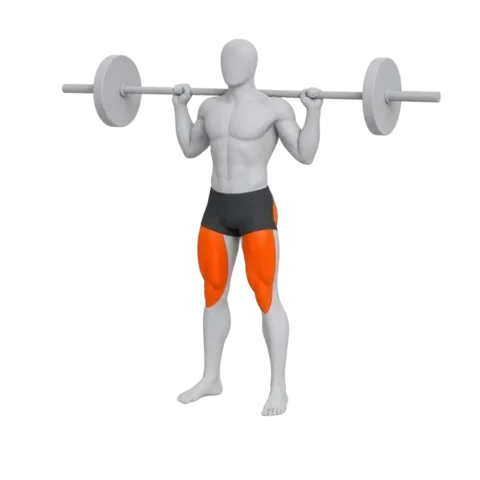
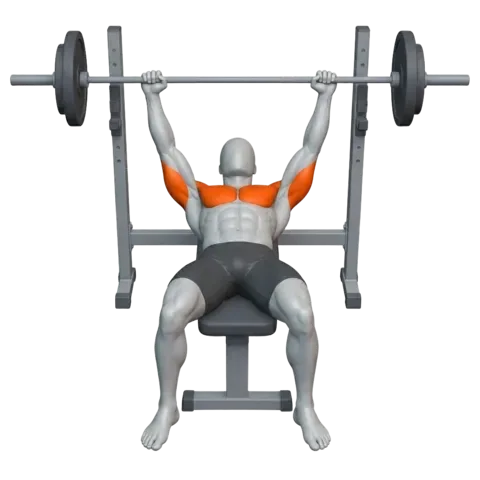
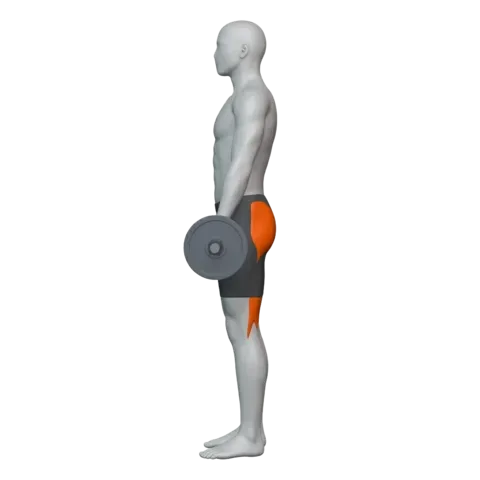
Do the lift that matters most first, then the other compounds, then isolation. Studies find the biggest strength gains in the exercises done first and mostly similar muscle growth either way. RIGOR opens each day with a squat, hinge, press or pull and puts isolation last.
What order should you do your exercises in?
Start with the exercise that matters most to you, usually a heavy compound, and work down to the lifts that tire you least. RIGOR builds every day that way: the day's first compound is its main compound, the other compounds follow, and isolation exercises come last. The order matters for two reasons. The lifts done first get you at your freshest, and the warm-up rule reads the list from the top.
The studies on order are few, and they find a clear effect on strength and a weak one on muscle size. The sections below take the research, the way RIGOR orders a day, the legs, and the effect on warm-ups.
How does RIGOR order a workout?
By a fixed template for each kind of day. The generator fills the day's compound slots in a set order, calls the first one the main compound, then adds the rest of the day. What you see is the main compound, then the other compounds in the order they were added, then core compounds, then isolation exercises. It never pairs two lifts as a superset: each exercise runs on its own.
| Day | Compound slots, in order | In a sample plan |
|---|---|---|
| Full body | A squat or a hinge, a push, a pull | Barbell Back Squat, Barbell Bench Press, Lat Pulldown |
| Upper | A push, then a pull | Dumbbell Bench Press, Lat Pulldown |
| Lower or legs | A squat and a hinge, either first | Leg Press, Dumbbell Romanian Deadlift |
| Push | A horizontal press, then an overhead press | Barbell Bench Press, Barbell Overhead Press |
| Pull | A vertical pull, then a horizontal pull | Lat Pulldown, Bent-Over Barbell Row |
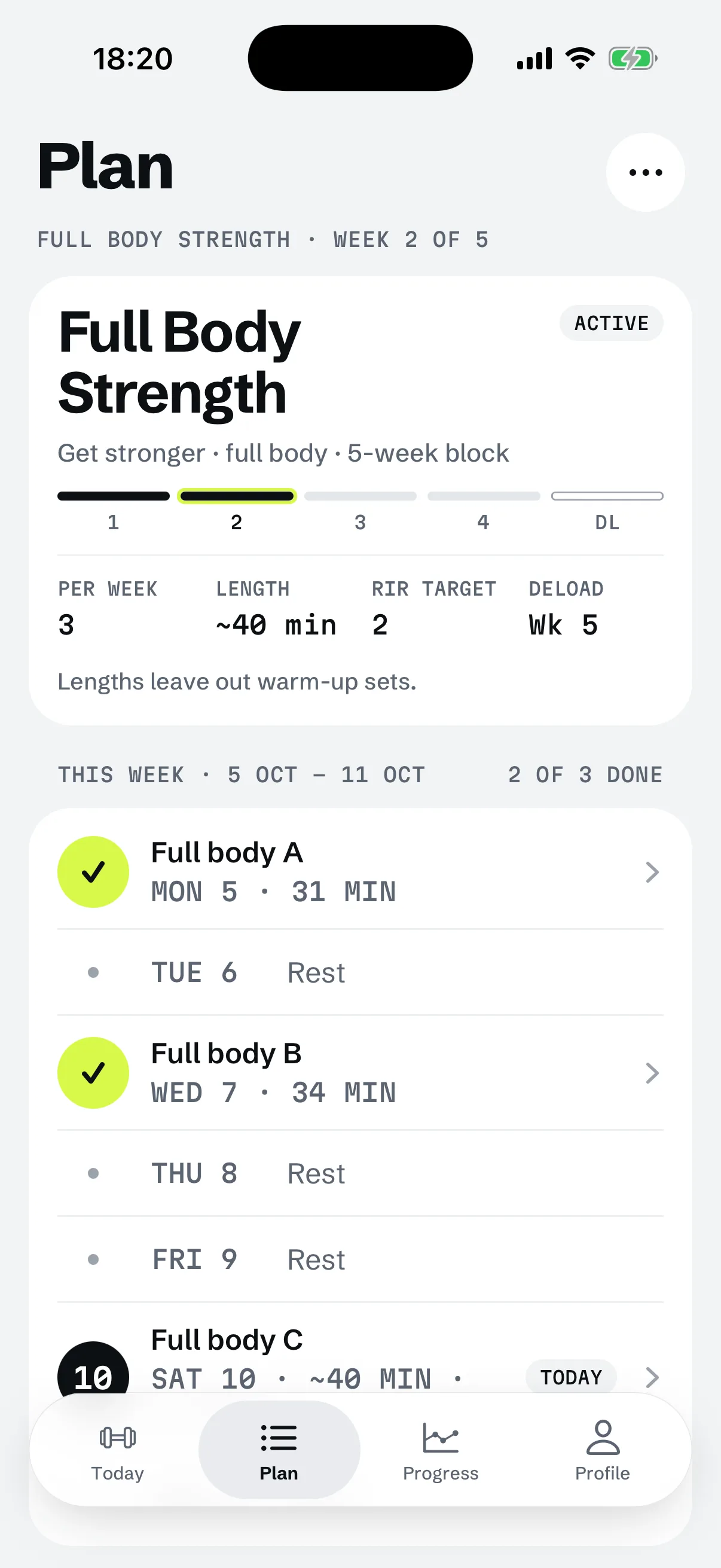
Two days of the same kind do not open alike. Squat-first and hinge-first days alternate, so in the 3 day full body program Full body A and C open with the Barbell Back Squat and Full body B opens with the Romanian Deadlift. The best workout split decides which day types a week holds; the template decides what each one starts with.
The first compound also gets the most sets, 3 or 4 against 2 or 3 for the rest, and its own rep range. The rep ranges guide gives the whole chart. The line between the two kinds of lift is in compound vs isolation exercises.
RIGOR is a strength training app for iPhone that builds your plan and sets every weight by rules you can read.
YOUR IPHONE

Does exercise order matter for strength training?
Yes, for the lifts at the front. A 2021 systematic review and meta-analysis of 11 studies found that gains in muscular strength were largest in the exercises done at the beginning of a session. A 2012 review reached the same place for untrained people: strength gains were greater for the first exercise in a sequence and weaker for the last. It also notes that an exercise placed first allows more total repetitions across several sets, and it recommends ordering exercises by their importance to the training goal.
RIGOR does not ask which lift you care about most. Its order comes from the template above, and a lift you want first can be dragged to the top. On a strength goal the main compound takes 4 to 6 reps, and a strength plan's pull day leads with a weighted pull-up or a row.
Does exercise order matter for hypertrophy?
Little, as far as the trials show. The same 2021 review found that muscle growth was similar whichever order was used. One of the trials it covers, from 2019, had 36 young men train for 6 weeks, 19 doing multi-joint exercises first and 17 single-joint first. Biceps thickness rose about 14% in both groups, 14.2% and 13.8%. Mid-thigh thickness rose 7.2% with multi-joint first and 3.9% the other way, and the authors report only the first rise as significant. They conclude that both orders built muscle in the short term, with a possible edge at the thigh for multi-joint first.
What order should you do leg exercises in?
A squat pattern and a hinge first, then the other leg compounds, then isolation and calves. Where the two lower-body lifts rank depends on the day. Take the 6 day push/pull/legs plan for a muscle goal: Legs A opens with the squat, Legs B with the Romanian deadlift.
| Day | Exercise | Sets × reps | Rest |
|---|---|---|---|
| Legs A | Barbell Back Squat | 4 × 6–10 | 3:00 |
| Legs A | Romanian Deadlift | 2 × 8–12 | 3:00 |
| Legs A | Bulgarian Split Squat | 3 × 8–12 | 3:00 |
| Legs A | Leg Extension | 2 × 10–15 | 1:30 |
| Legs A | Seated Calf Raise | 3 × 12–20 | 1:30 |
| Legs A | Standing Calf Raise | 2 × 12–20 | 1:30 |
| Legs B | Romanian Deadlift | 3 × 6–10 | 3:00 |
| Legs B | Leg Press | 3 × 8–12 | 3:00 |
| Legs B | Kettlebell Reverse Lunge | 3 × 8–12 | 3:00 |
| Legs B | Standing Calf Raise | 3 × 12–20 | 1:30 |
| Legs B | Machine Calf Raise | 3 × 12–20 | 1:30 |
One rule keeps the heaviest hinge off a squat's day: the conventional deadlift goes into a week once at most, and never on a day the back squat leads. The Romanian deadlift and the other hinges cover the rest.
How does the order change warm-up sets?
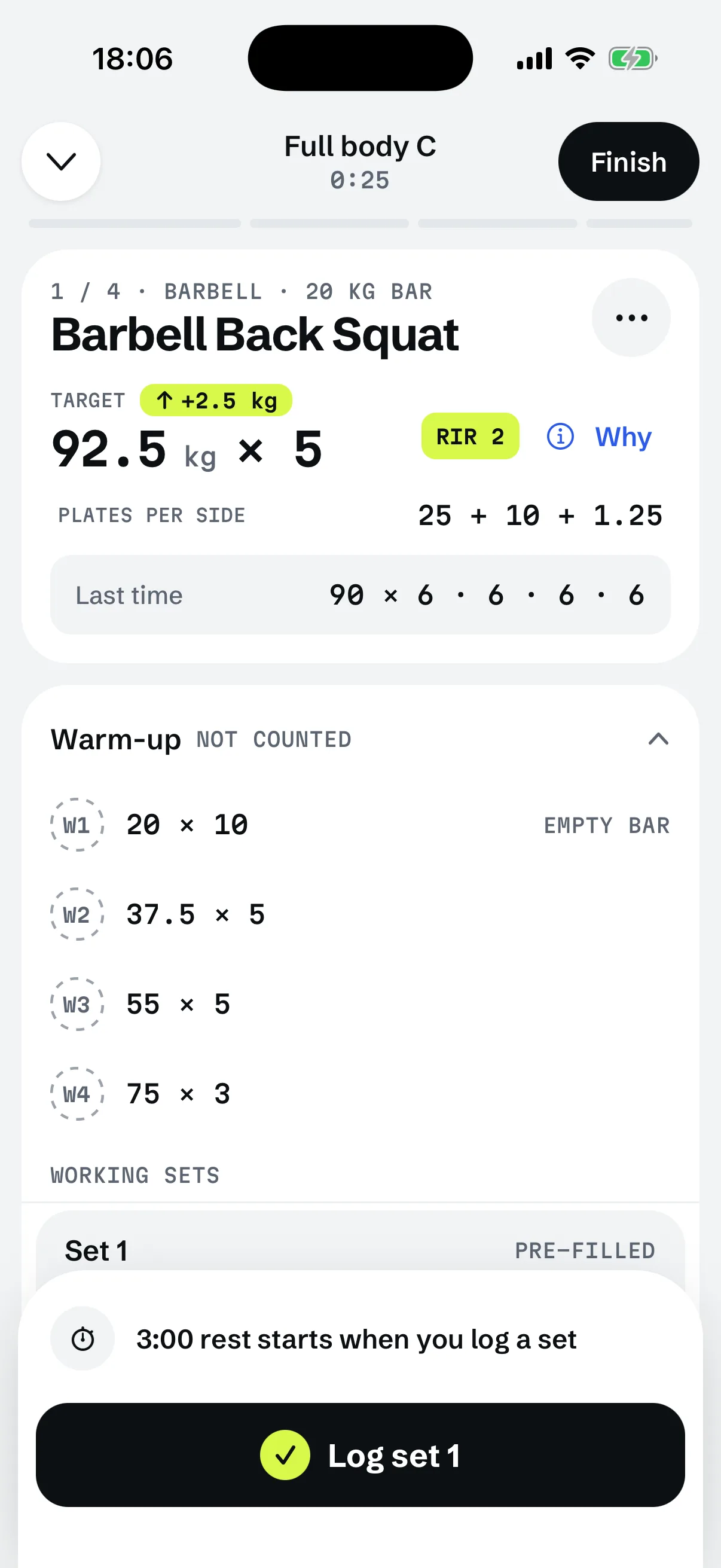
It decides which lifts get them. A compound skips its ramp only when an earlier exercise in the session trained the same movement pattern with working sets, and an isolation exercise skips only when an earlier exercise trained one of its primary muscles. The warm-up sets guide has the full rule. Here the point is the list: the rule reads it from the top, so a lift's place decides whether it counts as warm.
| Place | Exercise | Sets | Warm-up sets | Why |
|---|---|---|---|---|
| 1 | Barbell Back Squat | 4 | 3 | First squat pattern |
| 2 | Barbell Bench Press | 3 | 3 | First horizontal push |
| 3 | Lat Pulldown | 3 | 3 | First vertical pull |
| 4 | Stiff Leg Deadlift | 2 | 3 | A hinge, not a squat |
| 5 | EZ-Bar Curl | 3 | 1 | Nothing before it had the biceps as a primary muscle |
| 6 | Leg Extension | 2 | 0 | The squat already trained the quadriceps |
The session's 17 working sets come with 13 warm-up sets: 3 + 3 + 3 + 3 + 1 + 0. The same six lifts with the two isolation exercises first would be planned with 14, since the leg extension and the curl are then both cold: 1 + 1 + 3 + 3 + 3 + 3. The squat is not helped by a leg extension before it, because only a compound of the same pattern counts, so it keeps its whole ramp.
Rest between warm-up sets is shorter than between working sets; the times in rest between sets are for working sets. The warm-up calculator works out the weights of each ramp.
When does this not apply?
RIGOR orders the day and lists the warm-ups
Questions
Can I change the order in RIGOR?
Yes. Press and hold an exercise, then drag it, from Reorder exercises in the workout's menu or from the editor of a workout's day. Logged sets move with the exercise.
Does the order change with my goal?
Almost never. The template is the same for muscle, strength or both; only the rep ranges differ. The exception is a strength plan's pull day, which leads with a weighted pull-up when the lifter can do pull-ups and may take the weighted version, and with a row otherwise. A pulldown does not lead it.
Where do ab exercises go?
After the other compounds. Core work that the catalogue counts as compound, such as leg raises and knee raises, is placed behind the other compound lifts, ahead of the isolation exercises.
Does the first exercise get a different rep range?
Yes. A day's first compound takes the main-compound range: 6 to 10 reps on a muscle goal and 4 to 6 on a strength goal. Every other compound takes the next range, 8 to 12 and 6 to 8.