RIGOR's rules set 10, 13 or 16 counted sets a week for a major muscle group and 6, 8 or 10 for a minor one, by beginner, intermediate or advanced level. A set counts 1 for a primary muscle and 0.5 for a secondary one. Reviews link more weekly sets to more growth, with returns that fade.
How many sets per muscle group per week?
For a major muscle, RIGOR's rules ask for 10 counted sets a week at beginner level, 13 at intermediate and 16 at advanced. For a minor muscle they ask for 6, 8 or 10. RIGOR is the app behind this guide, and the numbers below are its own rules and its own sample plans.
| Beginner | Intermediate | Advanced | |
|---|---|---|---|
| Major (chest, back, quads, hamstrings, glutes, shoulders) | 10 | 13 | 16 |
| Minor (biceps, triceps, calves, abs) | 6 | 8 | 10 |
The rules count a set like this: "A set counts 1 for a group when one of the exercise's primary muscles is in it, otherwise 0.5 when a secondary muscle is, at most once per group." A set can therefore add 1 to one group and 0.5 to another, and the weekly figures can end in a half.
How many sets per muscle group per week does each sample plan give?
Counted this way, the four sample plans on this site give the numbers below. Here they are, with their goal and level:
- Full body, 3 days: commercial gym, 60 to 75 minutes, hypertrophy goal, intermediate level (targets 13 and 8).
- Upper/lower, 4 days: commercial gym, 45 to 60 minutes, goal "both", beginner level (targets 10 and 6).
- Push/pull/legs, 6 days: commercial gym, 60 to 75 minutes, hypertrophy goal, advanced level (targets 16 and 10).
- Dumbbells, 3 days full body: dumbbells only, 30 to 45 minutes, hypertrophy goal, beginner level (targets 10 and 6).
| Muscle group | Full body | Upper/lower | Push/pull/legs | Dumbbells |
|---|---|---|---|---|
| Chest | 12 | 10 | 16 | 6 |
| Back | 13.5 | 10 | 16.5 | 8 |
| Quads | 13 | 10 | 16.5 | 6 |
| Hamstrings | 12.5 | 10 | 16.5 | 6 |
| Glutes | 16 | 15 | 23 | 9 |
| Shoulders | 11.5 | 12 | 20 | 8 |
| Biceps | 7 | 6.5 | 10 | 6 |
| Triceps | 9.5 | 7 | 11 | 4 |
| Calves | 4.5 | 6 | 11 | 2 |
| Abs | 2 | 6.5 | 10.5 | 3 |
The upper/lower and push/pull/legs plans meet every target of their level.
RIGOR is a strength training app for iPhone that builds your plan and sets every weight by rules you can read.
YOUR IPHONE

Where do the plans fall under a target?
In the full body plan and the dumbbell plan. Both carry the note volume_capped_by_time in plans.json, which records a cut made to fit the session length. So some of their muscles sit under the target, and the rules' "a plan meets or exceeds each target" does not hold there.
- Full body (intermediate): chest 12, hamstrings 12.5 and shoulders 11.5 sit under 13; biceps 7, calves 4.5 and abs 2 sit under 8.
- Dumbbells (beginner): every major muscle sits under 10 (the highest is glutes at 9); triceps 4, calves 2 and abs 3 sit under 6. Biceps reaches exactly 6.
The cut follows a fixed order: sets from deprioritised muscles first, then sets from minor muscles, then sets evenly, never below 2 per exercise. That is why the minor muscles are short first. Two sets a week of direct work is the floor the rules keep for them: "Hypertrophy and both goals get at least 2 direct sets a week for each minor muscle."
How many sets per muscle group per workout?
At most 10 counted sets for one muscle in a session. The rules say: "No muscle gets more than 10 counted sets in one session; a larger weekly target is spread over more days." A weekly target of 16 therefore needs at least two days for that muscle.
The most any muscle gets in one day of the four plans is 10, chest on Push A. Here is that day.
Push A
- Barbell Bench Press4 × 6–10 · REST 2:00
- Barbell Overhead Press2 × 8–12 · REST 2:00
- Dumbbell Bench Press3 × 8–12 · REST 2:00
- Incline Barbell Bench Press3 × 8–12 · REST 2:00
- Cable Crunch3 × 12–20 · REST 1:00
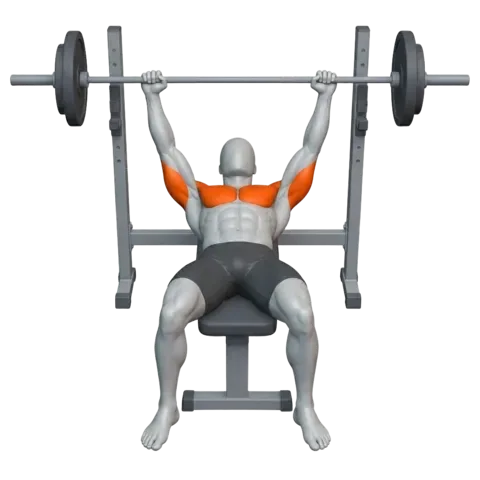
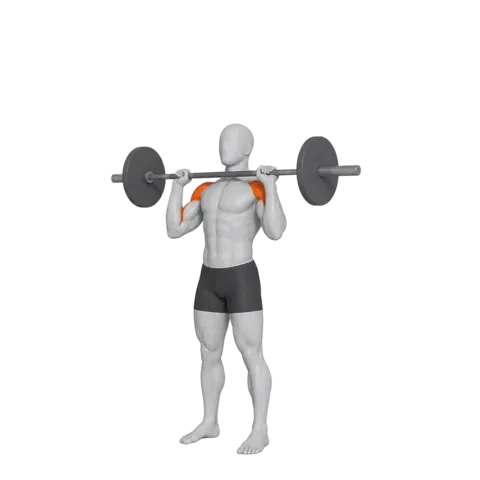
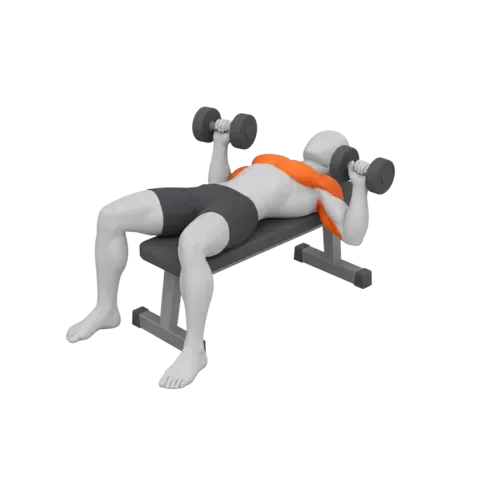
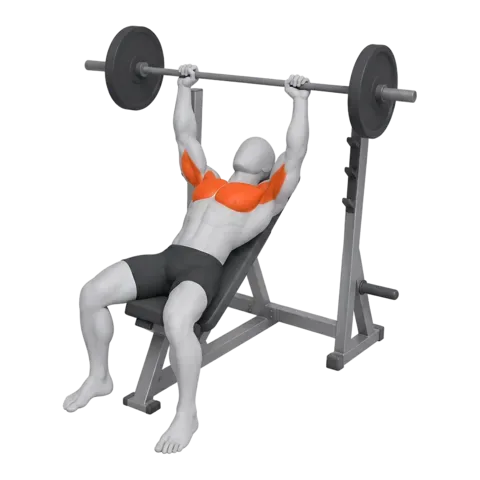
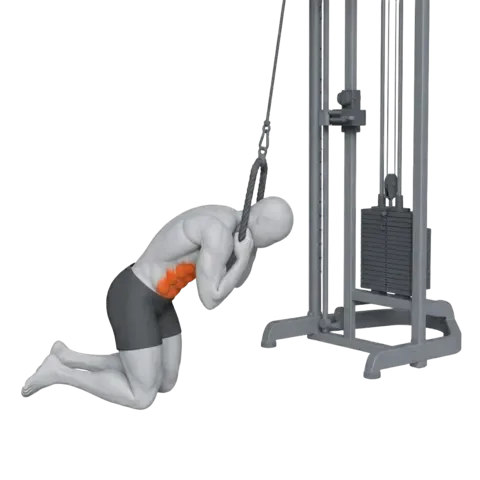
Over the week the chest in that plan gets 16 sets over 2 days, 10 on Push A and 6 on Push B. How days divide the week is the subject of best workout split, and how often a muscle is trained is in how often to train each muscle group.
What does the research say about sets per muscle group per week?
Schoenfeld 2017 and Pelland 2025 link more weekly sets to more growth, and Pelland found diminishing returns. Baz-Valle 2022 found no difference between moderate and high volume for two of three muscles. None of them gives one number that fits everyone.
- Schoenfeld 2017. A meta-analysis of 34 treatment groups from 15 studies. Each additional weekly set was associated with a 0.37% greater gain in muscle size (P = 0.002), and higher against lower volume within a study came to 3.9% (P = 0.03). Grouped as fewer than 5, 5 to 9 and 10 or more weekly sets per muscle, the result was only a trend (P = 0.074). The authors call it a graded dose-response relationship (Schoenfeld 2017).
- Baz-Valle 2022. Seven studies met the inclusion criteria and six entered the meta-analysis, with young trained men. Moderate volume (12 to 20 weekly sets per muscle group) and high volume (more than 20) did not differ for quadriceps or biceps, and high volume was better for triceps. The authors suggest 12 to 20 weekly sets per muscle group as an optimum standard for young, trained men (Baz-Valle 2022).
- Pelland 2025. Meta-regressions of 67 studies and 2,058 participants. Indirect sets were counted at 1, at 0.5 ("fractional") or at 0 (direct only), and the fractional method had the strongest relative evidence. Gains rose with weekly volume for hypertrophy and strength, with diminishing returns, much more pronounced for strength. For hypertrophy, the effect of frequency was compatible with negligible (Pelland 2025).
The 0.5 for a secondary muscle in RIGOR's count is the fractional method in Pelland's review. RIGOR's beginner target of 10 for a major muscle sits below the 12 to 20 range of the 2022 review, which studied trained men. The intermediate 13 and advanced 16 sit inside it. The page leaves out a figure for the point where extra sets stop helping, because the full text of Pelland 2025 could not be read for this guide, only its abstract.
Is a weekly set target the same as a goal for strength?
No. Under a strength goal the rules add a frequency rule on top of weekly sets: each main pattern appears at least twice a week when there are 3 or more days. The targets above are the same for each goal, and the hypertrophy vs strength guide covers how the two goals differ in reps and loads. Sets are also only half of progress: a target met with the same weights each week adds little, which is what double progression is for, and sets per exercise and exercises per workout count the pieces that make up a muscle's week.
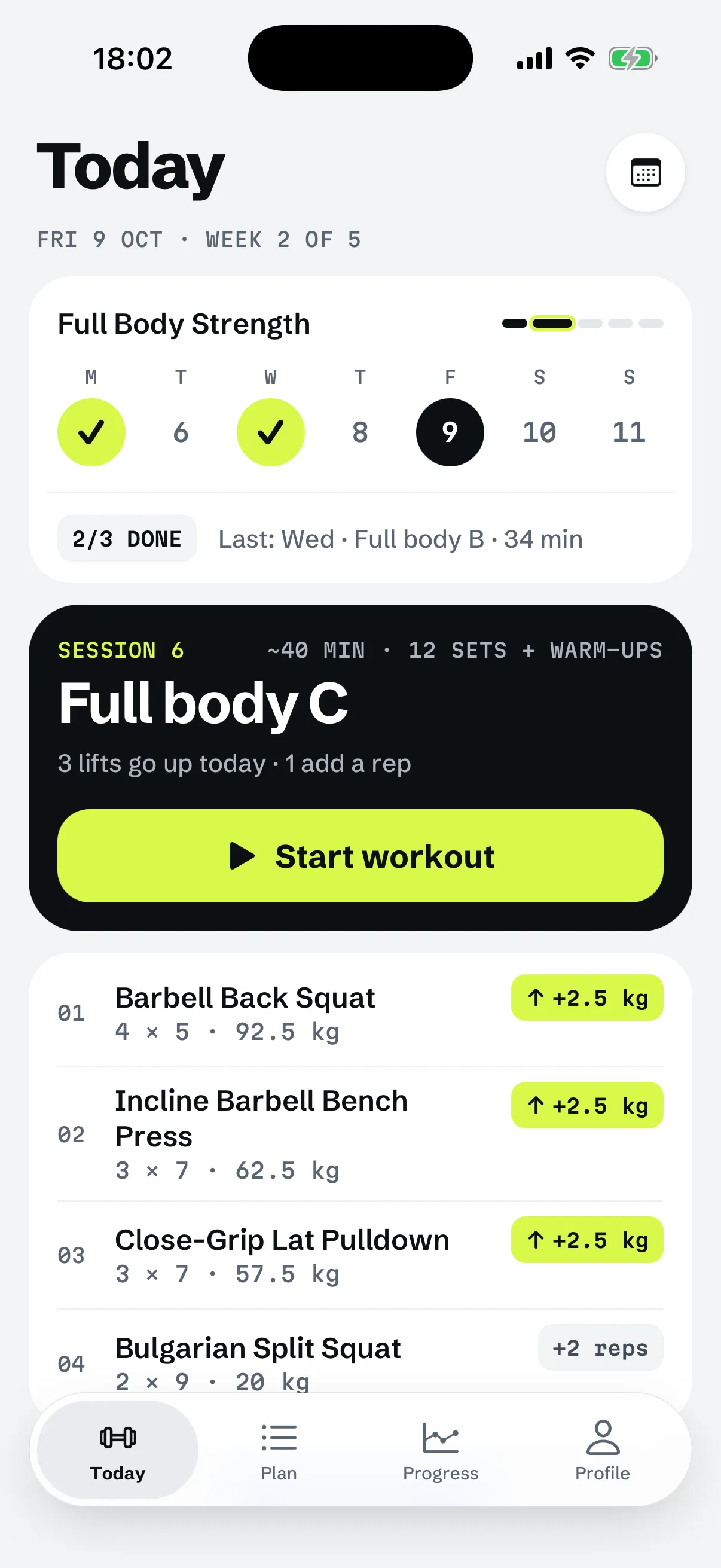
The Plan screen lists each coming workout with its sets. The weekly count per muscle is the sum across these days.
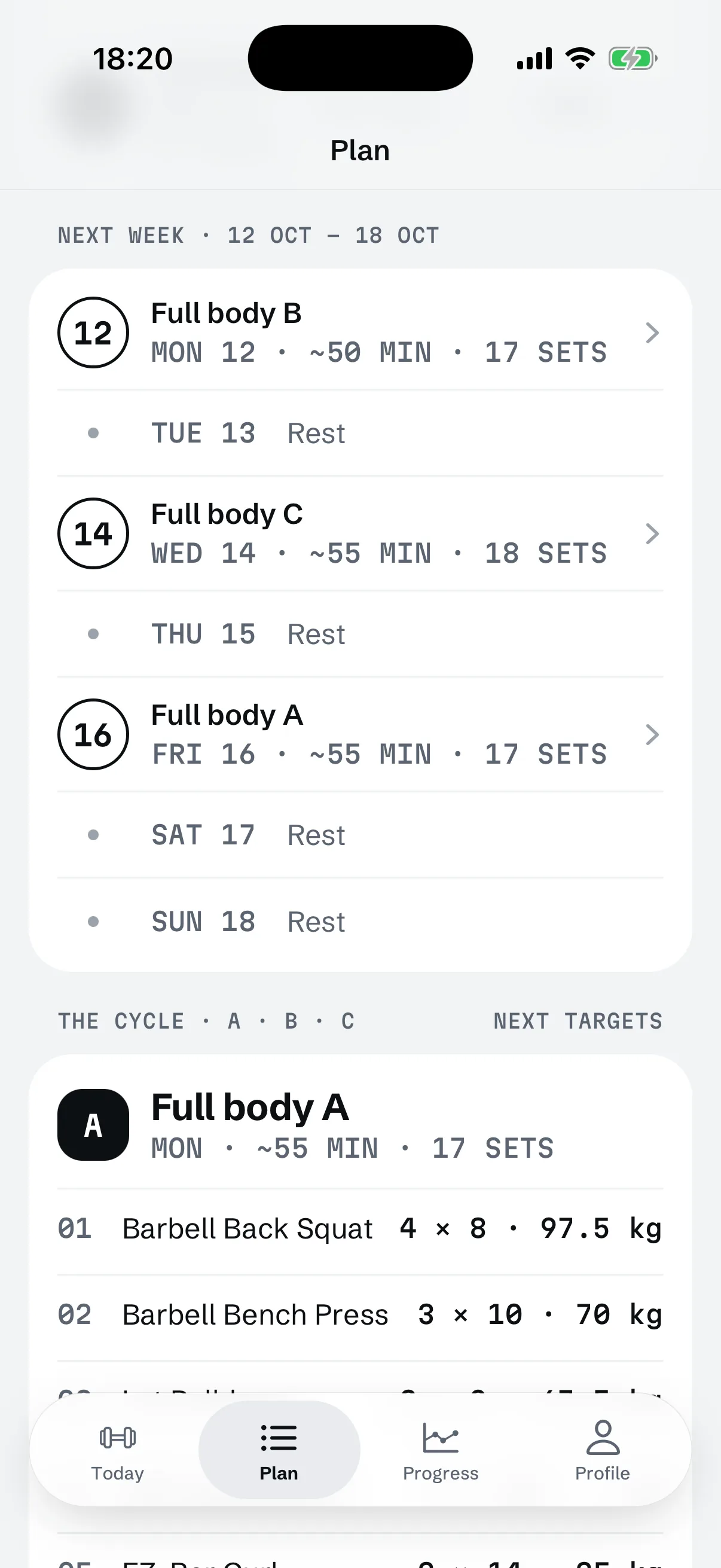
The 3 day full body program shows that week in full.
- WEEK1
- WEEK2
- WEEK3
- WEEK4
- DELOAD5
When does this not apply?
RIGOR counts the sets for every muscle
Questions
How many sets per muscle group per week for hypertrophy?
RIGOR's hypertrophy plans aim at 10, 13 or 16 counted sets for a major muscle and 6, 8 or 10 for a minor one, by level. A review of trained men suggested 12 to 20 weekly sets per muscle group.
How many sets per week for muscle growth?
Two reviews opened for this guide link more weekly sets to more growth, and one of them found the returns diminish. A third, in young trained men, found no difference between 12 to 20 sets and more than 20 for two of three muscles. No single number is proven for everyone.
How many sets per muscle group per workout?
RIGOR allows at most 10 counted sets for one muscle in a session. Across its four sample plans the most any muscle gets in one day is 10, chest on Push A of the push/pull/legs plan.
Do indirect sets count?
In RIGOR a set counts 1 for a muscle group when one of the exercise's primary muscles is in it, otherwise 0.5 when a secondary muscle is, at most once per group.
Are RIGOR's targets maximums?
No. Its targets are minimums: counted sets land on whole or half sets, so a plan meets or exceeds each target, unless time or the split caps the plan.