Start in four steps. Pick the days you can train, get a plan for them, find a starting weight for each exercise, then add reps before weight. The American College of Sports Medicine advises novices to train two to three days a week. RIGOR, the app behind this guide, follows this path.
How do you start lifting weights?
In four steps, in this order: pick the days you can train, get a plan built for them, find a starting weight for each exercise, and then add reps before you add weight. Each step is one decision, and the next one only needs the one before it.
RIGOR is the app behind this guide, and this is the path it takes a beginner down. Below, each step says what RIGOR does, with the conditions it applies.
How many days a week should a beginner lift?
Two or three. The American College of Sports Medicine's 2009 position stand says: "The recommendation for training frequency is 2-3 d x wk(-1) for novice training". That is its advice for training frequency, and it is the only thing taken from it for this step. Choose the number of days you can keep, then the split follows from it. The workout split by days guide compares them in full.
RIGOR builds plans for two to six days a week and names one structure as recommended for each.
| Days | Recommended | Also allowed |
|---|---|---|
| 2 | Full body | Upper/Lower |
| 3 | Full body | Push/Pull/Legs (flagged: each muscle once a week) |
| 4 | Upper/Lower | Full body |
| 5 | Upper/Lower + Push/Pull/Legs | Full body |
| 6 | Push/Pull/Legs twice | Upper/Lower three times |
RIGOR is a strength training app for iPhone that builds your plan and sets every weight by rules you can read.
YOUR IPHONE

What plan should a beginner start with?
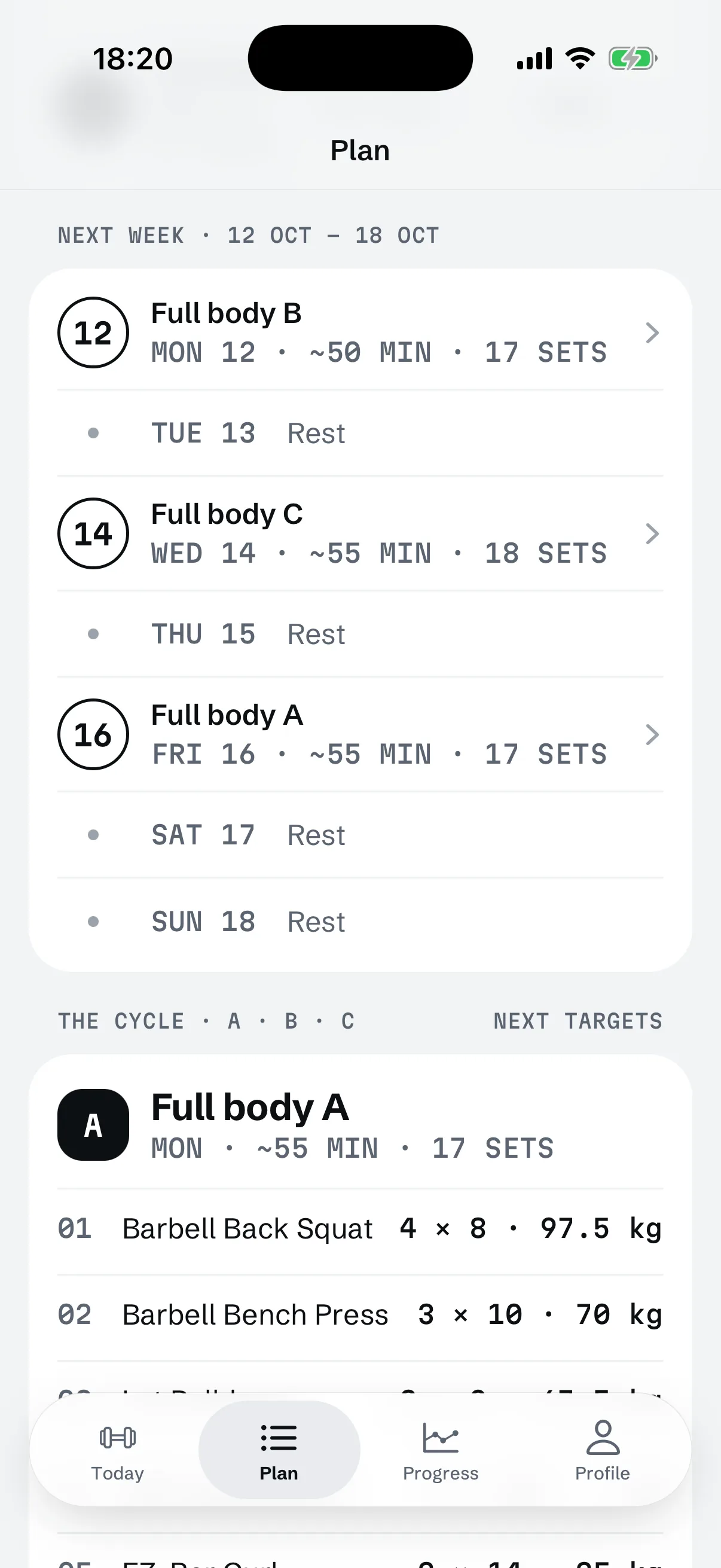
One built for your days, your session length and your gym. RIGOR's plan builder takes your goal, experience, days a week, session length, split and gym, and returns the whole block: the exercises, the sets and the rep range of each. A block is four training weeks, with the same exercises every week.
Choosing beginner changes four things:
- The exercises. A beginner gets a beginner-difficulty exercise where one exists for the movement.
- The effort targets. Reps in reserve are the reps you could still do after the last one. A beginner's compounds are planned at 3, 3, 2, 2 across weeks 1 to 4, and isolations at 2, 2, 1, 1.
- The weekly sets. The plan aims at 10 counted sets a week for each big muscle group and 6 for each small one. A set counts 1 for a group when one of its primary muscles is worked and 0.5 when a secondary muscle is, and a short session can cut the total.
- The deload week. It is off by default for beginners, and they can turn it on. A deload week is the lighter fifth week.
For three days a week the 3 day full body program shows a whole plan. It is written for an intermediate, and says how a beginner's week differs.
How do you find your first weights?
Pick a weight you could lift for the middle of the rep range, with about the planned number of reps left. For an exercise you have never logged, RIGOR leaves the weight blank, fills the reps at the middle of the range and shows the effort target: "Pick a weight you can lift for 8–12 reps with about 3 left". The middle of 8 to 12 is 10. Your first day at the gym walks through the whole workout.
Your count of reps left will be off. A 2022 review of 12 studies and 414 people found that participants tended to under-predict the repetitions they had left, by 0.95 on average, with considerable heterogeneity between studies. So the first weight is a starting point, not a verdict.
After your first completed sets, that session is the baseline. A first guess that was far off is recalculated at once, in two cases:
- Too heavy. Your best set's reps plus reps left come to less than the bottom of the range plus the effort target, minus 2. On 8 to 12 with 3 left that is under 9.
- Too light. At least half your sets score the top of the range plus the effort target plus 4, reps plus reps left. On 8 to 12 with 3 left that is 19 or more. The weight rises at most 20% at once.
In either case the weight changes only if the recalculated one differs in that direction. A set logged with no number is read as the planned effort. Anything between the two lines is left to the plain rule below.
How do you add reps, then weight?
Keep the weight and add a rep to each set, until every set reaches the top of the range. Then take the next weight your gym can make. This is double progression, and RIGOR applies it after every session. In an 8-week trial of 43 lifters with at least a year of lower-body training, both ways of progressing, more reps at a fixed weight and more weight at fixed reps, "appear to be viable strategies". Beginners were not in that trial.
The table follows a Barbell Bench Press of 3 sets of 8 to 12 reps, at 40 kg, with 3 reps left planned. It assumes the next weight your gym can make is 42.5 kg.
| You log | Next target | Why |
|---|---|---|
| 40 kg × 8, 8, 8 with 3 left | 40 kg × 9, 9, 9 | Every set in the range, none at the top: same weight, a rep more |
| 40 kg × 12, 12, 10 | 40 kg × 12, 12, 11 | One set short of the top: same weight, a rep more where there is room |
| 40 kg × 12, 12, 12 with 3 left | 42.5 kg × 9, 9, 9 | Every set at the top: the next weight, with the reps it should allow |
| 40 kg × 10, 10, 6 | 40 kg × 11, 11, 8 | A set under 8 is a miss: it aims for 8, the others a rep more |
The third row is the step up. RIGOR scores a set as its reps plus the reps left, 12 + 3 = 15, and estimates the most you could lift once with the Epley formula: 40 × (1 + 15 ÷ 30) = 60 kg. At 42.5 kg that gives floor(30 × (60 − 42.5) ÷ 42.5) = 12 reps to the limit, minus the 3 planned, which is 9.
TOP OF THE RANGE8 REPS · BOTTOM
The weight goes up only if every target set reached the top, and no logged set had more than one rep fewer in reserve than planned. With 3 planned, a set logged with 1 or 0 left holds the weight at 12 reps instead; it holds once, and not when the session before was also every set at the top. Two sessions in a row with a miss at one weight cut that exercise by 10%. Reps in reserve explains the scale.
What do you write down?
The weight and reps of every working set, and the reps you had left if you can say. The next target is worked out from last time's sets. An exercise with no logged history starts with a blank weight. How to track workouts gives the notebook version.
How to start lifting weights at home?
The same four steps, with the gym changed. RIGOR's setup asks for a gym preset: commercial gym, home gym, dumbbells only or bodyweight. The plan uses only exercises the equipment allows. For dumbbells, the 3 day dumbbell workout is a worked plan. A bodyweight exercise asks for reps only. At the top of its range, RIGOR suggests added load or a harder variation.
When does this not apply?
RIGOR picks the plan, then sets each weight
Questions
How to start lifting weights at the gym?
Choose the days you can train, then do the plan's first workout and use it to find a weight for each exercise. In RIGOR the weight box starts empty and the first completed sets become your baseline.
How should a beginner start lifting weights?
With two or three days a week, a full-body plan and weights you can lift with a few reps left. Then keep the weight and add reps until every set reaches the top of its range.
How to start weight lifting for beginners?
Follow the same four steps: days, plan, first weights, then reps before weight. A beginner setting in RIGOR changes the effort targets, the exercises chosen and the weekly sets.
Do I have to log reps in reserve?
No. In RIGOR you can log how many reps you had left after a set, or nothing. A set logged with none is read as the planned effort.
What if my first weight is wrong?
A little off, and you add reps then weight as usual. Far off, and RIGOR recalculates the weight after your first session of that exercise from your strongest set.