Gym terms are the words lifters use for how a workout is built, how hard a set is and what it is done on. This page defines them in one place, in a sentence or two each. It covers sets and reps, effort and progress, splits, equipment and slang.
What are the main gym terms?
They fall into a few groups: the words for a set and its reps, the words for effort and progress, the words for how a week is split up, the names of equipment, and slang. Each group has a table below, and each term gets a sentence or two. RIGOR is the app behind this guide, so where it does something specific with a term, the entry says what.
What do sets, reps and 3×10 mean?
A rep is one lift of the weight, and a set is a run of reps without putting it down. A plan writes the two together, so each term below builds on those.
| Term | What it means |
|---|---|
| Rep | One full lift and lowering of the weight. |
| Set | A group of reps done in a row before you rest. |
| 3×10 | Three sets of ten reps. A range is written 3×8–12: three sets of 8 to 12 reps. |
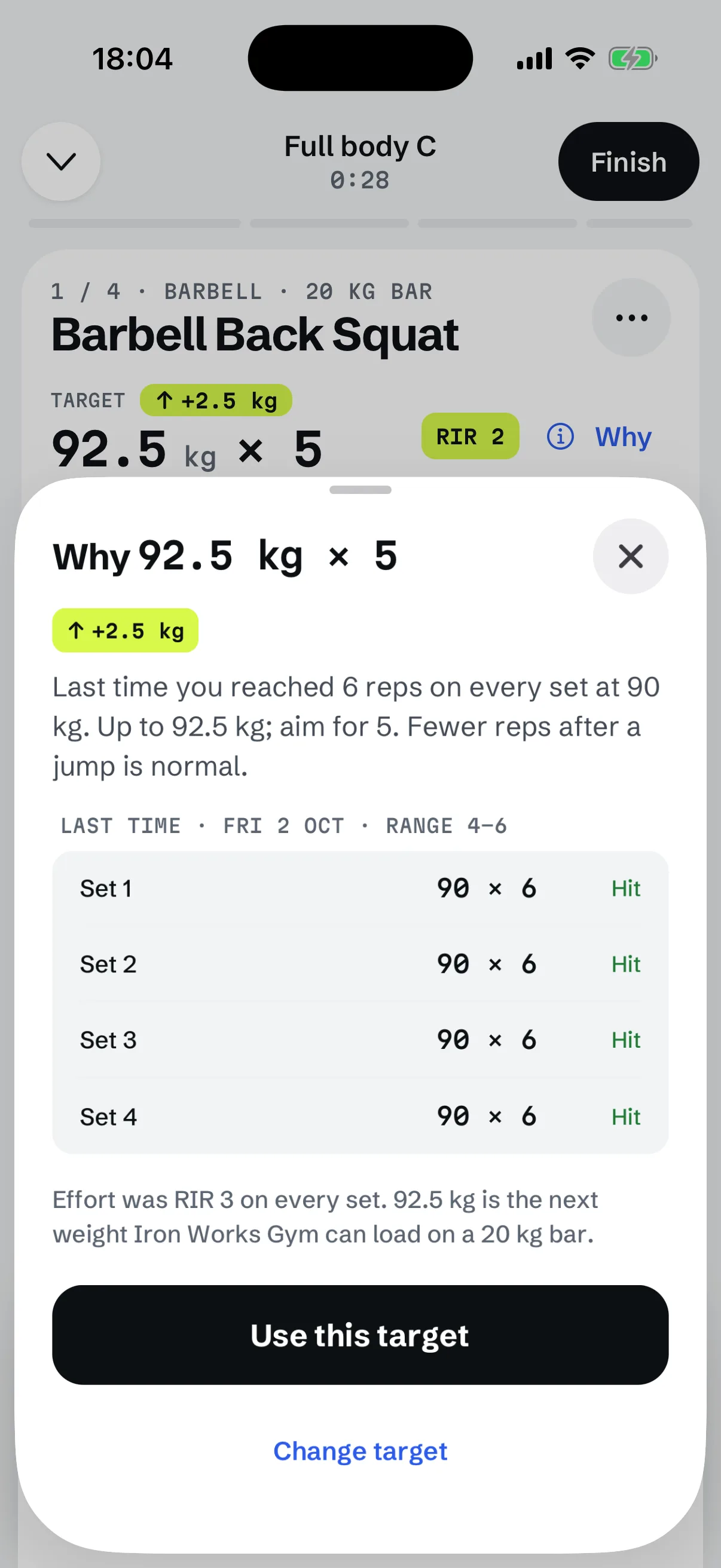
| Rep range | The span of reps a set aims for, such as 8 to 12. RIGOR plans a range for each lift you log with reps. |
| Rest | The pause between sets. |
| Working set | A set that counts as training, as opposed to a warm-up. RIGOR counts only completed working sets for progression, records and volume. |
| Warm-up set | A lighter set before the working sets. RIGOR makes them only for exercises with a weight, on by default, shows them apart from working sets, and never counts them toward volume, records or progress. The warm-up calculator shows the steps. |
| Top set | The heaviest or hardest working set of an exercise. |
| Back-off set | A lighter set after the top set, often for more reps. |
| Drop set | A set taken close to the end, then continued at once with a lighter weight. |
| Superset | Two exercises done back to back, with rest only after the pair. |
| AMRAP | As many reps as possible: a set with no rep target. |
RIGOR is a strength training app for iPhone that builds your plan and sets every weight by rules you can read.
YOUR IPHONE

What do RIR, RPE, failure and PR mean?
These describe how hard a set was and how a lift is moving over time.
| Term | What it means |
|---|---|
| RIR | Reps in reserve: the reps you could still have done when you ended the set. In RIGOR you can log 0, 1, 2, 3 or 4+ after a set, or nothing, and a set with no number is read as the planned effort. See reps in reserve. |
| RPE | Rating of perceived exertion: a score for how hard a set was. On the lifting version, RPE 10 is 0 reps in reserve and RPE 9 is 1, and so on down. |
| Failure | Ending a set only when you cannot do another rep, which is 0 in reserve. A 2023 meta-analysis of 15 studies found no evidence that going to momentary muscular failure beats stopping short for muscle growth. See training to failure. |
| 1RM | One-rep max: the most weight you can lift once. It is often estimated from a harder set, as the 1RM calculator does. |
| e1RM | An estimated one-rep max. RIGOR uses the Epley formula on the reps you did plus the reps you had left. |
| PR | Personal record: your best yet on a lift, in weight or in reps. RIGOR counts only completed working sets toward records. |
| Progressive overload | Asking a little more of a lift over time: more reps, more weight, or both. |
| Double progression | Adding reps within a rep range until every set reaches the top, then adding weight. A trial of 43 resistance-trained people found that raising reps at a fixed weight and raising weight at a fixed rep range both appeared viable over 8 weeks. RIGOR raises the weight when every set reaches the top of the range, except when a set was logged with more than one rep fewer in reserve than planned, which repeats the weight, or when the next weight up is too big a jump for the range, when it adds reps first. See double progression. |
| Deload | A planned lighter week. RIGOR halves the sets (rounded up), takes about 10% off the weight and asks for 2 more reps in reserve than week 1, never fewer than 4. It is on by default for intermediate and advanced lifters and off for beginners. See the deload week. |
| Plateau | A lift that has stopped going up for several sessions. RIGOR calls it a stall when three full sessions at one weight end with the newest no more total reps than the oldest, and it then takes 10% off that lift. The strength plateau guide has the rest. |
| Volume | The amount of work done, usually counted in sets over a week. RIGOR counts only completed working sets. |
| Form | How you perform a rep: the position and control of the movement. |
What do split, compound and push/pull/legs mean?
A split is how training is divided across the days of a week. The rest of these terms either name a split or describe the exercises inside one. RIGOR's sample plans cover full body, upper/lower and push/pull/legs.
| Term | What it means |
|---|---|
| Split | How a program divides the week's training across days. See how to choose a workout split. |
| Full body | A split in which every session works the main muscle groups. |
| Upper/lower | A split that alternates upper-body days and lower-body days. |
| Push/pull/legs | A split with push days (chest, shoulders, triceps), pull days (back, biceps) and leg days. |
| Bro split | An informal name for a split with one muscle group a day, such as chest day. |
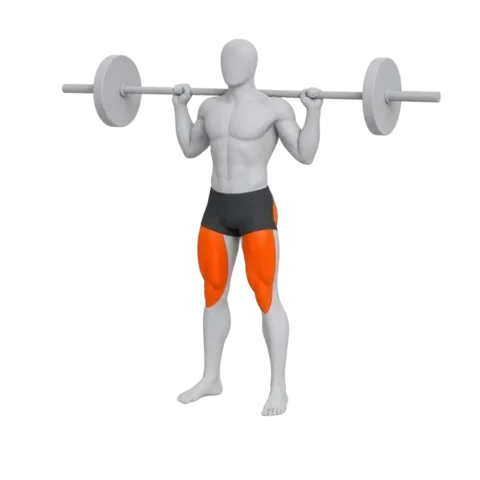
| Compound | An exercise that moves two or more joints, like a squat or a row. |
| Isolation | An exercise that moves one joint, like a curl. See compound and isolation exercises. |
What are the gym terms for equipment?
The equipment words mostly name a piece of kit and what it is for.
| Term | What it means |
|---|---|
| Barbell | A long bar you load with plates at both ends. |
| Dumbbell | A short bar with a weight at each end, held in one hand. |
| Plates | Discs of a known weight that slide onto a barbell. |
| Collars | Clamps that hold plates on the ends of a bar. |
| Rack | A frame with supports that hold a bar at set heights, for squats and presses. |
| Bench | A padded seat, flat or at an angle, for pressing and rowing. |
| Smith machine | A barbell fixed to vertical rails, so it moves only up and down. |
| Cable machine | A weight stack pulled through a pulley by a handle or attachment. |
| Spotter | A person who stands by during a heavy set to help if you cannot finish a rep. |
What does gym slang mean?
Slang names the feeling or the habit rather than a measurement, so it is looser than the terms above.
| Term | What it means |
|---|---|
| Gains | Strength and muscle you have built. |
| Pump | The tight, full feeling in a muscle during or after a set. |
| Ego lifting | Loading more weight than you can lift with control, to show it off. |
| Spot me | A request for someone to stand by and help if a rep fails. |
How do you read a line like 3 × 8–12?
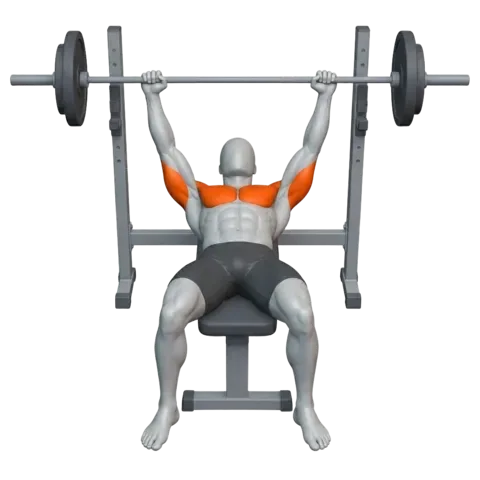
It means three sets, each aiming for 8 to 12 reps. Pick a weight that lets you reach that range, then stop each set with the number of reps in reserve the plan gives. In RIGOR's 3 day full body plan for an intermediate lifter, the Barbell Bench Press is 3 sets of 8 to 12 reps, and a compound lift in week 1 carries a target of 3 in reserve.
RIGOR plans the sets, reps and effort
When does this not apply?
Questions
What does PR mean in the gym?
PR means personal record: your best yet on a lift, in weight or in reps. RIGOR counts only completed working sets toward records, so a warm-up set never sets one.
What are the weights used in a gym called?
Free weights are mainly barbells, dumbbells and the plates loaded onto bars. Machines, including cable machines and the Smith machine, hold or guide the weight for you.
What is the difference between RIR and RPE?
They are one scale read from two ends. RIR counts the reps you had left, and RPE rates how hard the set was. On the lifting version of RPE, 10 is 0 reps in reserve and 9 is 1.
What does spot me mean?
It asks someone to stand by during a heavy set and help if you cannot finish a rep. The helper is a spotter.