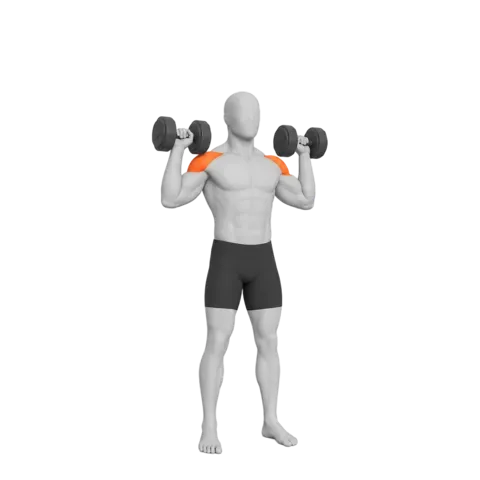
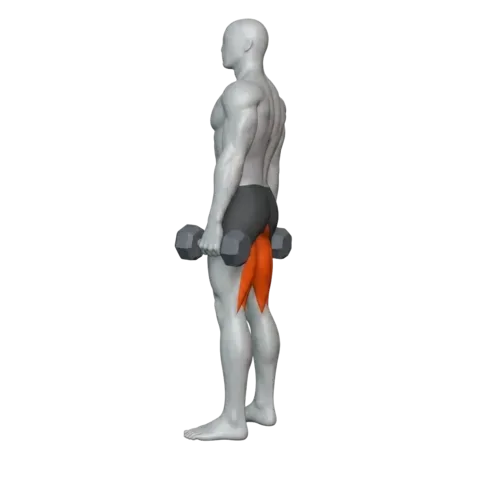
Neither is better; they aim at different results. In studies that took every set to failure, muscle growth was similar across light and heavy loads, while one-rep max strength gains favoured heavy loads. In RIGOR the goal mainly sets the rep ranges: 6 to 10 reps on a day's first compound for hypertrophy, 4 to 6 for strength.
What is the difference between hypertrophy and strength training?
Hypertrophy is growth in muscle size; strength is how much force you can produce, often tested as a one-rep max. The two overlap, and the studies below find muscle growth across a wide spread of loads, with the heaviest loads giving the larger strength gains. RIGOR treats the choice as a setting: goal is one of hypertrophy, strength or both, and it feeds the plan generator along with experience, days per week and session length.
The sections below take the studies, then the lines in the training rules that name the goal, then the cases where the choice hardly matters.
Which is better, heavy or light loads?
It depends on the result. Three papers that compared loads, each opened for this page:
- Schoenfeld 2017. A systematic review and meta-analysis of 21 studies. Each compared low-load training (60% of a one-rep max or less) with high-load training (above 60%), took every set to momentary muscular failure and lasted at least 6 weeks. Gains in one-rep max were significantly greater with high loads. Isometric strength did not differ significantly, and changes in muscle growth were similar. The authors conclude that maximal strength benefits come from heavy loads while muscle growth can be equal across a spectrum of loading ranges (Schoenfeld 2017).
- Lopez 2021. A network meta-analysis of 28 studies and 747 healthy adults, all with sets to volitional failure. Low load meant more than 15 reps to failure, moderate 9 to 15 and high 8 or fewer. Muscle growth did not differ between loads. Strength improved more with both high and moderate loads than with low; high against moderate favoured high, but not significantly (P = 0.068) (Lopez 2021).
- Schoenfeld 2015. A trial of 18 young men experienced in resistance training, trained 3 times a week for 8 weeks. One group did 25 to 35 reps a set, the other 8 to 12, both to failure. Muscle thickness rose in both groups with no significant difference between them. Back squat strength rose more with the heavier sets (19.6% against 8.8%), and bench press showed a trend the same way (6.5% against 2.0%). Upper-body muscle endurance, a bench press at 50% of the one-rep max to failure, rose more with the lighter sets (16.6% against −1.2%) (Schoenfeld 2015).
Endurance is the third word people put beside these two. The 2015 trial found the lighter sets gave the larger endurance gain on its bench press test, and RIGOR's goal setting offers hypertrophy, strength or both, with no endurance goal.
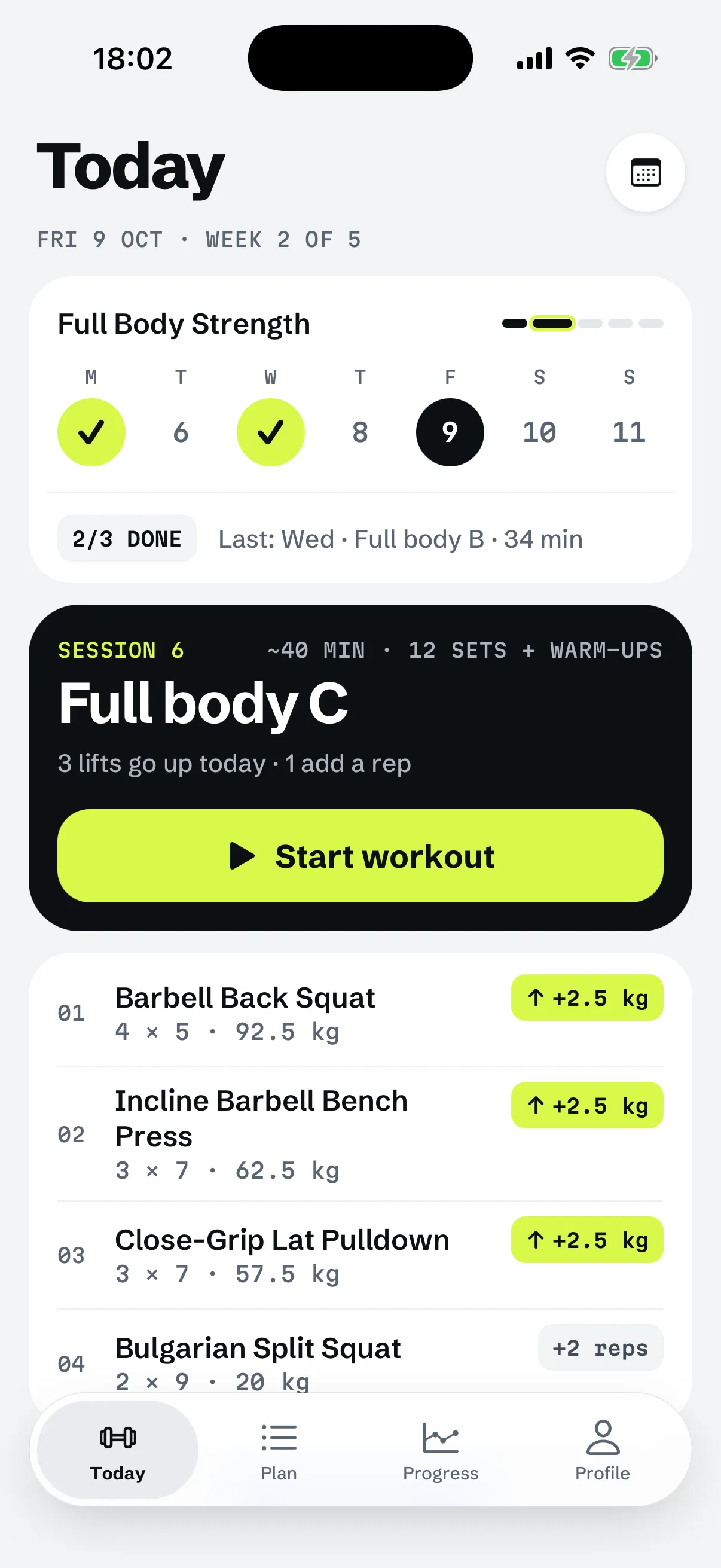
RIGOR is a strength training app for iPhone that builds your plan and sets every weight by rules you can read.
YOUR IPHONE

What does the goal change in RIGOR?
Rep ranges first. The goal sets the range for each kind of exercise, and the chart is the whole of it.
| Goal | Main compound | Other compound | Isolation | Small-muscle isolation |
|---|---|---|---|---|
| Strength | 4–6 | 6–8 | 8–12 | 10–15 |
| Hypertrophy | 6–10 | 8–12 | 10–15 | 12–20 |
| Both | 5–8 | 8–12 | 10–15 | 12–20 |
The ranges stay fixed through the block. The rep ranges guide goes into the slots and how the app uses a range to decide the next weight; double progression is the rule that does it.
A few other lines in the rules are tied to the goal, each with its condition.
| Goal | Line | Condition |
|---|---|---|
| Strength | Each main pattern (squat, hinge, horizontal push, pull) appears at least twice a week | When the plan has 3 or more days |
| Hypertrophy and both | At least 2 direct sets a week for each minor muscle (biceps, triceps, calves, abs) | The sets go on the day with the most room that can take them; a minor muscle the gym has no exercise for, or no day has room for, goes without them |
| Hypertrophy and both | One raise or rear-delt exercise a week, 2 sets | Plans of four days or more, when the gym has one and time allows |
| Strength | A pull day leads with the weighted pull-up, otherwise with a row | The weighted pull-up when you answered yes to pull-ups and the weighted version is yours to take; a beginner is not started on it |
The goal reaches rest through the rep range. An exercise whose range tops out at 6 reps or fewer rests 180 seconds by default, and a rest you saved yourself wins. On the strength goal that is a day's first compound (on any goal, a negative pull-up too). On the other two goals the top of that range is 10 or 8, so the rest follows the exercise: 120 seconds for an upper-body compound and 180 for a lower-body one. Full-body compounds count as lower-body.
Reps in reserve are not tied to the goal. The targets in the rules go by week and by kind of exercise.
| W1 | W2 | W3 | W4 | Deload | |
|---|---|---|---|---|---|
| Compounds | 3 | 2 | 2 | 1 | 4 or more |
| Isolations | 2 | 1 | 1 | 0 | 4 or more |
| Beginner compounds | 3 | 3 | 2 | 2 | 4 or more |
| Beginner isolations | 2 | 2 | 1 | 1 | 4 or more |
The reps in reserve guide explains the scale, and rest between sets covers rest. Weekly set targets are listed by experience, not by goal (see the questions below).
The one plan on this site for the both goal is the sample 4 day plan, a beginner plan. Its Upper A opens with Dumbbell Bench Press, 4 sets of 5 to 8, then Lat Pulldown, 3 sets of 8 to 12. The 4 day upper lower program has the whole week. The sample plans hold no strength-goal plan.
When does the difference not matter?
When you want size, the load matters little in these studies. Muscle growth was similar across the loads in all three: the 2017 review says it can be equal across a spectrum of loading ranges, and Lopez 2021 found no difference between low, moderate and high loads. What the choice moves is the strength test: one-rep max gains favoured heavier loads, while size was similar.
Two cautions keep that from becoming a rule. First, the sets in these trials went to failure, and RIGOR's targets give a number of reps in reserve that changes by week, as the table above shows. The studies compare loads, not the ranges here. Second, the strength result was specific: the 2017 review found one-rep max gains favoured heavy loads but isometric strength did not differ significantly. The 1RM calculator estimates a one-rep max from a set.
The both goal exists for that middle: a day's first compound at 5 to 8 reps, the other slots as for hypertrophy. For the long-running argument over how a fixed set and rep scheme compares, see 3x10 vs 5x5.
RIGOR gives every lift its range from your goal
Questions
Is hypertrophy or strength training better?
Neither is better; it depends on the result you want. In the reviews cited here, muscle growth was similar between low and high loads taken to failure, and one-rep max gains favoured heavy loads.
How many reps for hypertrophy vs strength?
In RIGOR, a day's first compound takes 6 to 10 reps on a hypertrophy goal and 4 to 6 on a strength goal. Other compounds take 8 to 12 and 6 to 8, isolation lifts 10 to 15 and 8 to 12, and small-muscle isolation lifts 12 to 20 and 10 to 15. Negative pull-ups are 3 to 5 on any goal.
Do hypertrophy and strength use different sets?
The rules list the weekly set targets by experience, not by goal: for a beginner, intermediate or advanced lifter, 10, 13 or 16 counted sets for a major muscle and 6, 8 or 10 for a minor one. They are minimums, each focus point adds 2, a deprioritised muscle gets at most 4 (major) or 2 (minor) sets of work aimed only at it, and a short session can cut sets to fit the time.
Does the goal change the reps in reserve?
No. The reps-in-reserve targets in the rules are set by week, by compound or isolation, and by beginner or not. They are not set by goal.
What is the 'both' goal in RIGOR?
Both gives a day's first compound 5 to 8 reps, between the strength and hypertrophy ranges. Its other three slots match the hypertrophy goal.