A leg press sled's weight varies by machine, so check your model. Where a product page gives a figure, it is 70 to 118 lb for a sled or starting resistance, and 14 lb per arm on one machine with two arms. RIGOR logs the plates you load, and you can add the machine's own weight.
How much does a leg press sled weigh?
There is no one number. The weight depends on the machine and the maker. The answer for your gym is on its machine, on its maker's page or in its manual.
Where a maker does state a figure, it is called starting resistance or the sled's own weight, and it is what the machine gives before you add a plate. It is separate from the weight of the whole machine. It plays the part the bar plays in a barbell lift, which is the question does the bar count as weight answers: something you move that is not a plate.
What do makers say a leg press sled weighs?
Four product pages state a figure: three are makers' own pages, and one is from Life Fitness's Australian distributor. The table copies each one as the page prints it. It is not a survey of makers: another maker may give its figure in a manual rather than on a product page, and a figure here is for that model only.
| Model | What the page lists | In kilograms |
|---|---|---|
| Hammer Strength Plate Loaded Linear Leg Press (HSLLP), 45-degree | Starting resistance 118 lb | 53 kg |
| Life Fitness Plate Loaded Linear Leg Press (SPLLLP) | Starting resistance 103 lb | 47 kg |
| Hammer Strength Plate Loaded Iso-Lateral Leg Press (IL-LP) | Starting resistance 14 lb per arm | 6.3 kg per arm |
| Body-Solid SGLP500 Linear Bearing Commercial Leg Press, 45-degree | 70 lb of resistance from the sled itself | Not stated |
The spread is the point. Two linear presses from one company differ by 15 lb, and a press with two arms starts at 14 lb per arm. So a figure for one machine says little about the next. "Without weights" on a sled means the starting resistance if the maker prints one, and no number to guess if it does not.
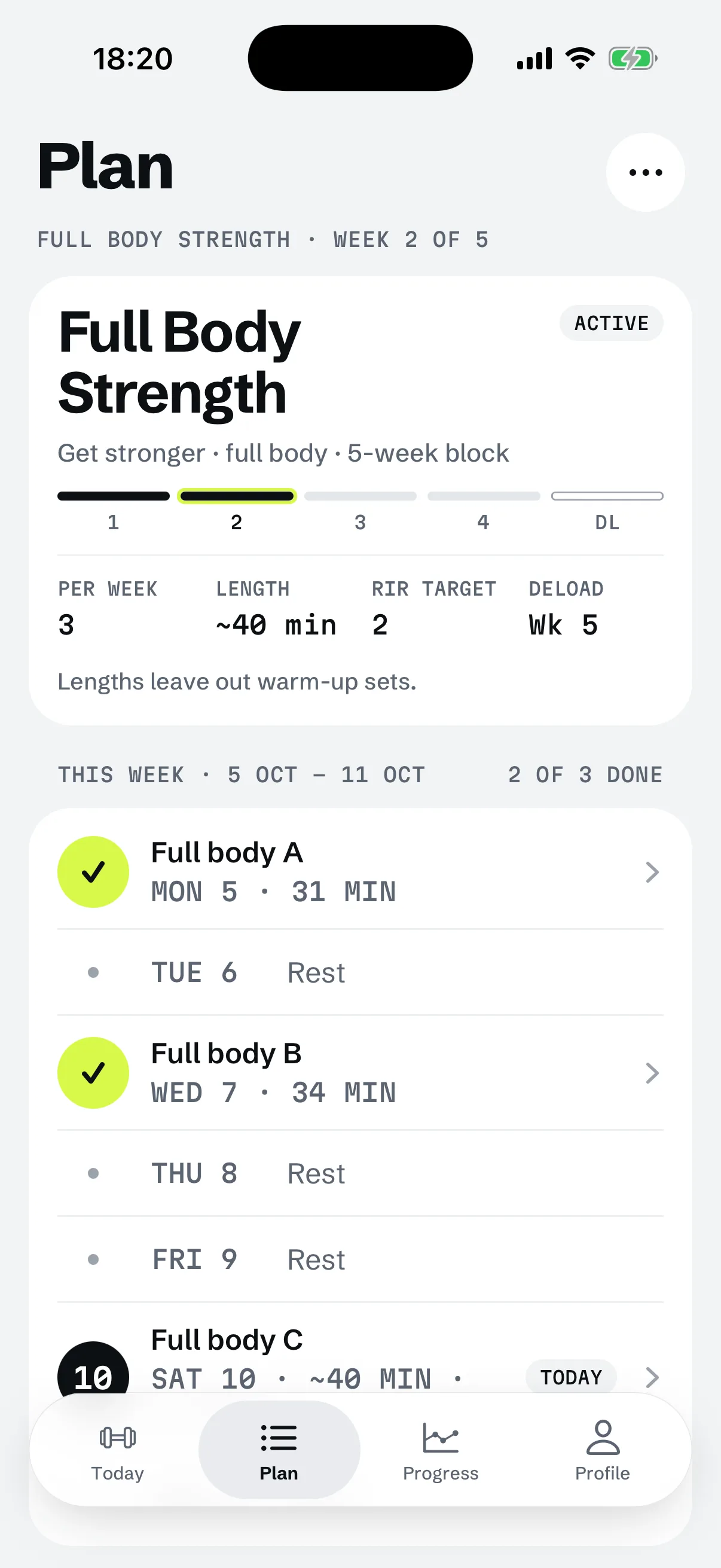
RIGOR is a strength training app for iPhone that builds your plan and sets every weight by rules you can read.
YOUR IPHONE

Does the whole sled weight reach your legs?
Not on an angled sled. A sled that slides up a 45 degree rail is on an incline, and only part of its weight acts along the rails. OpenStax's physics text gives that part as the weight times the sine of the angle: if the incline is at an angle θ to the horizontal, the component of the weight parallel to it is w sin(θ), which equals mg sin(θ).
So 200 kg of moving mass asks about 141 kg of the legs on a frictionless 45 degree rail. This is before friction, which pushes the other way and changes with the bearings and how clean the rails are. A different angle changes the share, and a counterweight changes the sled's effective weight. Treat the sum as the shape of the effect, not as a number to use. Your log should say what you loaded, not what it felt like.
How do I find my own machine's number?
Use what is already written down, in this order:
- The machine. Look for a plate or a label with the model name on the frame. The model name is what you need for the next two.
- The maker's manual or specification page. Search the model name with the words "starting resistance" or "sled weight". The Life Fitness pages in the table list it under specs; Body-Solid gives it in its product description.
- The gym. Ask staff, who may have the manual or the order sheet.
If none of them gives a number, leave it blank. A blank is better than a guess, because RIGOR treats a blank as 0 rather than as a value it made up.
How does RIGOR count the machine's own weight?
In RIGOR a plate-loaded leg press has no bar. You log the plates you load, and the loads the gym can make are the plate pairs alone, starting from 0. The gym setup note says: "Plates only: you enter the plates you load. Add the machine’s own weight if you know it, so totals and history stay comparable." The field is labelled "Machine’s own weight · optional".
When it is known, the engine uses it inside the rules, not in what you type. The rule is written in the training rules: every Epley step uses the effective load, which is the logged load plus the machine's own weight, and the results subtract it again and round to loads the gym can make. When the weight is unknown it is 0. Epley's formula estimates a one-rep max from the load and the reps you could do, as in the 1RM calculator.
Here is why it matters. Take the same leg press in two gyms. In gym A the sled is 50 kg, and in gym B it is 100 kg (made-up numbers). You log 8 reps with 2 reps in reserve, so the set's capacity is 10 reps, and the estimate is load × (1 + 10 / 30).
| Logged plates | Sled weight known | e1RM | Predicted reps at the next load | |
|---|---|---|---|---|
| Gym A, weight entered | 100 kg | 50 kg, so 150 kg | 200 kg | 110 kg of plates (160 kg): 5 |
| Gym B, weight entered | 50 kg | 100 kg, so 150 kg | 200 kg | 60 kg of plates (160 kg): 5 |
| Gym A, left blank | 100 kg | 0, so 100 kg | 133.3 kg | 110 kg: 4 |
| Gym B, left blank | 50 kg | 0, so 50 kg | 66.7 kg | 60 kg: 1 |
Check the first row: 150 × (1 + 10 / 30) = 200, and 30 × (200 − 160) / 160 = 7.5, which rounds down to 7, less 2 is 5. With the weight left blank, gym B's 50 kg of plates reads as a far weaker set, and the same rep target looks nearly out of reach. With it entered, both gyms read as the same effort, so the history stays comparable from one machine to the other. It is the same convention as the Smith machine in the Smith machine page, where the plates are logged and the machine's weight is optional.
Add the machine's weight once, if you know it
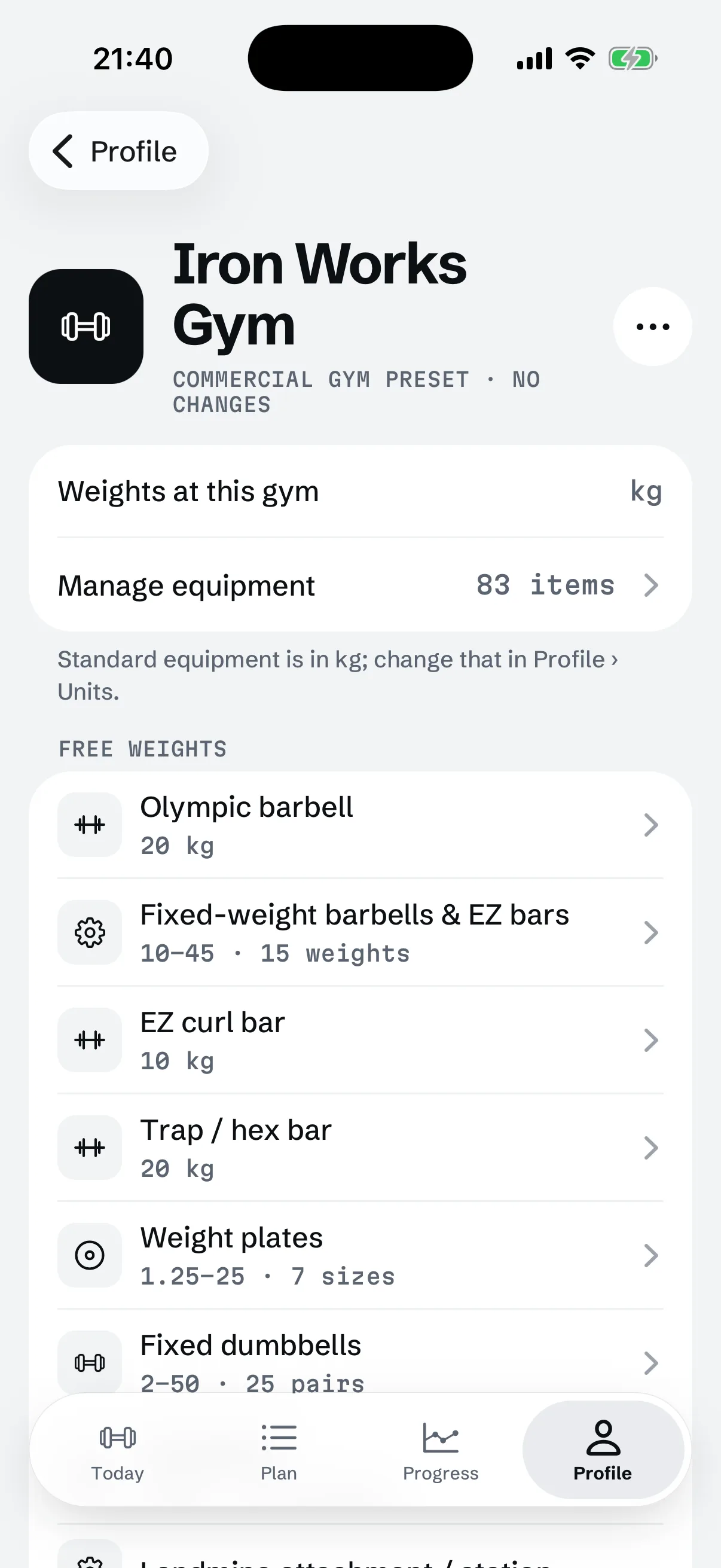
Is this the same as a Smith machine bar?
Close, but not the same. A Smith machine bar rides on rails and is sometimes counterbalanced; how much a Smith machine bar weighs has its own page. A leg press sled slides on rails at an angle: 45 degrees on two of the presses in the table. Plate math works through the totals for plates on a machine, and the plate calculator turns a target total into plates per side.
When does this not apply?
Questions
How much weight does a leg press start with?
It depends on the model. Life Fitness lists a starting resistance of 118 lb (53 kg) for its Hammer Strength linear leg press, 103 lb (47 kg) for its Life Fitness linear leg press, and its Australian distributor lists 14 lb (6.3 kg) per arm for the Hammer Strength iso-lateral press. Check your machine.
Is the leg press sled weight the same on every machine?
No. The four product pages here give four different figures, and the angle of the sled, the bearings and any counterweight change what you push.
Does RIGOR add the sled to my logged weight?
No. You always log the plates alone. If you enter the machine's own weight in gym setup (the field is optional), RIGOR adds it inside its progression sums and takes it off again. Left blank, it counts as 0.
How do I find the weight of my gym's leg press?
Look for a plate or label on the machine, then the maker's manual or specification page for the model, and ask the gym if neither says. Search the manual for words like starting resistance.