RIGOR's gym setup lists five kinds of bar: Olympic, trap or hex, EZ curl, standard 1-inch and fixed-weight. Its defaults are 20 kg for the Olympic bar and 10 kg for the EZ curl bar, or 45 lb and 25 lb in a pound gym. Real bars differ, so check the end cap or weigh yours.
What are the types of barbells and what do they weigh?
RIGOR's gym setup lists five bars. Each starts at a default weight, and the default depends on your unit: the app keeps one for kilograms and a separate one for pounds. They are two different defaults, not a conversion of each other.
| Bar | Kilogram gym | Pound gym |
|---|---|---|
| Olympic barbell | 20 kg | 45 lb |
| Trap / hex bar | 20 kg | 45 lb |
| EZ curl bar | 10 kg | 25 lb |
| Standard 1-inch barbell | 10 kg | 20 lb |
| Fixed-weight barbells and EZ bars | 10 to 45 kg, in steps of 2.5 kg | 20 to 110 lb, in steps of 10 lb |
Where a kilogram figure and a pound figure sit on one row, read them as two gyms. A kilogram gym starts its EZ curl bar at 10 kg and a pound gym starts it at 25 lb. As a conversion, 10 kg is 22.0 lb and 25 lb is 11.3 kg, so the two defaults are not the same bar expressed twice. The same goes for the 1-inch bar: 10 kg in one gym, 20 lb in the other.
Four of the five are bars you load with plates. The fixed-weight item is for pre-loaded barbells and EZ bars, which come at set weights from a rack. The 1-inch bar is the exception on plates: it carries its own, and for the other bars the plates live on the gym's weight plates item. How the plates add up is a separate sum from the bar itself.
How much does an Olympic bar weigh?
In RIGOR, 20 kg in a kilogram gym and 45 lb in a pound gym. It is the bar the app's bench press uses, and the one in the worked sums on whether the bar counts as weight.
Outside the app, two rulebooks give these figures:
| Source | Figure |
|---|---|
| USA Weightlifting, online event rules | Men use a 20 kilogram bar and women a 15 kilogram bar; 2.5 kg collars are acceptable |
| IPF Technical Rules Book, January 2015 | Bar and collars together 25 kg; collars 2.5 kg each; overall length at most 2.2 m; bar diameter at least 28 mm and at most 29 mm |
A 15 kg bar changes every sum made on a 20 kg one. Plate math shows a 15 kg bar with two 20 kg plates on each side coming to 95 kg, not 100.
RIGOR is a strength training app for iPhone that builds your plan and sets every weight by rules you can read.
YOUR IPHONE

How much does a trap bar weigh without weights?
RIGOR starts a trap or hex bar at 20 kg, or at 45 lb in a pound gym. Those are the app's defaults, and a real trap bar may be heavier. Rogue's TB-2 Trap Bar lists a product weight of 60 lb, with "two sets of knurled handles" and Olympic-compatible sleeves. As a conversion, 60 lb is 27.2 kg.
That one maker's page does not tell you what other trap bars weigh. It does show that the default is a starting figure: if your bar is labelled or weighed at something else, set that weight in gym setup, so the plates the app shows on each side add up to the right total.
How much does an EZ bar weigh without weights?
RIGOR starts an EZ curl bar at 10 kg in a kilogram gym and at 25 lb in a pound gym. The bar with the wiggly shaft goes by several names in the app's list: ez bar, curl bar, w-bar and zig-zag bar.
One maker's page gives a different figure. Rogue's curl bar is listed at 30 lbs, with a 28.5mm shaft, and described as "cambered for reducing stress on wrists during curls". That is 13.6 kg as a conversion, against RIGOR's 25 lb default. Rogue's page calls the bar cambered and does not use the term EZ, so treat it as an example of a curl bar and not as a rule for all of them. For yours, weigh it or read the label.
What are the standard 1-inch bar and the fixed-weight barbells?
The standard 1-inch barbell starts at 10 kg in a kilogram gym and 20 lb in a pound gym, and the app gives it its own plates. In a kilogram gym those are 20, 10, 5, 2.5 and 1.25 kg plates; in a pound gym, 25, 10, 5 and 2.5 lb.
Fixed-weight barbells and EZ bars are the pre-loaded kind. Their default is a list of weights: 10 to 45 kg in steps of 2.5 kg in a kilogram gym, and 20 to 110 lb in steps of 10 lb in a pound gym.
How does RIGOR use the bar's weight?
A barbell lift is logged as the total, bar included. The bar's weight in gym setup is the bar in that total. With a 20 kg bar and 1.25 kg plates the smallest step above the empty bar is 2.5 kg; fractional plates make the step smaller.
Set each bar once in gym setup
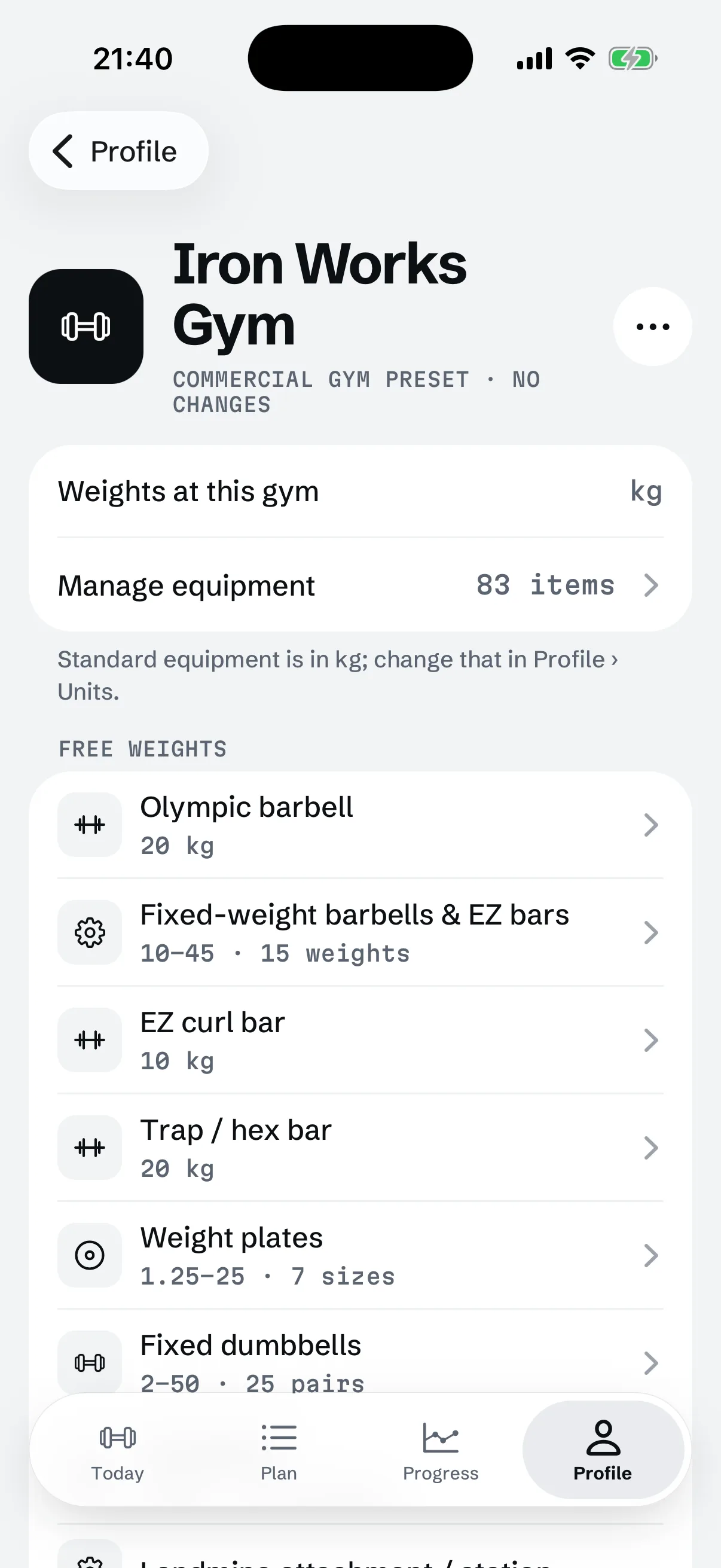
The barbell plate calculator takes a target total and a bar and gives the plates for each side. The warm-up calculator opens a barbell compound lift with the empty bar for 10 reps.
When do these weights not apply?
This page is equipment and the app's own defaults, so there is no training study to cite. The competition figures come from the rulebooks listed under sources, and the maker figures from the two Rogue product pages.
Questions
What are the wiggly barbells called?
EZ curl bars. RIGOR's equipment list files them as the EZ curl bar, also known as the ez bar, curl bar, w-bar or zig-zag bar, and starts it at 10 kg, or 25 lb in a pound gym.
What sizes of barbells are there?
RIGOR's list holds five bar items: the Olympic barbell, the trap / hex bar, the EZ curl bar, the standard 1-inch barbell and the fixed-weight barbells and EZ bars. Their default weights are in the table on this page. Outside the app, men's and women's competition bars differ: 20 kg and 15 kg in the USA Weightlifting event rules.
Are all bench press bars the same weight?
No. In RIGOR the bench press uses the Olympic barbell, which starts at 20 kg or at 45 lb, but a gym may have a 15 kg bar or a bar of some other weight. Read the end cap or weigh it, then set that weight in gym setup.
Is 20 kg the same as 45 lb?
Nearly, but RIGOR does not convert one into the other. A kilogram gym starts its Olympic bar at 20 kg and a pound gym starts it at 45 lb. As a conversion, 20 kg is 44.1 lb and 45 lb is 20.4 kg.
Do I log the bar's weight in RIGOR?
On a barbell lift you log the total, bar included. The bar's weight is the default in gym setup, so changing it there changes the plates the app shows for each side.