Train each muscle group about twice a week. A 2016 meta-analysis found twice a week gave larger muscle gains than once. A 2019 one found frequency made no meaningful difference when weekly volume was equal, so pick the days that let you spread your sets.
How often should you train each muscle group?
About twice a week. RIGOR's rules base their supported splits on that: "research (train each muscle about twice a week)", in the plan-generation rules. The studies and four real plans follow.
What does the research say about training frequency for hypertrophy?
Four reviews were opened for this guide, each through its published abstract.
- Schoenfeld, Ogborn and Krieger 2016. Ten studies met the inclusion criteria. Higher frequency gave a larger muscle-growth effect size than lower frequency: 0.49 ± 0.08 against 0.30 ± 0.07 (P = 0.002). The authors concluded that training each major muscle group at least twice a week gives better results than once, and that whether three times is better remains undetermined (Schoenfeld 2016).
- Schoenfeld, Grgic and Krieger 2019. Twenty-five studies. Frequency made no significant difference to muscle growth when volume was equated. In the studies that did not equate volume, higher frequencies were favoured, but the gap between one day and three or more days a week was modest. The authors concluded that frequency per muscle can be chosen by preference, provided volume is equal (Schoenfeld 2019).
- Grgic and colleagues 2018. Twenty-two studies, on strength. Effect sizes rose with frequency: 0.74, 0.82, 0.93 and 1.08 for one, two, three and four or more sessions a week. With volume equated, the effect of frequency was not significant (P = 0.421). The authors noted that most studies used untrained participants (Grgic 2018).
- Pelland and colleagues 2025. Meta-regressions of 67 studies and 2,058 participants. For hypertrophy, the effect of frequency was compatible with negligible. Strength gains rose with frequency, with diminishing returns (Pelland 2025).
RIGOR is a strength training app for iPhone that builds your plan and sets every weight by rules you can read.
YOUR IPHONE

Training frequency vs volume: which matters more?
Volume, in the studies above. Where weekly sets were the same, frequency did not significantly change muscle size (2019) or strength (2018). Where volume was not matched, more frequent groups did better, and the likely reason is that they also did more sets in the week.
So the two work together. Weekly sets are the dose. Frequency is how you cut that dose into sessions. RIGOR sets the dose first, in the sets per muscle group per week targets, then lets frequency fall out of the split and the cap on a session.
How does RIGOR decide how often a muscle is trained?
By the number of days you choose. The rules give a recommended split for each:
| Days | Recommended | Also allowed |
|---|---|---|
| 2 | Full body | Upper/Lower |
| 3 | Full body | Push/Pull/Legs (flagged: each muscle once a week) |
| 4 | Upper/Lower | Full body |
| 5 | Upper/Lower + Push/Pull/Legs | Full body |
| 6 | Push/Pull/Legs ×2 | Upper/Lower ×3 |
In the plans below, three days of full body reach most muscles three times and four days of upper/lower reach most twice. Six days of push/pull/legs give chest, back and quads two direct days, and hamstrings, glutes and shoulders more. The best workout split guide goes through the choice, and upper lower vs full body compares the two most common.
A second rule limits the frequency from the other side. "No muscle gets more than 10 counted sets in one session; a larger weekly target is spread over more days." A muscle that needs 16 sets a week therefore needs at least two days. When the structure cannot reach a target inside that cap, the plan gives that group 9.5 to 10 counted sets in its best session and records volume_capped_by_frequency. The example the rules give is the 3 day Push/Pull/Legs plan.
How many days a week does each RIGOR plan train each muscle?
Counted from the plans themselves, in four sample plans. Each cell shows two numbers: days with any counted set, then days with a direct set. A set counts 1 for a group when one of the exercise's primary muscles is in it, and 0.5 when a secondary muscle is, at most once per group (§6). A "direct" day is a day with at least one set of the first kind. So a bench press day is a direct chest day, and a row day with no curl, which gives biceps 0.5 a set, is a counted biceps day but not a direct one.
| Muscle group | Full body, 3 days | Upper/lower, 4 days | Push/pull/legs, 6 days | Dumbbells, 3 days |
|---|---|---|---|---|
| Chest | 3 / 3 | 2 / 2 | 2 / 2 | 3 / 3 |
| Back | 3 / 3 | 2 / 2 | 4 / 2 | 3 / 3 |
| Quads | 3 / 3 | 2 / 2 | 3 / 2 | 2 / 2 |
| Hamstrings | 3 / 2 | 2 / 2 | 4 / 4 | 3 / 1 |
| Glutes | 3 / 3 | 2 / 2 | 4 / 4 | 3 / 3 |
| Shoulders | 3 / 1 | 2 / 2 | 4 / 3 | 3 / 1 |
| Biceps | 3 / 1 | 2 / 1 | 3 / 1 | 3 / 1 |
| Triceps | 3 / 1 | 2 / 1 | 2 / 1 | 3 / 1 |
| Calves | 2 / 1 | 1 / 1 | 2 / 2 | 1 / 1 |
| Abs | 1 / 1 | 2 / 2 | 4 / 3 | 1 / 1 |
The plans, with goal, level and days: the full body plan is an intermediate hypertrophy plan for 3 days, the upper/lower plan a beginner plan with the goal "both" for 4 days, the push/pull/legs plan an advanced hypertrophy plan for 6 days, and the dumbbell plan a beginner hypertrophy plan for 3 days. These differ in more than days, so the table is not a controlled comparison of frequency.
Full body, 3 days: chest gets 3, 3 and 6 counted sets, 12 a week. Push/pull/legs, 6 days: Push A gives 10 and Push B 6, 16 a week. Both reach chest twice or more.
What the table shows:
- The six major groups reach at least two days a week in every plan, by the counted measure. By the direct measure the exceptions are shoulders in both 3 day plans (1 day) and hamstrings in the dumbbell plan (1 day). In the 6 day push/pull/legs plan chest has two direct days and glutes four.
- Small muscles are often trained directly once and indirectly on the other days. Biceps get one direct day in each plan and are counted on 2 to 3 days, because rows and pulldowns give them half sets.
- Calves and abs are the exception. The 3 day plans train them on one or two days, and the 4 day upper/lower plan trains calves on one day. The rules' minimum for them is a weekly set count (at least 2 direct sets a week for each minor muscle on hypertrophy and "both" goals), not a number of days.
From the same data: chest has 12 counted sets over 3 days in the full body plan, at most 6 in a session, and 16 over 2 days in the push/pull/legs plan, at most 10, which is the cap.
What is the best training frequency for muscle growth?
The studies opened here do not name one. Two sessions a week per muscle beat one in the 2016 analysis, the 2016 authors left three open, and the 2019 analysis found no significant difference once volume was equal. A frequency that lets you finish your weekly sets with sets you can still do well is a sensible reading, and it is the reading the rules take: the weekly targets come first, then enough days to spread them.
When does this not apply?
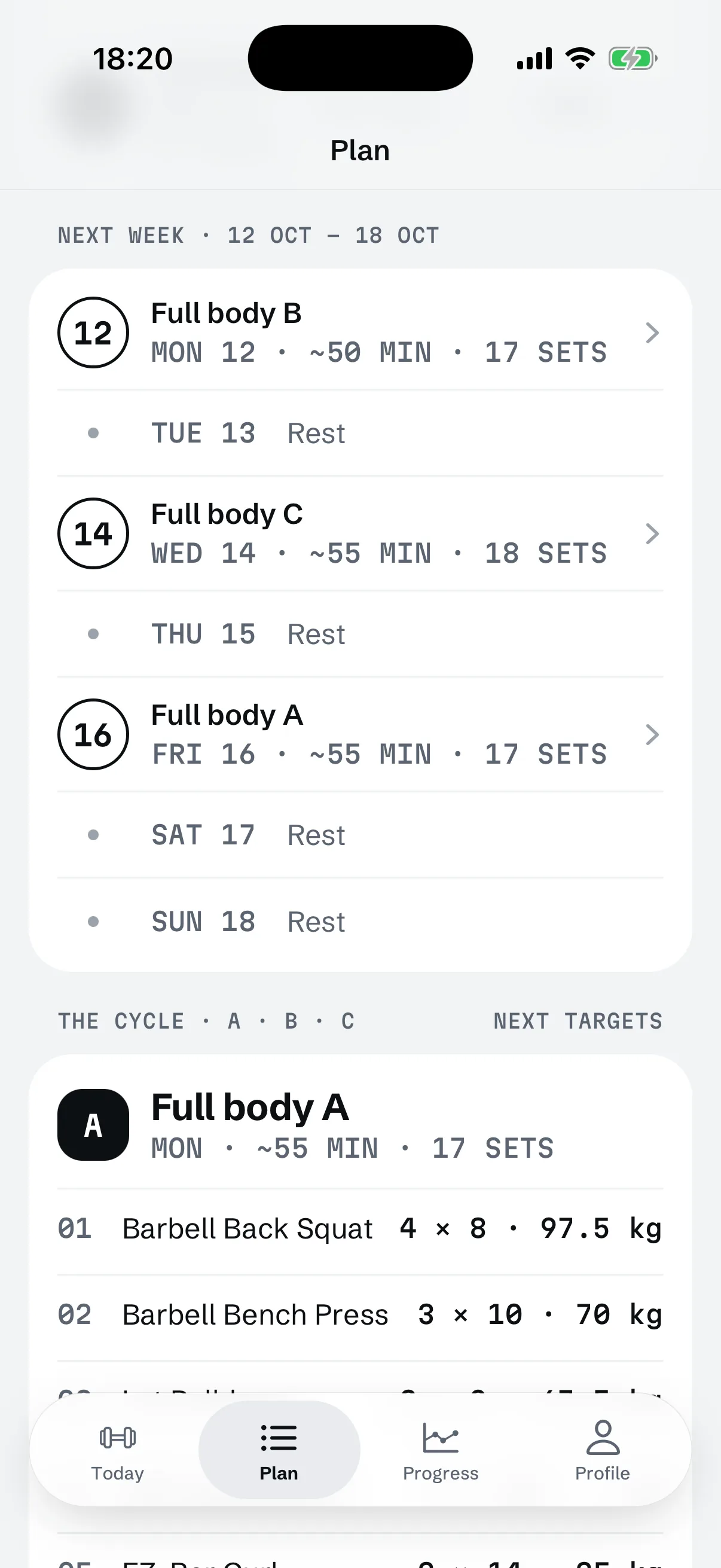
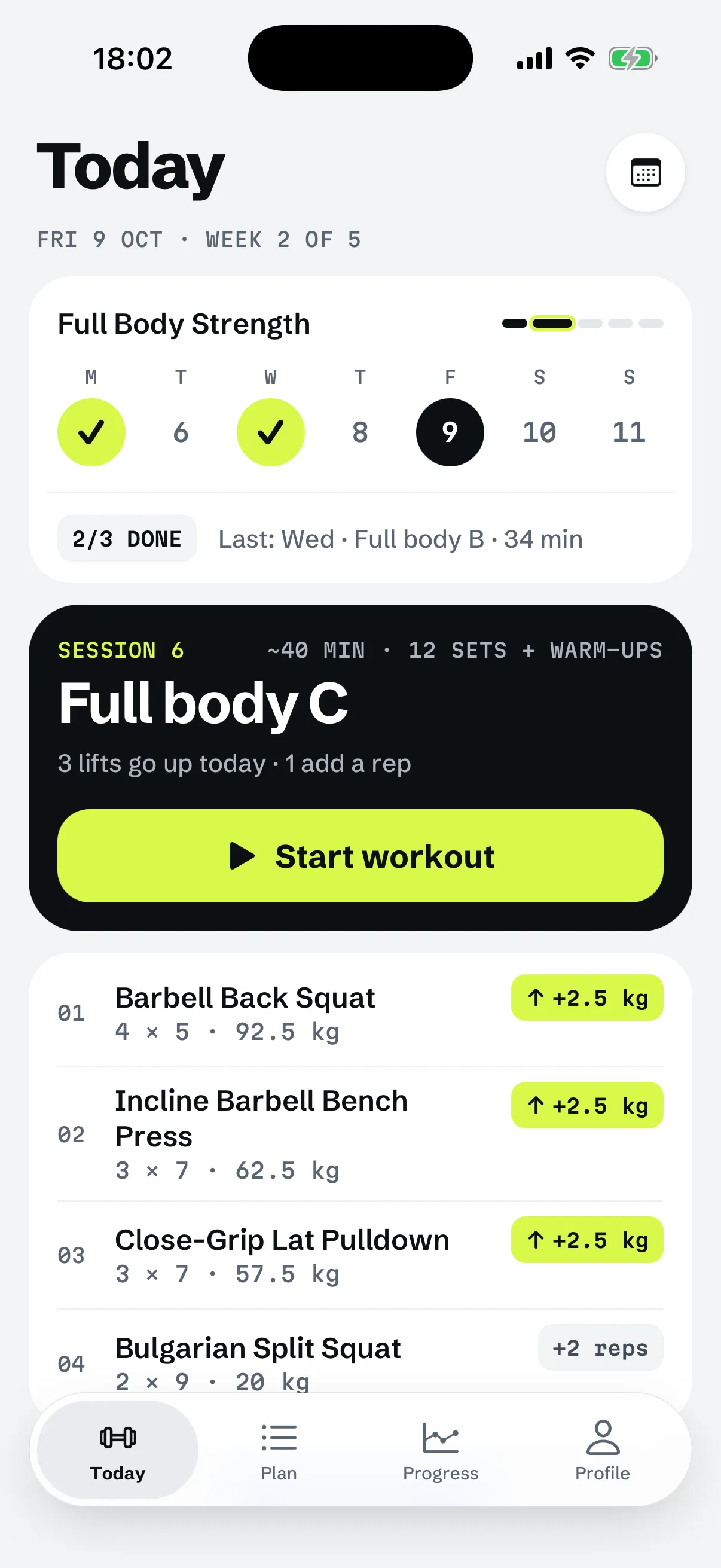
The Plan screen shows the week as it will run: the same three sessions in rotation, with the rest days between them.
How do you apply it with progressive overload?
Frequency gives each muscle more chances to show progress, because it is loaded more often. The progressive overload guide explains what to add each time, and the 3 day full body program shows a full week in which legs, chest and back are worked three times.
RIGOR spreads your sets over the days you pick
Questions
How often should you train each muscle group per week?
About twice. That is the basis RIGOR's rules cite for its splits, and the 2016 meta-analysis below found at least twice a week beat once.
What is the best training frequency for muscle growth?
No single frequency is named here. Twice a week beat once in the 2016 meta-analysis, and with volume equal the 2019 one found no significant difference between frequencies.
Is training frequency for hypertrophy more important than volume?
The studies opened for this guide point the other way: with volume equated, frequency did not significantly change muscle size. Frequency matters mainly as a way to fit the weekly sets.
Does training a muscle more often build more strength?
In a 2018 meta-analysis of 22 studies, strength effect sizes rose with frequency, but with volume equated the effect was not significant (P = 0.421).
Can you train a muscle every day?
RIGOR's plans never do. Across its four sample plans, no muscle gets a counted set on more than four days, and the rules cap a muscle at 10 counted sets in one session.
What if your split trains a muscle only once a week?
RIGOR allows a 3 day Push/Pull/Legs plan, flags it as each muscle once a week, and records volume_capped_by_frequency when a weekly target cannot fit.