RIGOR does not lower the weight after one miss, last set or not. A session with a working set below the bottom of the rep range repeats the weight, barring a stall. A miss in that session and the one before it, both at the same weight, takes 10% off, rounded down to a weight your gym can make.
Should I lower the weight on my last set?
Not after one miss. In RIGOR, a session in which a working set ends below the bottom of the rep range keeps the same weight the next time, and the sets that fell short aim for the bottom of the range. A miss in the newest session and in the session before it, both at the same weight, takes the weight down: the weight used times 0.90 on that exercise, rounded down to a weight your gym can make. A stall, described below, cuts it too.
A short set anywhere in the session counts, not only the last. The sections below say what counts, work a bench press through both outcomes and list where the rule does not apply.
What counts as a miss?
A miss is a completed working set that ends with fewer reps than the bottom of its rep range, such as 5 reps on a range of 6 to 10. Reps decide it, not how hard the set felt.
- Only planned working sets count. Warm-up sets do not, and neither do sets beyond the number planned.
- A miss is judged per set and acts per session. One short set and three short sets are the same thing: a session with a miss.
- A set logged with 0 reps is a miss, and so is a set you stopped short and logged with fewer reps than the bottom of the range.
- A set you never logged is not a miss. If fewer working sets were logged than planned and none fell under the range, the weight stays and the reps go up by one, within the cap below (rule 12).
A 2022 review of 12 studies and 414 people found that lifters tended to under-predict the reps they had left to failure, by 0.95 reps on average, with a lot of spread between studies. For how RIGOR uses the effort you log, see reps in reserve.
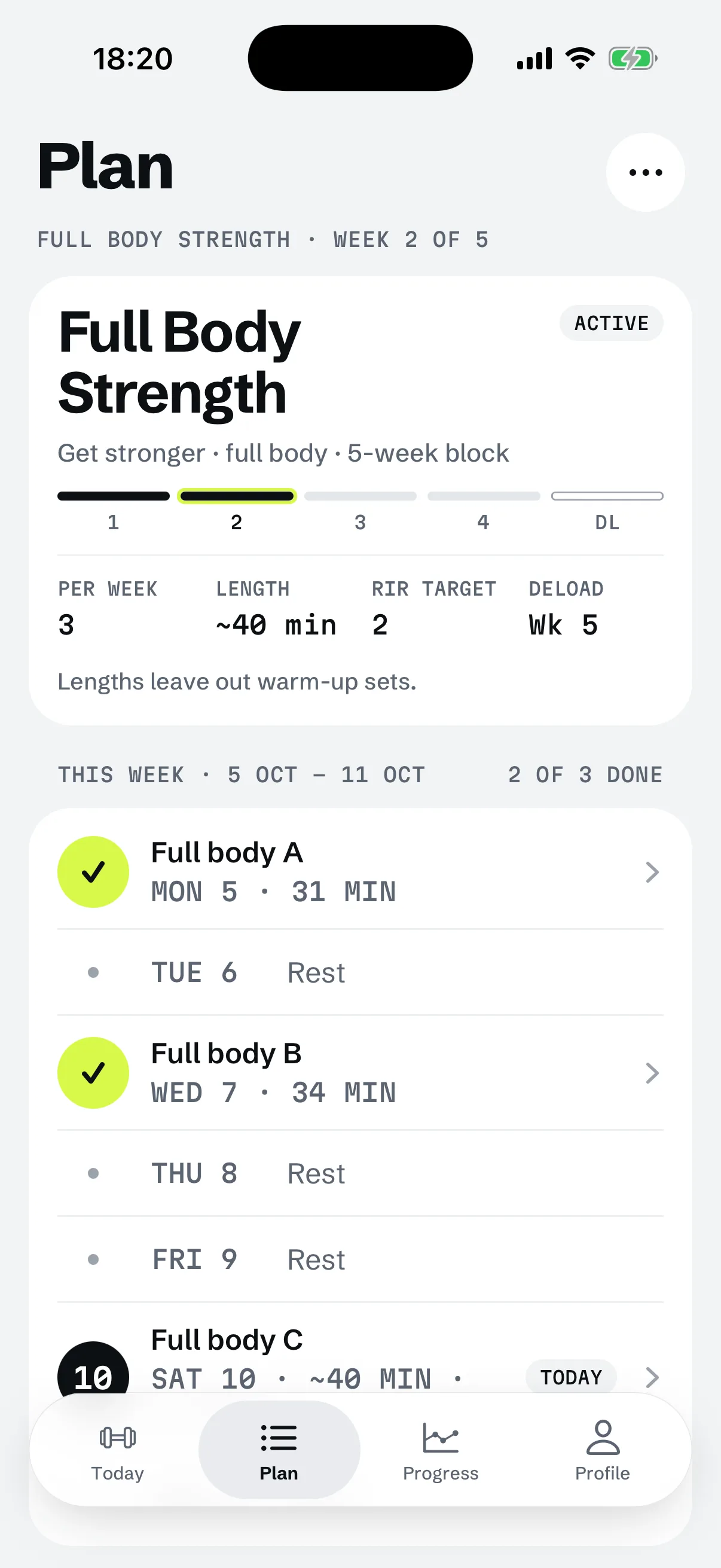
RIGOR is a strength training app for iPhone that builds your plan and sets every weight by rules you can read.
YOUR IPHONE

What does RIGOR do after one miss?
It repeats the weight. The sets that fell short aim for the bottom of the range. Each other set aims for one rep more than it did, up to the top of the range or what it did if that was more. Extra reps beyond the top have a cap: 2 above the top when the top is 8 or less, and 5 above it otherwise.
Take a Barbell Bench Press, 3 sets of 6 to 10 reps, at 60 kg, on a lift you have done before. The last session is 8, 7 and 5 reps. The 5 is under 6, so the session has a miss.
TOP OF THE RANGE6 REPS · BOTTOM
This is double progression with one more step: reps first, as the double progression guide sets out, and the missed set goes back to the start of the range.
What happens at the next session?
That depends on what you log. The table takes the bench press three ways and adds the case of unfinished sets.
| What you log next | What RIGOR does after it |
|---|---|
| 60 kg × 9 · 8 · 6: no set under 6, not every set at 10 | Same weight, one rep more on each set, up to the top of the range (or what it did if that was more): 10 · 9 · 7 |
| 60 kg × 9 · 8 · 5: a miss again, at the same weight | A miss in this session and in the one before it, both at 60 kg: 60 × 0.90 = 54 kg, rounded down to 52.5 kg |
| 60 kg × 9 · 8, the third set not logged | Same weight; the first two sets aim for 10 and 9, the unlogged set for 6 |
The first row follows rule 13: all sets hit, not all at the top, so every set adds one rep, capped at the top of the range or what it did if that was more. The third follows rule 12. With no set under 6, the logged sets add one rep and the unlogged set gets the bottom of the range.
How the 10% is rounded
The second row is rule 9: a miss in the newest session and in the session before it, both at the same weight. The cut is the weight used on the most sets, times 0.90, so 60 kg becomes 54 kg. The cut takes the heaviest weight your gym can make at or below that. On a 20 kg bar with plates down to 1.25 kg, 54 kg needs 17 kg a side, which the plates cannot make, so the next target is 52.5 kg, which is 15 + 1.25 a side. The plate calculator shows the plates for any total. If the rounded weight comes out the same as the weight used, RIGOR takes the next one below. If your gym has nothing lighter, the weight stays and the target is the bottom of the range.
After the cut the lift climbs again by double progression: reps first, then the smallest step up. The 3 day full body workout is built on these rules. See strength plateau for stalls.
What lowers the weight from one week to the next?
Misses are one cause among several. In RIGOR the weight on an exercise also goes down when:
- Three complete sessions sit at one weight and the newest has no more total reps than the oldest, a stall. The cut is the same 10%.
- You pick easier today for one session: loads times 0.90, rounded down, and one set fewer.
- The plan reaches its deload week, when deload is on: loads at 0.90 of the usual weight, rounded down, with the sets halved, rounded up. See deload week.
An easier-today or deload session is not the baseline for the next target unless every planned set was a hit at the usual weight or heavier (at the usual weight, only when your gym can load 90% of it or less).
What does the research say?
Nothing on this exact rule. The 10% cut is RIGOR's own, from free linear programs that cut 10% on one lift after two or three failures. No trial is cited for it.
The nearby evidence is about adding reps before weight. In an 8-week trial, 43 resistance-trained people with at least a year of lower-body training were split in two. One group aimed to add load at a fixed rep range, the other to add reps at a fixed load, over four lower-body exercises twice a week. The authors judged both viable. Growth of one thigh muscle, the rectus femoris, modestly favoured the reps group and strength slightly favoured the load group, differences of questionable practical significance. It did not test misses or cuts.
For the step up, the American College of Sports Medicine's position stand recommends a 2 to 10% increase in load when a lifter can do the current load for one to two repetitions over the target.
When does this not apply?
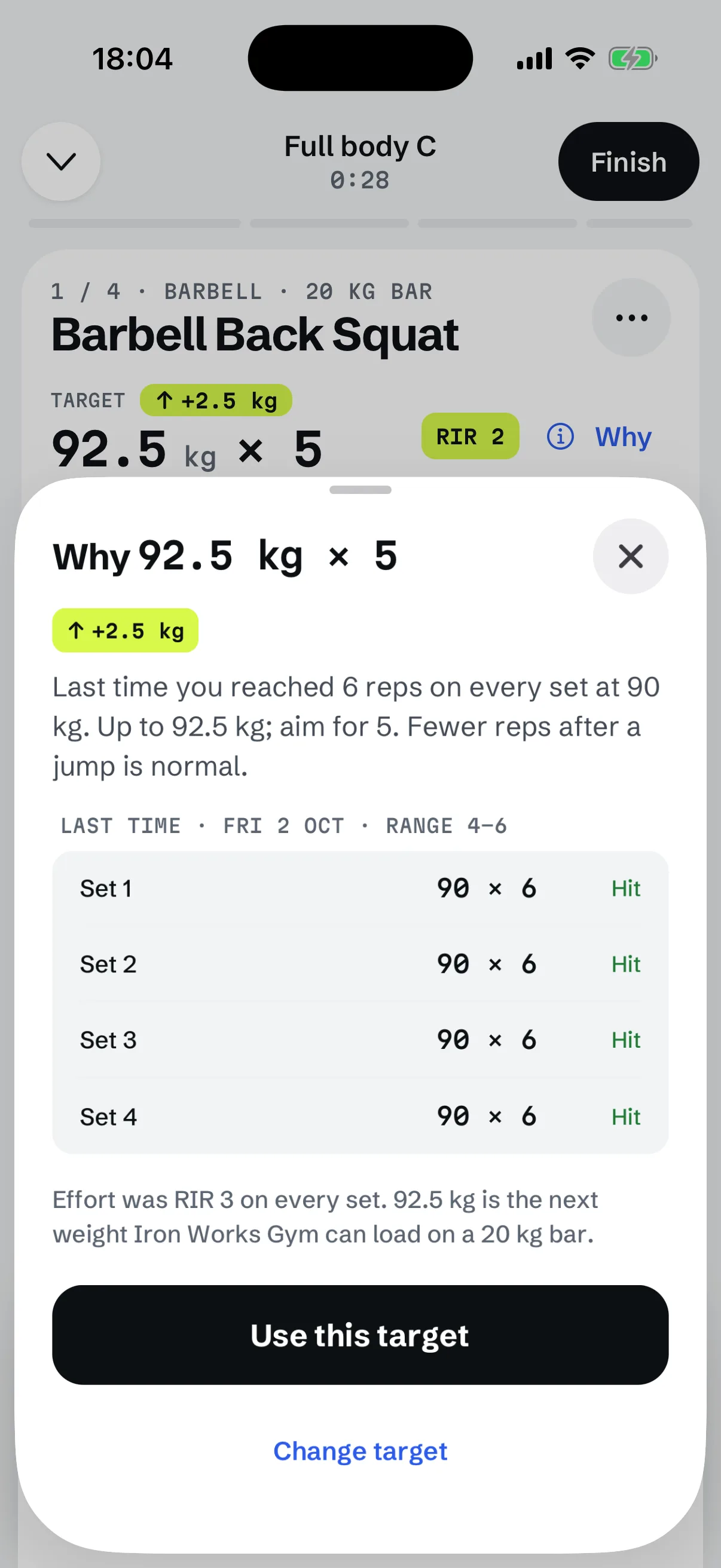
RIGOR says why the weight stayed or came down
Questions
Should I lower the weight between sets?
RIGOR plans one weight for all the working sets of an exercise, and its rules compare your logged sets with the rep range to set the next session's weight. One session with a set under the bottom of the range keeps the weight, barring a stall. A miss in that session and in the session before it, both at the same weight, takes 10% off, rounded down to a weight your gym can make.
Should I drop the weight when deadlifting?
The miss rules read a deadlift like any exercise logged with a weight and reps. One session with a set under the bottom of the range keeps the weight, barring a stall. A miss in that session and in the session before it, both at the same weight, takes 10% off, rounded down to a weight your gym can make.
What does the next session aim for after a miss?
The same weight. Each set that fell short aims for the bottom of the range. Each other set aims for one rep more than it did, up to the top of the range or what it did if that was more, within the app's cap on extra reps.
How much does the weight drop after two misses?
When the newest session and the one before it both had a miss at the same weight, the next weight is 0.90 times the weight used, rounded down to a weight your gym can make. If that lands on the same weight, RIGOR takes the next one below. If the gym has nothing lighter, the weight stays and the target is the bottom of the range.
Does a set I did not finish count as a miss?
It depends on whether you logged it. A set logged with fewer reps than the bottom of the range, including 0 reps, is a miss. A set you never logged is not. With fewer working sets logged than planned and no logged set under the range, the weight stays and each logged set aims for one rep more, up to the top of the range or what it did if that was more, and sets with no log aim for the bottom of the range.