This page gives no dumbbell to barbell conversion: three small studies compare dumbbell, barbell and Smith machine loads, each in one group of people. One, of 12 resistance-trained men, found the dumbbell chest-press one-rep max 17% below the barbell's. In RIGOR a swapped-in exercise with no history starts blank, unless you enter a weight you have used.
Is there a dumbbell to barbell conversion?
This page has no calculator and no multiplier. The studies below each measured one group of people, and they asked different questions: one compared one-rep max loads, one compared reps to fatigue and used them to predict a barbell one-rep max, and one compared a Smith machine with free weights.
In RIGOR the dumbbell version is a separate exercise with its own history: you pick a weight, log a session, and the log sets the next one. The sections below take the studies, what 50 lb dumbbells add up to, and what RIGOR does when you swap a lift in.
What do the studies on dumbbell and barbell loads say?
Each one tested a different thing in a different group.
| Study | Who | What it found |
|---|---|---|
| Saeterbakken 2011 | 12 resistance-trained men | One-rep max: dumbbell load 14% under the Smith machine, 17% under the barbell |
| Heinecke 2021 | 40 college football players | Reps to fatigue at 90.9 kg: barbell 13.8, dumbbells with the same total 12.5; both predicted the barbell bench one-rep max |
| Cotterman 2005 | 16 men and 16 women | Bench one-rep max higher with free weights than on the Smith machine; squat higher on the Smith machine for women only |
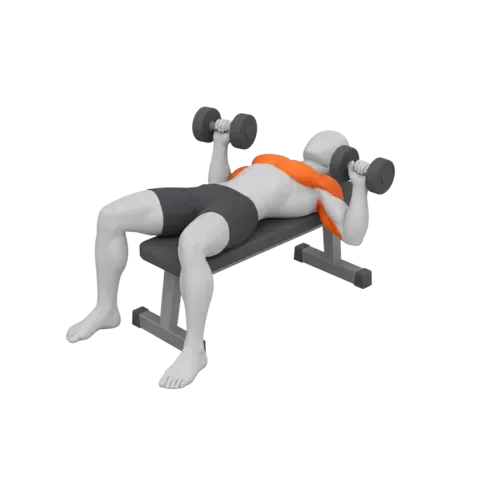
The 2011 study had 12 resistance-trained men, aged 22.7 years on average, test their one-rep max on a chest press three ways, 3 to 5 days apart. The dumbbell load was 14% less than the Smith machine's and 17% less than the barbell's, and the barbell load was about 3% higher than the Smith machine's. That is one group of 12 men and one lift, and the abstract does not say whether its dumbbell figure is one dumbbell or both.
The 2021 study asked a different question. Forty college football players did reps to fatigue with a 90.9 kg barbell and, on another day, with bilateral dumbbells of the same 90.9 kg total. They managed 13.8 reps on average with the barbell and 12.5 with the dumbbells, and the two counts were highly correlated (r = 0.96). The authors concluded that barbell and dumbbell repetitions with equivalent weights place a similar demand on the upper-body muscles in football athletes. That is reps at one total, not a one-rep max. The study also predicted the barbell bench one-rep max from those reps: prediction was equally effective with the barbell (r = 0.90) or the bilateral dumbbells (r = 0.87), with total errors of 7.3% and 8.2%. That is a prediction from reps, not a load ratio.
RIGOR is a strength training app for iPhone that builds your plan and sets every weight by rules you can read.
YOUR IPHONE

What is benching 50 lb dumbbells equivalent to?
A pair of 50 lb dumbbells is 100 lb in your hands, but this page names no barbell equivalent for it. The number on a dumbbell is the weight of one. A barbell lift is entered as a total, bar included: a 45 lb bar with a 45 lb plate on each side is 45 + 2 × 45 = 135 lb. The 2011 study above measured 12 men on a one-rep max chest press, not 50 lb dumbbells in a working set.
In RIGOR each exercise names what its number means: per dumbbell, the total including the bar, a machine setting, weight added to bodyweight or assistance. Dumbbell Bench Press is per dumbbell and Barbell Bench Press is the total. The bar and plates guide has the sums for the barbell side, and the plate calculator loads a total on the bar. Bars differ, and the types of barbell lists the standard ones.
How do you use dumbbells instead of barbells?
Swap in the dumbbell version, and start its weight fresh. In RIGOR the two are separate lifts. Comparable history means earlier sessions of the same exercise with the same load convention, and a swapped-in exercise has its own history and never inherits another exercise's load.
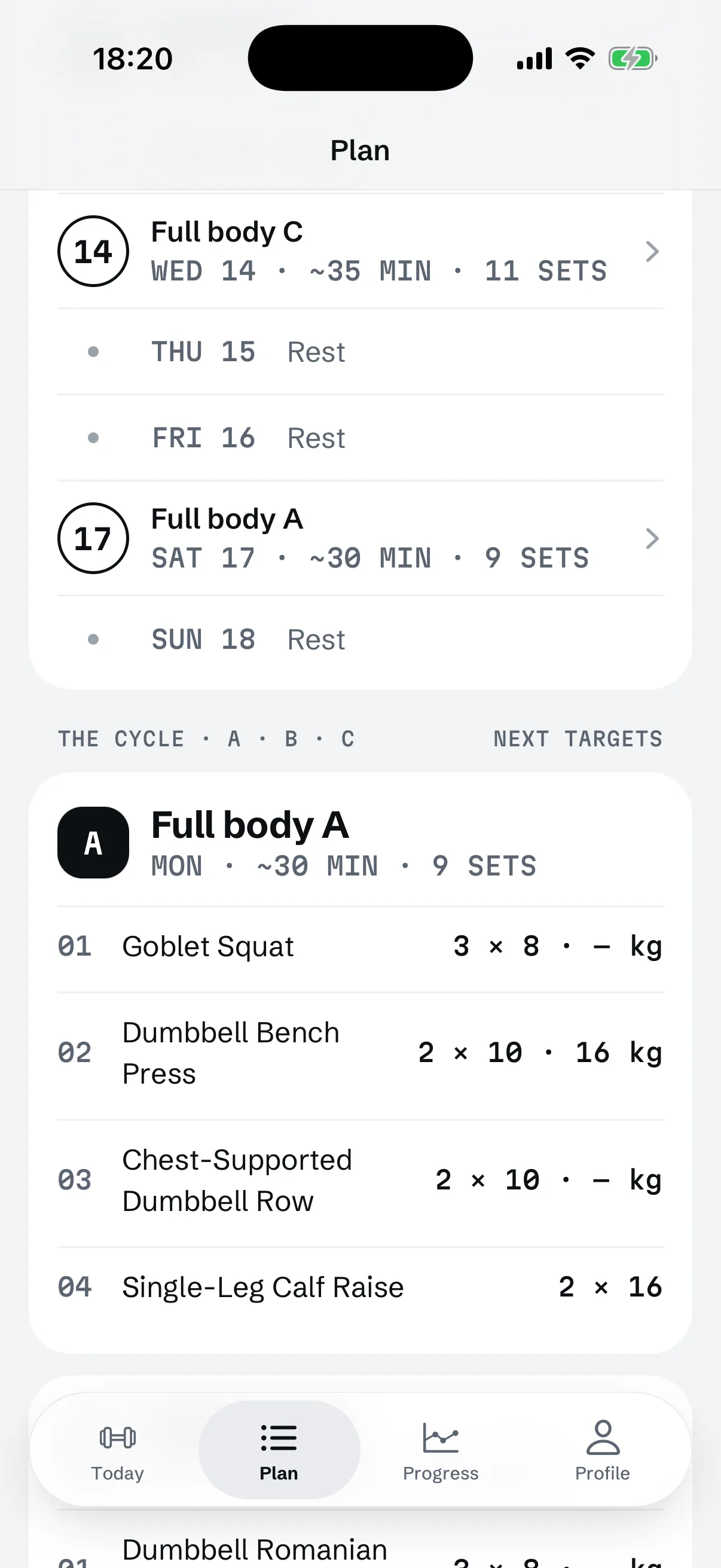
The sample 3 day full body plan on this site shows it. Full body A has the Barbell Bench Press for 3 × 8–12 and Full body B has the Dumbbell Bench Press for 3 × 8–12, each with its own history. For a lift with no history, the weight starts blank: the sheet says "RIGOR won't guess a weight" and asks you to pick one you can lift for the plan's rep range with about the plan's number of reps left. The sheet also offers "I know a weight I've used", which takes 10% off what you report before it sets the start, and a trial set. Warm-up sets do not count toward volume, records or progress. The same idea is in how to know what weight to lift.
A program built on dumbbells needs no barbell at all: the 3 day dumbbell program is one.
What if your first dumbbell weight is far off?
One session can correct it, but only under conditions. RIGOR scores a set as its reps plus the reps left. The too-heavy rule applies on a lift's first session, when a set was logged at a weight other than the one the app asked for, or when the session before was also too heavy at the same weight. The best set must score below the bottom of the range plus the target's reps left, minus 2, and a lighter weight must be possible. The too-light rule needs at least half the planned sets to score the top of the range plus the target's reps left plus 4 or more, a heavier weight must be possible, and the rise is at most 20% at once.
Take Dumbbell Bench Press for 3 sets of 8–12 with 3 left, in a gym whose dumbbells go up in 2.5 kg steps. The lifter picks 30 kg dumbbells, a guess, and logs 6, 5 and 4 reps with 0 left.
The sums. The best set scores 6 + 0 = 6, and the line is 8 + 3 − 2 = 9, so 6 is under it. The estimate is 30 × (1 + 6 ÷ 30) = 36 kg, the Epley sum in the 1RM calculator. At 25 kg it gives 30 × (36 − 25) ÷ 25 = 13.2, so 13 reps to the limit, minus 3 left is 10, the middle of 8–12. At 27.5 kg it gives 9 minus 3 is 6, short of 10. So 25 kg per dumbbell. The numbers are an example, not a conversion: another lifter would land elsewhere.
From there the lift follows the same rules as any other, such as the reps-first climb in double progression.
What about machines and free weights?
A machine exercise is an exercise of its own, so in RIGOR it has its own history too, and a swapped-in exercise never inherits another exercise's load. The 2005 study had 16 men and 16 women test one-rep maxes on the Smith machine and with free weights. Bench was higher with free weights, and the authors give an equation for converting a free-weight bench one-rep max to a Smith machine one-rep max in kilograms: −6.76 + 0.95 × the free-weight figure. It comes from their lifters and their machine. For squat, the Smith machine load was higher for the women only. RIGOR does not use it.
When does this not apply?
RIGOR names what the weight means and gives a swapped lift its own history
Questions
What weight do I start at when I switch to dumbbells?
Swap in the dumbbell version of the lift and pick a weight for one dumbbell. In RIGOR a swapped-in exercise has its own history and never inherits another exercise's load. With no history for it, the weight starts blank and the sheet offers "I know a weight I've used" or a trial set.
How to calculate bench press weight?
On a barbell it is the bar plus the plates on both sides: a 20 kg bar with 36.25 kg on each side is 20 + 2 × 36.25 = 92.5 kg. How much you can lift has no formula. You find it with trial sets, and after that your log decides.
How heavy is a barbell?
RIGOR starts from 20 kg, or 45 lb in pounds, for an Olympic barbell. A trap bar starts at 20 kg or 45 lb and an EZ curl bar at 10 kg or 25 lb. Other bars vary, so check the end cap or weigh it.
Is there a calculator for dumbbell to barbell weight?
Not here. The studies below each measured one group of people, so this page does not turn them into a multiplier.