The RPE scale rates how hard a set was from 1 to 10. On the lifting version, RPE 10 means no reps were left, RPE 9 means one, RPE 8 two and RPE 7 three. RIGOR, the app behind this guide, asks for the reps you had left instead of a score, because you can count them.
What is the RPE scale in lifting?
RPE stands for rating of perceived exertion: a score from 1 to 10 for how hard a set felt. On the version made for lifting, the top of the scale is a set with nothing left, and each point below it is a rep you still had.
A program that says "squat 5 reps at RPE 8" is asking for a weight that leaves two reps in you. RIGOR, the app behind this guide, asks for the same thing in other words: it plans the number of reps to leave in reserve and shows it beside the weight. The rest of this page is the chart, where it comes from, and why the app counts reps left instead of asking for a score.
RPE scale for weightlifting: what each number means
Each number from 5 up is a count of reps left; the numbers below 5 describe effort only. The chart follows the resistance-training scale of Zourdos and colleagues (Zourdos 2016), as set out by Helms and colleagues (Helms 2016).
| RPE | Reps in reserve | What it means |
|---|---|---|
| 10 | 0 | Maximum effort: no more reps |
| 9 | 1 | One more rep was there |
| 8 | 2 | Two more reps were there |
| 7 | 3 | Three more reps were there |
| 5–6 | 4–6 | Four to six more, given as one band |
| 3–4 | None given | Light effort |
| 1–2 | None given | Little to no effort |
In plain words: RPE 10 is a set to failure, RPE 9 is very hard with one rep to spare, and RPE 8 is hard but controlled. RPE 7 is solid work with room left. Below RPE 5 the scale stops counting reps and describes effort only. Reps in reserve has the same chart read from the other end, from the reps left up to the score.
What does RPE mean in a program?
It tells you how close to your limit to end a set, whatever the weight. RPE 8 on 5 reps and RPE 8 on 10 reps both mean two reps left, but the weights differ. That is the point: the target describes effort, so it holds as you get stronger. You pick the weight that makes the set land there.
RIGOR is a strength training app for iPhone that builds your plan and sets every weight by rules you can read.
YOUR IPHONE

Where does the RPE scale come from?
From Gunnar Borg, whose original scale rated exertion from 6 to 20 to roughly match heart rate, so its use in lifting may have been limited (Helms 2016). Borg's 1982 paper describes his rating scale and a method that combines categories with ratio properties (Borg 1982). His CR10 scale was the first to give exertion ratings from 1 to 10.
The lifting version tied the numbers to reps left. Zourdos and colleagues studied 29 squatters, 15 experienced (about 5.2 years of training on average) and 14 novices (about 0.4 years). Each did a one-rep max, then single reps at 60%, 75% and 90% of it and an 8-rep set at 70%, and rated every one. Bar speed fell as the rating rose, in both groups: the correlation was strong and negative, -0.88 for the experienced and -0.77 for the novices. The authors concluded that the scale is a practical way to regulate training load.
How accurate is an RPE rating?
Less than the numbers suggest, and best close to failure. In the same squat study, the one-rep max, which should rate 10, was rated 9.80 on average by the experienced squatters and 8.96 by the novices (p = 0.023) (Helms 2016). The novices rated a set with nothing left as if a rep remained. Helms and colleagues add that in a study by Hackett and colleagues, bodybuilders often rated sets below 10 even when they went to failure.
A 2022 review looked at how well people predict the reps they have left. Across 12 studies and 414 people, they tended to underpredict by 0.95 reps (95% CI 0.17 to 1.73), with very large differences between studies (Halperin 2022). Predictions made closer to failure were slightly more accurate, and so were sets of 12 reps or fewer. Training status made no meaningful difference. For a new lifter, Helms and colleagues advise recording the reps left beside the normal log before basing any weight on it, and checking a guess by taking a later set at the same weight to failure.
Why does RIGOR ask for reps in reserve instead of RPE?
Counting reps is a question with an answer. "Could you have done two more?" can be checked with the next set, where "was that an 8 or a 9?" cannot. RIGOR plans the number from three things: the week of the block, the kind of lift and your level.
| Week | Compound | As RPE | Isolation | As RPE |
|---|---|---|---|---|
| 1 | 3 | 7 | 2 | 8 |
| 2 | 2 | 8 | 1 | 9 |
| 3 | 2 | 8 | 1 | 9 |
| 4 | 1 | 9 | 0 | 10 |
| Deload | 4 or more | 6 or lower | 4 or more | 6 or lower |
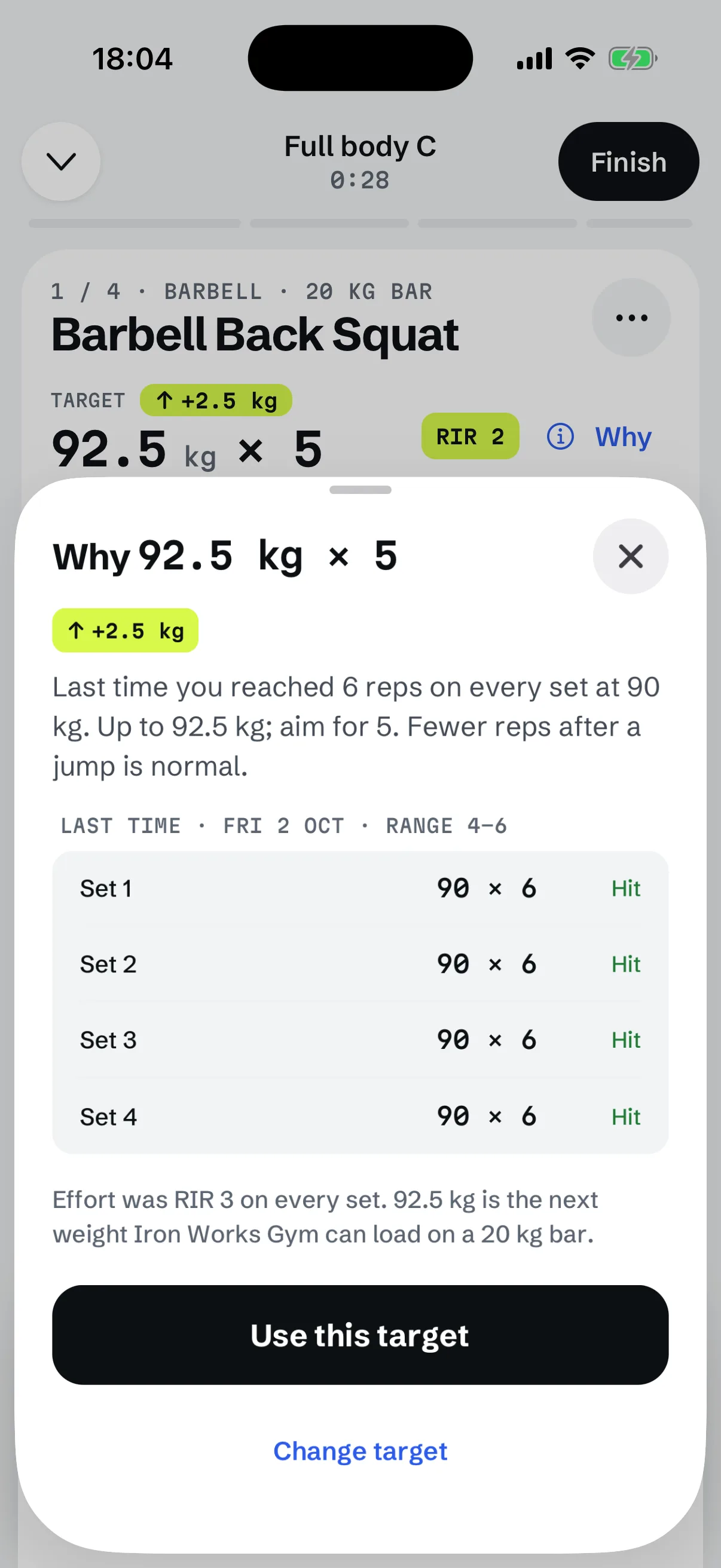
The target stands beside the weight and reps: here RIR 2, which is RPE 8.
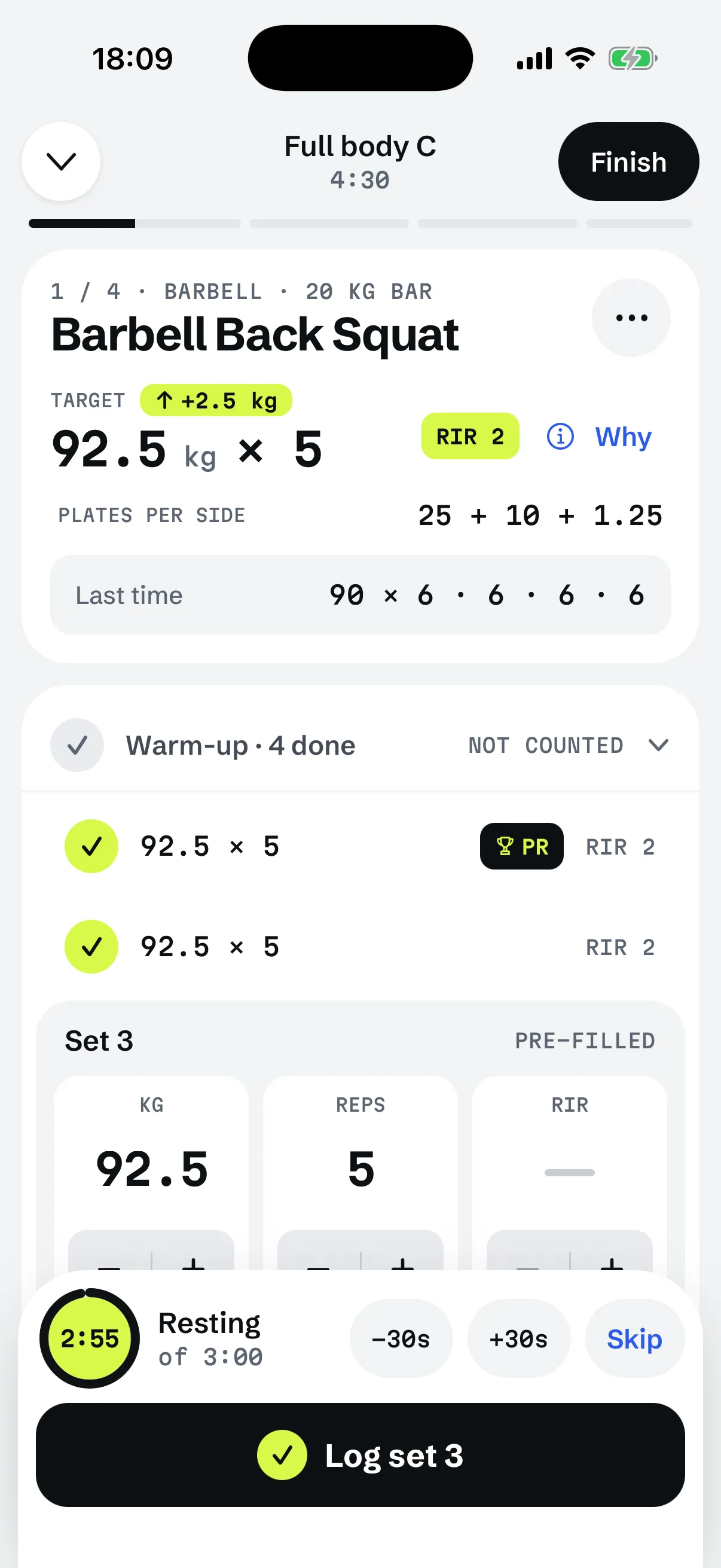
A deload week asks for 4 or more in reserve. By the chart that falls in the band for RPE 5 and 6, or below it, so it sits at the easy end of the scale.
How does the number you log change the next target?
It holds the weight when a set was much harder than planned. RIGOR raises the weight when every set reaches the top of the rep range, and it adds a second condition: the logged effort. If you log a set two or more reps below the planned reserve, the weight stays for another session, even when every set reached the top of the range. Planned RPE 8, logged RPE 10, and the weight holds. Planned RPE 8, logged RPE 9, and it does not.
The number also feeds the estimate of what you can lift. A set counts as the reps plus the reps left, then the Epley formula, load × (1 + capacity / 30), gives the estimated one-rep max. Take 100 kg for 5 reps at each rating from 10 down to 7.
The 1RM calculator takes reps in reserve in the same way. This is why an honest number matters: rate the same set one point easier and the estimate, and the next target built from it, moves.
Can you still use RPE with RIGOR?
Yes. Convert it with the chart: RPE 8 is 2 in reserve, RPE 9 is 1, RPE 10 is 0. A program that asks for a half point such as RPE 8.5 sits between 1 and 2 left, so pick the count that matches the set. The double progression rule the app follows needs the reps and, as the second check, the effort, in either language. Training to failure covers what the studies found on stopping short against going all the way.
When does the RPE scale not apply?
RIGOR plans the reps you leave
Questions
What is RPE 10 in lifting?
A set with nothing left: you could not have done another rep, which is 0 in reserve. On the lifting scale it is the top rating.
What does RPE 6 mean?
Four to six reps were left. The lifting scale gives RPE 5 and 6 one shared band of 4 to 6 reps in reserve, because lifters find a range easier to give than a count once it passes 3.
Is the lifting RPE scale the same as the Borg scale?
No. Borg's original scale ran from 6 to 20 to roughly match heart rate. The lifting version runs 1 to 10 and ties each number from 5 up to the reps left.
Do I have to log RPE in RIGOR?
No. RIGOR asks for reps in reserve, not RPE, and logging it is optional. A set logged without one is read as the planned effort.