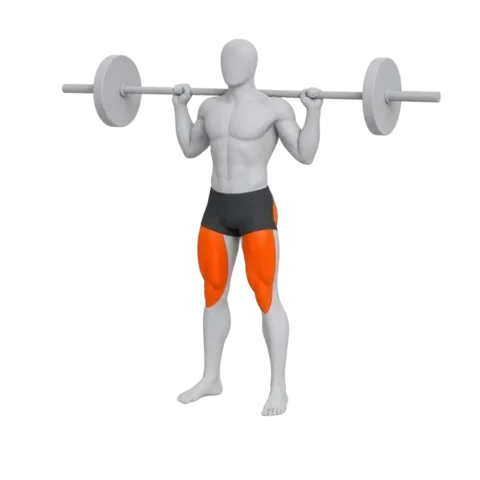
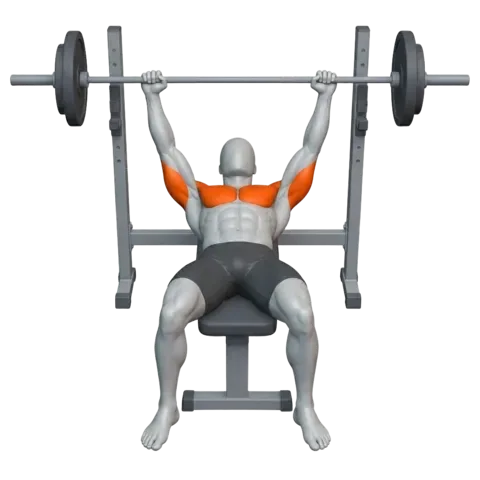
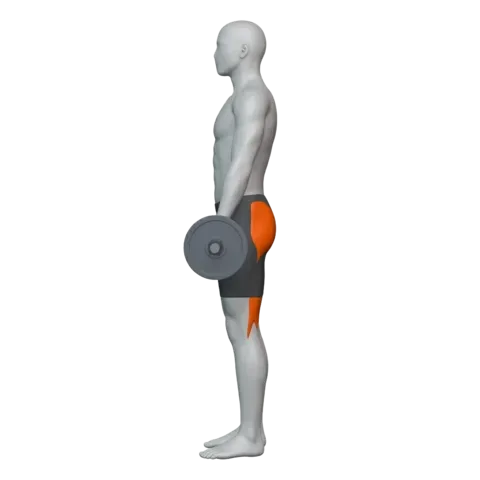
RIGOR's catalogue has no dumbbell exercise in the lat pulldown's or the pull-up's pattern. RIGOR's dumbbell plan trains the same primary muscle, the lats, with rows. Its bench press, incline press, curl and face pull are dumbbell lifts that the catalogue lists as alternatives to the bar or cable version.
What is a dumbbell alternative to the lat pulldown?
There is none in the catalogue. Its Lat Pulldown is a vertical pull, and none of the 22 exercises in that pattern lists dumbbells as equipment or accepts them as a stand-in. They need a pulldown station, a pull-up bar, rings, a band, a rope, an assisted machine or plates.
What the dumbbell plan has in that place is rows. The 3 day dumbbell program puts a Chest-Supported Dumbbell Row or a Single-Arm Dumbbell Row in each of its three days. Both are horizontal pulls, and both list the latissimus dorsi, the lat pulldown's primary muscle, among their primary muscles, beside the rhomboids. A row and a pulldown are different movements.
What does the dumbbell plan use beside the main barbell and machine lifts?
The table sets the main barbell and machine lifts in three commercial-gym sample plans (3 day full body, 4 day upper/lower, 6 day push/pull/legs) beside what the 3 day dumbbell plan uses in the same pattern.
How each row was matched is in the last column. "Named" means the catalogue lists the dumbbell exercise as an alternative to the barbell or machine exercise. "Pattern and muscles" means the two share a pattern and the same primary muscles, and the catalogue does not name one as an alternative to the other. Nothing in the plans records a swap, so every row is a match made on those fields, not a record of one lift replacing another.
| Lift in the commercial plans | Pattern | The dumbbell plan uses | How matched |
|---|---|---|---|
| Barbell Back Squat (Full, PPL) | squat | Goblet Squat | Pattern and muscles. The catalogue's alternative is Dumbbell Squat; it lists the goblet squat as a regression |
| Leg Press (U/L, PPL), Hack Squat (Full) | squat | Goblet Squat | Pattern and muscles. Neither names a dumbbell lift |
| Barbell Bench Press (Full, PPL) | horizontal push | Dumbbell Bench Press | Named |
| Incline Barbell Bench Press (Full, PPL) | horizontal push | Incline Dumbbell Press | Named |
| Bent-Over Barbell Row (Full, PPL) | horizontal pull | Chest-Supported Dumbbell Row, Single-Arm Dumbbell Row | The catalogue names Bent-Over Dumbbell Row, which the plan does not use. The plan's two rows match by pattern and muscles |
| Seated Cable Row (U/L, PPL) | horizontal pull | Chest-Supported Dumbbell Row, Single-Arm Dumbbell Row | Pattern and muscles. The catalogue names only a one-arm cable row |
| Lat Pulldown (Full, U/L, PPL), Close-Grip and V-Bar versions | vertical pull | Nothing in this pattern | The catalogue has no dumbbell exercise in the pattern |
| Barbell Overhead Press (Full, PPL) | vertical push | Nothing in this pattern | No vertical push in the plan. The catalogue has a Dumbbell Shoulder Press, which the barbell press lists as a regression, not an alternative |
| Romanian Deadlift, Stiff Leg Deadlift (Full, PPL) | hinge | Dumbbell Romanian Deadlift | Pattern and muscles. Neither lists it as an alternative; the Romanian Deadlift lists it as a regression |
| EZ-Bar Curl (Full, U/L, PPL) | isolation | Dumbbell Bicep Curl | Named |
| Standing Calf Raise (Full, U/L, PPL) | isolation | Single-Leg Calf Raise | Pattern and muscles. It lists no equipment, so it is not a dumbbell lift |
| Cable Crunch, Machine Seated Crunch | core | Crunch | Pattern and muscles. It lists no equipment |
These are not like-for-like plans. The commercial plans were built for an intermediate (full body), a beginner (upper/lower) and an advanced lifter (push/pull/legs). The dumbbell plan was built for a beginner with a goal of hypertrophy and 30 to 45 minutes a session, and its days hold 4, 4 and 5 exercises. Its plan records a cut made for time, so a lift missing from it is not proof that no dumbbell version exists.
RIGOR is a strength training app for iPhone that builds your plan and sets every weight by rules you can read.
YOUR IPHONE

What do RIGOR's rules say about equipment?
Two of the rules that build a plan bear on this:
- An exercise can go in a plan only if the gym has every item it needs or, for each missing item, one of the stand-ins the catalogue lists for it.
- "A slot with no candidate falls back to the next pattern that trains the same muscle."
The catalogue's stand-ins are part of that test. The Goblet Squat is an example: the catalogue lists kettlebells as the equipment it needs and fixed dumbbells as a stand-in for them. The rules do not describe a dumbbell lift taking a barbell lift's place, and this page does not claim it. The rules add that a swapped-in exercise has its own history and never inherits another exercise's load. The dumbbell to barbell guide covers what that means for weights.
What is the dumbbell alternative to a face pull, a pull up or a seated row?
What is the dumbbell alternative to a face pull?
The Dumbbell Face Pull. The catalogue lists it as an alternative to the Cable Face Pull, and the two list the same primary muscles, the posterior deltoid and the rhomboids. It is the last exercise of Full body C in the dumbbell plan, 2 sets of 10 to 15 reps.
What is the dumbbell alternative to a pull up?
None. The Pull-Up is a vertical pull with the latissimus dorsi as its primary muscle and a pull-up bar as its equipment. Its alternatives in the catalogue are the Chin-Up and the Neutral-Grip Pull-Up, and it lists the Lat Pulldown as a regression. No dumbbell exercise is in its relations, or in its pattern.
The Dumbbell Pullover lists the latissimus dorsi and the pectoralis major as primary muscles and needs a flat bench, but it is an isolation exercise, not a vertical pull. It is in the 3 day full body sample plan, not the dumbbell plan.
What is a seated row alternative with dumbbells?
The catalogue has no seated dumbbell row. Its dumbbell rows in the horizontal pull pattern are the Bent-Over Dumbbell Row (dumbbells only), the Chest-Supported Dumbbell Row and the Single-Arm Chest-Supported Dumbbell Row (both need an adjustable bench) and the Single-Arm Dumbbell Row (needs a flat bench). The plan uses two of them, and the Seated Cable Row's primary muscles, the latissimus dorsi and the rhomboids, are the ones they list.
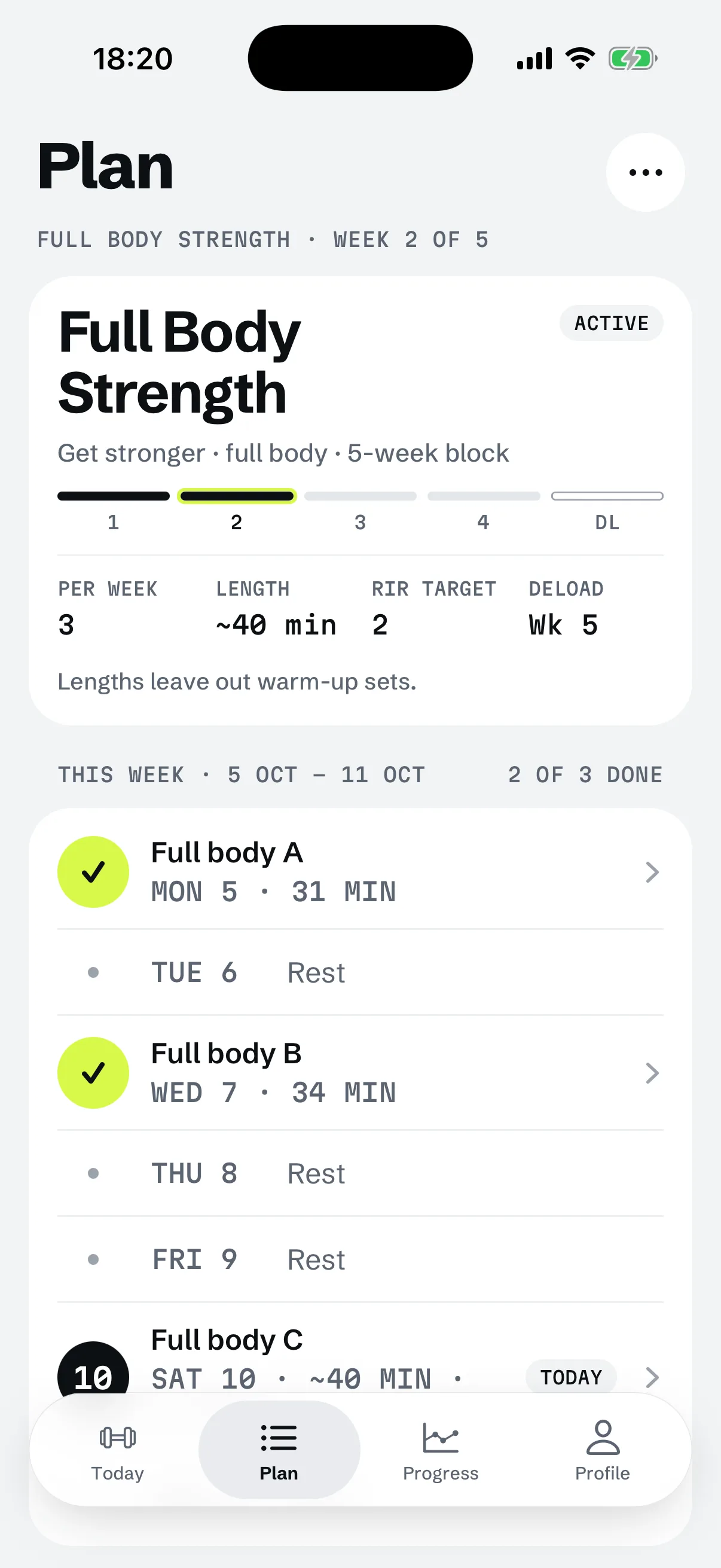
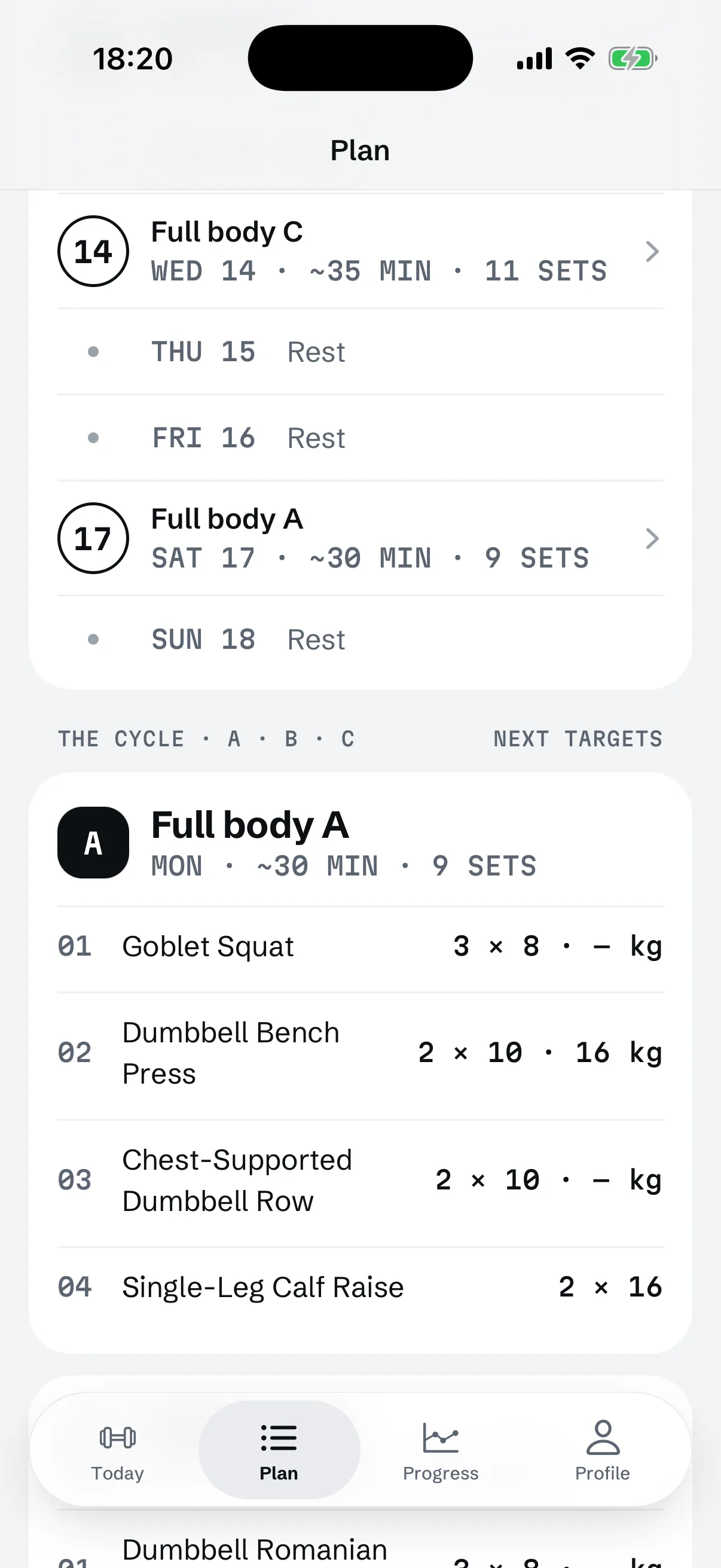
The plan screen lists each workout of the dumbbell plan with its length and its number of sets.
How does RIGOR count one dumbbell day by muscle?
By RIGOR's weekly-set rule: a set counts 1 for a muscle group when one of the exercise's primary muscles is in it, otherwise 0.5 when a secondary muscle is, and at most once per group. Full body C has five exercises and 11 sets.
Full body C
- Goblet Squat3 × 6–10 · REST 3:00
- Push-Up2 × 8–12 · REST 2:00
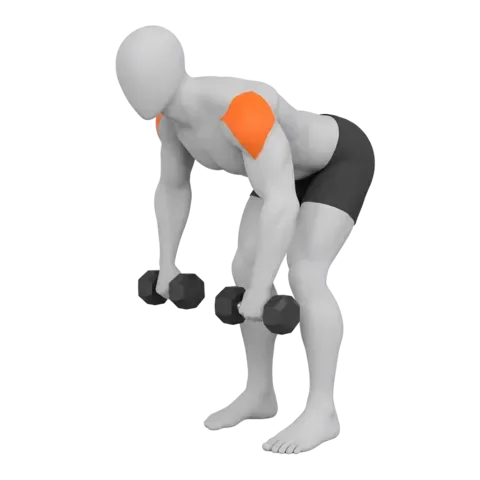
- Chest-Supported Dumbbell Row2 × 8–12 · REST 2:00
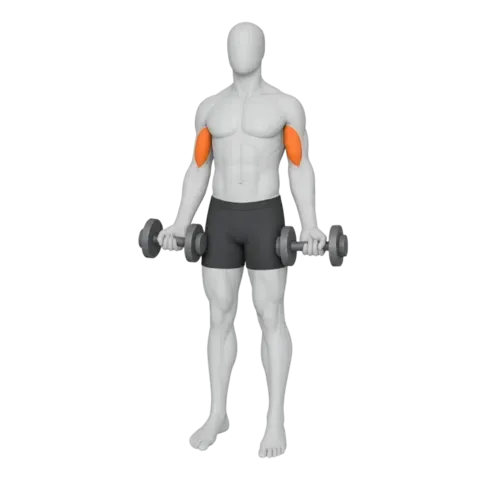
- Dumbbell Bicep Curl2 × 10–15 · REST 1:30
- Dumbbell Face Pull2 × 10–15 · REST 1:30
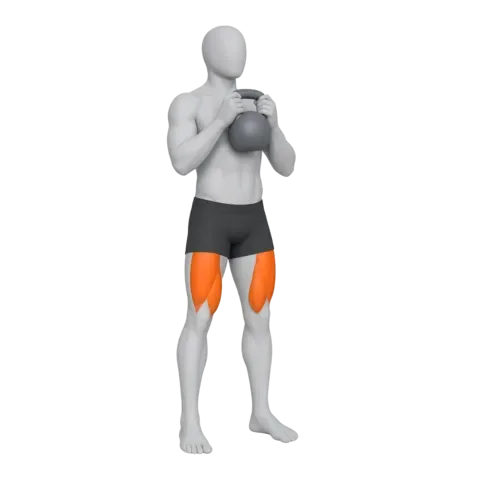
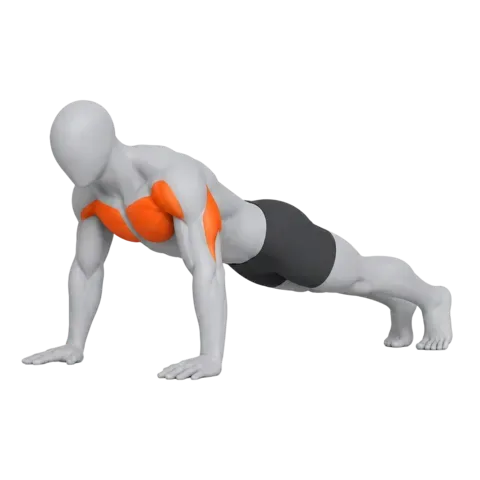
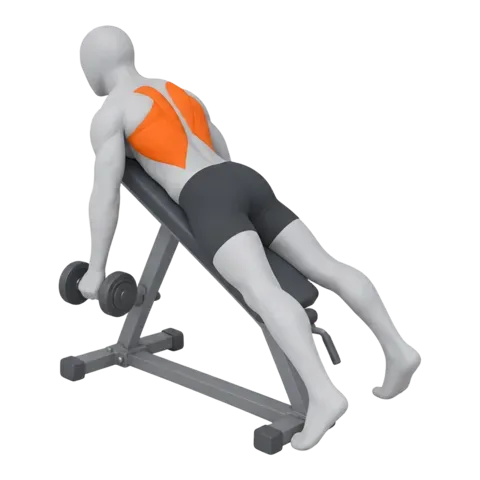
| Muscle group | Where the sets come from | Counted sets |
|---|---|---|
| Back | Chest-Supported Dumbbell Row 2 (primary), Dumbbell Face Pull 2 (primary) | 4 |
| Shoulders | Push-Up 2 × 0.5, Row 2 × 0.5, Face Pull 2 (primary) | 4 |
| Biceps | Row 2 × 0.5, Dumbbell Bicep Curl 2 (primary), Face Pull 2 × 0.5 | 4 |
| Quads | Goblet Squat 3 (primary) | 3 |
| Glutes | Goblet Squat 3 (primary) | 3 |
| Hamstrings | Goblet Squat 3 × 0.5 | 1.5 |
| Chest | Push-Up 2 (primary) | 2 |
| Triceps | Push-Up 2 (primary) | 2 |
The groups add to 4 + 4 + 4 + 3 + 3 + 1.5 + 2 + 2 = 23.5, and the exercises to 7.5 + 5 + 4 + 2 + 5 = 23.5. No group reaches the 10 counted sets the rules allow in one session. The sets per exercise guide counts sets by exercise.
What does research say about dumbbells and machines?
It was read as an abstract, through Europe PMC, not as a full paper. Haugen and colleagues (2023) pooled 13 studies with 1,016 adults aged 18 to 60 (789 men, 219 women). Each study compared free-weight and machine-based strength training over at least 6 weeks. The abstract reports no difference between the two in the direct comparison for hypertrophy (SMD -0.055, CI -0.397 to 0.287, p = 0.751) or for dynamic strength (SMD 0.084, p = 0.387). Strength in free-weight tests rose more with free-weight training (SMD -0.210, p = 0.023). (Haugen 2023).
Two smaller trials were read the same way. In eight untrained women, each leg trained 9 weeks with lunges or an inclined leg press, and the abstract reports no group-by-time interaction in muscle thickness (Amanuma 2025). In 36 male novices, 10 weeks with machines, free weights or both gave no significant difference between groups in muscle size, strength or function (Aerenhouts 2020).
None of the abstracts names dumbbells. They say "free weights", and the second names a lunge and an inclined leg press. They do not test a dumbbells-only plan against a commercial-gym plan.
RIGOR builds the plan from the equipment you have
Questions
Which muscles are worked in the lat pulldown?
The catalogue lists the latissimus dorsi as its primary muscle, and the biceps brachii, posterior deltoid and rhomboids as secondary muscles.
What is a dumbbell alternative to a barbell row?
The catalogue lists the Bent-Over Dumbbell Row as an alternative to the Bent-Over Barbell Row. RIGOR's dumbbell plan uses the Chest-Supported Dumbbell Row and the Single-Arm Dumbbell Row, which share the barbell row's pattern and primary muscles.
What is a dumbbell alternative to the overhead press?
The catalogue has a Dumbbell Shoulder Press in the same pattern, and four more dumbbell exercises in it. RIGOR's dumbbell plan has no overhead press of any kind.
What is a dumbbell alternative to a leg press or a hack squat?
The dumbbell plan uses the Goblet Squat, which shares their pattern and their primary muscles. The catalogue names no dumbbell lift in the relations of the leg press or the hack squat.